
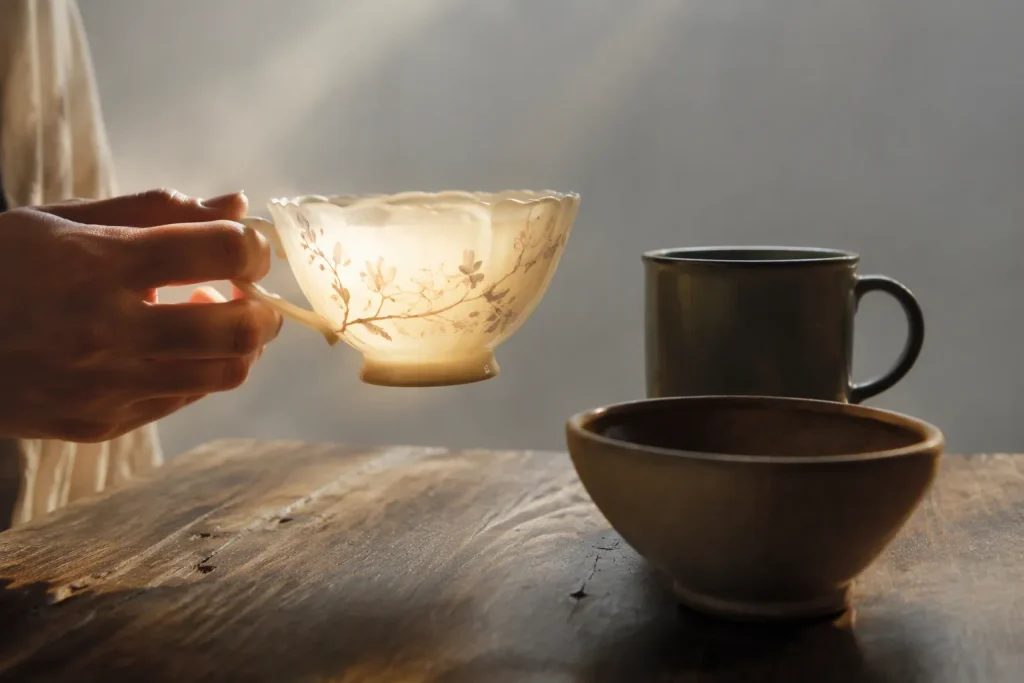
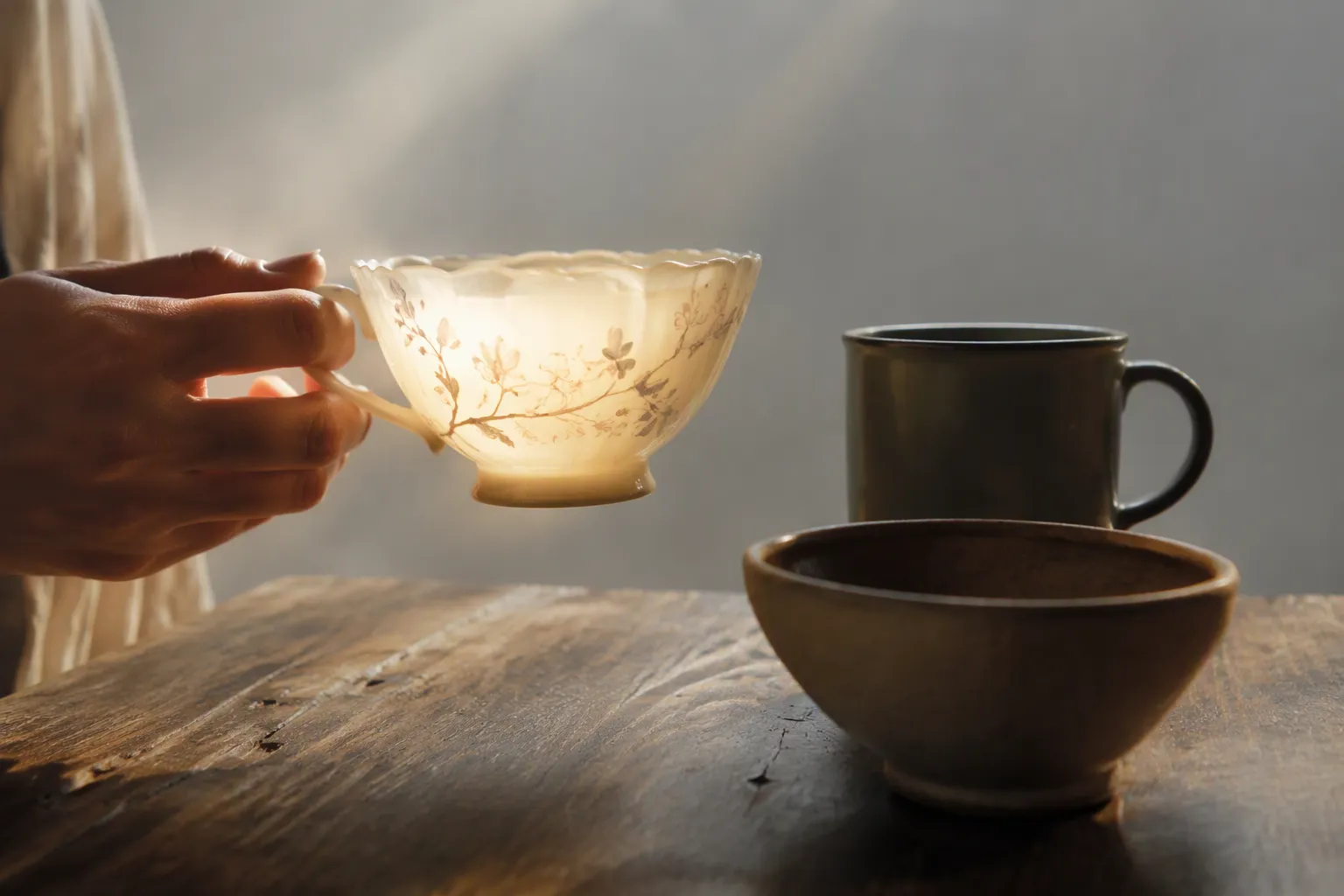
You hold a delicate teacup up to a window. Light goes right through the wall, and your fingers glow on the other side. Now you hold a strong stoneware mug up to the same light. No light comes through. Why does one ceramic glow and the other block light completely?
Porcelain is translucent because of what it is made of and the high heat it is fired at. These two things create a dense, glassy structure inside the clay. This structure lets light pass through. Earthenware and stoneware do not have this quality. Their recipes and lower firing temperatures leave tiny holes and crystals that block light.
So what exactly happens inside the kiln? The answer shows why white, translucent porcelain is so special.
Key Takeaways
Porcelain is made with kaolin, feldspar, and silica in a special mix that forms a glassy structure.
Very high heat, from 1200 to 1400°C, melts the ingredients into a thick material that lets light pass through.
The glassy base with tiny mullite crystals scatters little light, so porcelain lets light pass through.
Earthenware and stoneware don’t have the right mix or heat, so they stay opaque.
You can check if something is translucent by holding a thin porcelain cup up to a light and watching it glow.
Why Porcelain Is Translucent: The Recipe
Kaolin, Feldspar, and Silica
Think of porcelain as a recipe that needs to be just right. Three ingredients do most of the work: kaolin, feldspar, and silica. Each one has its own job. Kaolin, also called china clay, is the clay mineral. Its main part, kaolinite, makes the body flexible and gives it a white color. Feldspar works as a flux. It melts at high heat and forms a glassy phase that holds the other particles together. Silica, or quartz, is the filler. It adds strength and helps the body keep its shape while it is fired.
The exact ratio of these three materials makes porcelain different from other ceramics. A normal porcelain clay body is formulated with more flux than a stoneware body. This higher flux content helps the body vitrify better. Vitrification means the particles melt and join into a dense, glassy mass. That glassy mass is what gives porcelain its chance to become translucent.
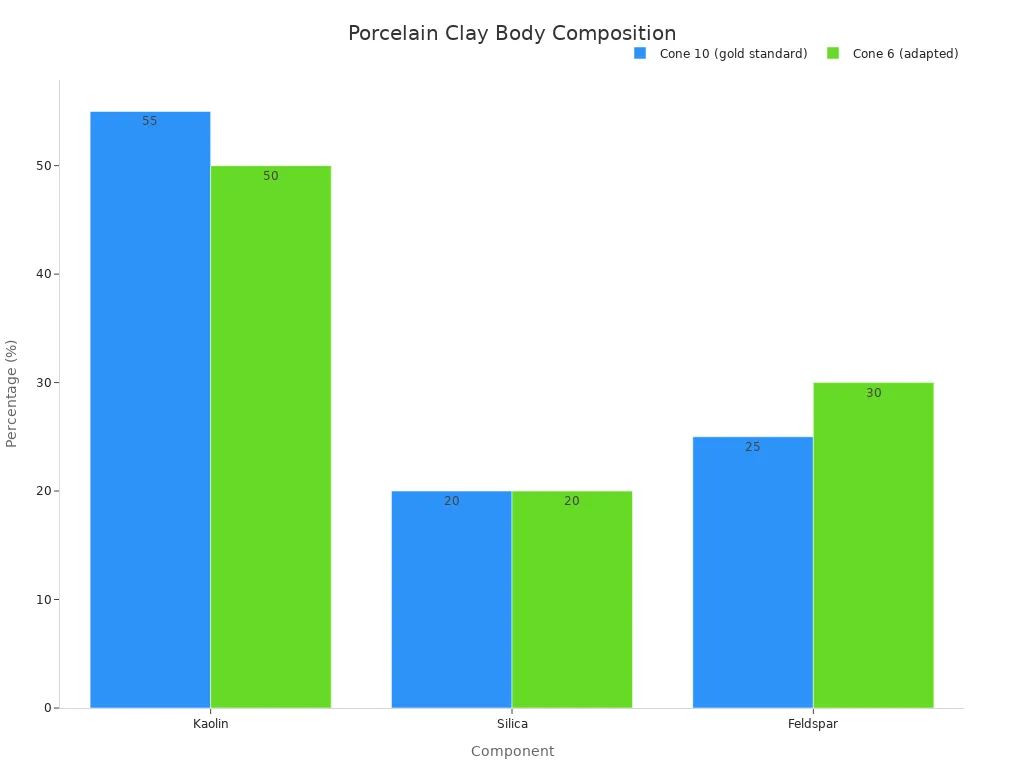
The makeup of porcelain directly affects its whiteness and translucency. High-purity kaolin with low iron and titanium content helps light pass through. The table below shows two common recipes for translucent porcelain clay bodies.
Firing Range | Kaolin | Silica | Feldspar |
|---|---|---|---|
Cone 10 (gold standard) | 55% | 20% | 25% |
Cone 6 (adapted) | 50% | 20% | 30% |
Porcelain Clay Bodies and Fluxes
A porcelain clay body depends on feldspar as its main flux. Feldspar melts into a thick glass at high temperatures. This molten glass breaks down some kaolin and quartz particles. It also fills the spaces between crystals. When it cools, the glass forms the ceramic’s matrix. This matrix increases transparency and mechanical strength.
Feldspar content matters a lot. Porcelain usually contains 25 to 30 percent feldspar. Stoneware contains only 10 to 13 percent. That difference is about one-third lower. Higher feldspar levels usually increase translucency. But too much feldspar can hurt structural stability. The balance is very important.
Not all porcelains are translucent. The balance of ingredients mostly decides this property. Adding more kaolin than the best amount can actually lower translucency. You need enough flux to dissolve the kaolin and enough silica to keep strength. The makeup of the body must work as a system.
This is where clayesouk comes in. Based in Jingdezhen, the “Porcelain Capital of the World,” clayesouk uses traditional porcelain clay bodies and time-honored techniques to craft handmade ceramic cups. Their artisans understand that true porcelain demands precise material selection. They source high-purity kaolin and beneficiated feldspar. This attention to the recipe gives their cups the potential to become translucent.
The purity of your materials also matters. Beneficiated kaolin with kaolinite content above 85 weight percent and iron oxide below 0.5 weight percent ensures high whiteness. Feldspar purified to above 95 weight percent provides consistent melting behavior. These details separate ordinary porcelain from the finest translucent porcelain.
Firing Temperature and Translucent Porcelain
Why High Heat Matters
A good recipe is not enough. Temperature decides if it turns into glass or clay. True porcelain must stay in very high heat, about 1200–1400°C. Earthenware never comes near this range. Stoneware is fired hotter but still lacks the final push.
Commercial-grade porcelain matures around 1300–1320°C. The body fully vitrifies and becomes dense. Below 1200°C, underfiring makes the surface dull, increases water absorption, and blocks light. Even with the same raw materials, a low-fired body stays opaque. You cannot force it to become glass. The recipe alone cannot do that.
Factor | Result |
|---|---|
1200–1400°C | Required range for porcelain to mature |
1300–1320°C | Commercial-grade porcelain fully vitrifies |
Below 1200°C | Underfiring: dull color, high water absorption, no light gets through |
So controlling the kiln is very important. A few degrees can be the difference between chalk and glass.
Vitrification and Porosity
High heat melts feldspar into a glassy liquid. That liquid moves into gaps between particles. It breaks down some kaolin and quartz. When the kiln cools, the glassy matrix holds the body together.
This process removes open pores. A fully vitrified porcelain body has zero or near-zero porosity. Stoneware usually cannot go below 2–3% porosity without swelling. Earthenware stays around 5% porosity.
Ceramic Type | Typical Porosity |
|---|---|
Fully vitrified porcelain | ~0% |
Stoneware | 2-3% minimum practical |
Earthenware | ~5% |
Pores scatter light and keep it from passing. Porous clay can even pull oxides from a covering glaze, making the wall opaque. Glass does not scatter light. When the body reaches near-zero water absorption, it has enough glassy material to let light through. That is why porcelain lets light through while other ceramics stay dark. Less pore space means fewer obstacles, so more light finds its way through.
clayesouk’s artisans fire their handmade ceramic cups at 1200–1400°C. This heat lets them vitrify the body completely. The finished cup is fully vitrified and translucent.
Microstructure of Translucent Porcelain
Glassy Matrix and Mullite Crystals
When you look at fired porcelain under a microscope, you see two main things. The first is a glassy matrix. This matrix comes from feldspar melting during firing. It fills the gaps between particles and forms the continuous phase that holds the body together. The second thing is mullite crystals. These crystals form when the feldspar melt dissolves kaolinite: the diffusion of aluminum ions from dehydrated kaolin into the melt creates the conditions for mullite formation. This mix of vitrification and mullite formation gives the porcelain body its special optical properties.
The glassy matrix and mullite crystals work together. The glassy phase holds everything in place. The mullite crystals add strength. Residual quartz grains also remain, contributing strength. In a fully vitrified body, porosity approaches zero and water absorption is minimal. This dense structure makes a porcelain body vitrified and ready to pass light.
Translucency is a highly sought-after property in porcelain, fired close enough to melting to take on the glass-like property of passing light. Translucency implies tendency to warp during firing.
Less Light Scattering
Light scattering depends on what the light hits inside the material. Large pores and big crystals scatter light in many directions. That scattering makes a ceramic look opaque. In translucent porcelain, the dense glassy matrix leaves almost no pores, so there are few boundaries to scatter light. The result is less light scattering and more light passing through.
You will notice translucence most in thin, unglazed or lightly glazed sections. Thick walls and heavy glaze layers block more light. The composition and microstructure of the porcelain body determine how much light can pass through. The whiteness and translucency you see in a fine cup come from this precise internal structure.
Why Other Ceramics Stay Opaque
Earthenware: Low Fire, Porous
Earthenware is fired much cooler than porcelain. Low-fire ceramics, including earthenware, are heated only a fraction as hot as the 1200–1400°C range where porcelain matures. At that heat, the clay stays a bit porous and does not fully turn glassy. Those tiny pores scatter light in all directions, so the wall looks opaque.
Porosity numbers explain why. Fully vitrified porcelain approaches zero porosity, while stoneware often cannot be fired below 2–3% porosity without bloating, and earthenware may sit around 5% porosity. Every pore is a tiny obstacle that blocks light.
Flux content also matters. Porcelain bodies typically contain 25–30% feldspar, while stoneware bodies contain only 10–13% feldspar. Without enough flux and enough heat, the body never becomes dense enough to let light through.
Stoneware: Dense but Opaque
Stoneware is fired hotter than earthenware, typically around 1200–1300°C (cone 6–10). This heat only partly turns the clay glassy. The particles fuse, and porosity drops. The body turns dense, tough, and useful. Still, it blocks light.
Why? Stoneware uses unrefined or semi-refined clays. Those clays often have iron and other mineral impurities. These impurities and leftover crystals scatter light. Since the clay is not fully glassy, its inner structure still stops light.
When held to light, thin high-fired porcelain lets a faint glow through, but stoneware and earthenware stay fully opaque even in bright light.
The feldspar table below shows the pattern. At 1300°C, a vitreous body needs only about 25% feldspar, because the high heat helps create a glassy melt. At 1200°C, it needs about 35% feldspar to make up for the lower heat. Stoneware, with only 10–13% feldspar, does not reach that same glassy state.
Firing range | Feldspar proportion in body | Relationship to translucency |
|---|---|---|
Cone 10 vitreous body (1300°C) | ~25% | Less feldspar is needed because high heat forms a glassy melt. |
Cone 6 vitreous body (1200°C) | ~35% | More feldspar is needed to make up for lower heat and maintain vitrification. |
Stoneware | 10–13% | Much less feldspar leaves pores and crystals that block light. |
Earthenware and stoneware do not combine the high firing heat and glassy microstructure that porcelain achieves. Porcelain does. Its mix of kaolin, feldspar, and silica, fired at 1200–1400°C, creates a dense, glassy body. That body scatters very little light.
You now know why porcelain is translucent. Three things work together: the recipe of kaolin, feldspar, and silica; the high firing heat of 1200-1400°C; and the glassy matrix with fine mullite crystals inside. Earthenware and stoneware never reach this point. Their lower firing temperatures leave pores and large crystals that block light.
So the next time you lift a porcelain teacup to a lamp, remember what you see. That soft glow is not magic. It is kaolin, fire, and skill working as one. In Jingdezhen, clayesouk’s artisans still follow this path, and their translucency carries centuries of craft into your hands.
FAQ
Can you see through all porcelain?
No. Whether light passes through depends on the recipe and the firing heat. A porcelain body with too much kaolin can stay opaque. Thin walls and light glaze also help you see the glow. Thick pieces with heavy glaze block more light.
Does bone china glow brighter than regular porcelain?
Bone china glows when it has the same dense, glassy structure that makes any porcelain translucent. A body with near-zero porosity scatters little light, so the thinner walls glow more brightly. Whether it outshines another porcelain depends on its exact composition and firing.
Why does a porcelain cup feel cooler than a stoneware mug?
A fully vitrified porcelain body has a dense, glassy structure. That structure pulls heat from your hand quickly. Stoneware has more pores and crystals. Those features slow heat transfer, so the mug feels warmer to the touch.
Can earthenware ever become translucent?
No. Earthenware fires at lower temperatures than porcelain, well below the 1200–1400°C range. It stays porous, and those pores scatter light in all directions. Without high heat and enough flux, the body never turns glassy enough to pass light.
Does a thicker porcelain wall block more light?
Yes. Light passes best through thin, unglazed or lightly glazed sections. Thick walls and heavy glaze layers create more obstacles. They scatter and absorb light before it can travel through the piece.
