
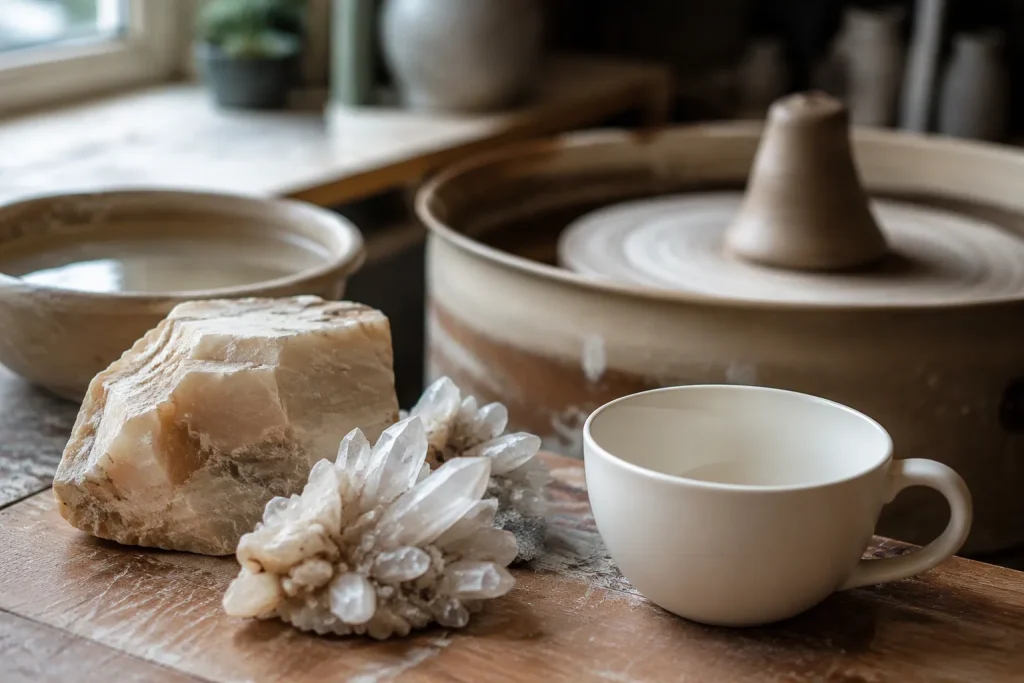
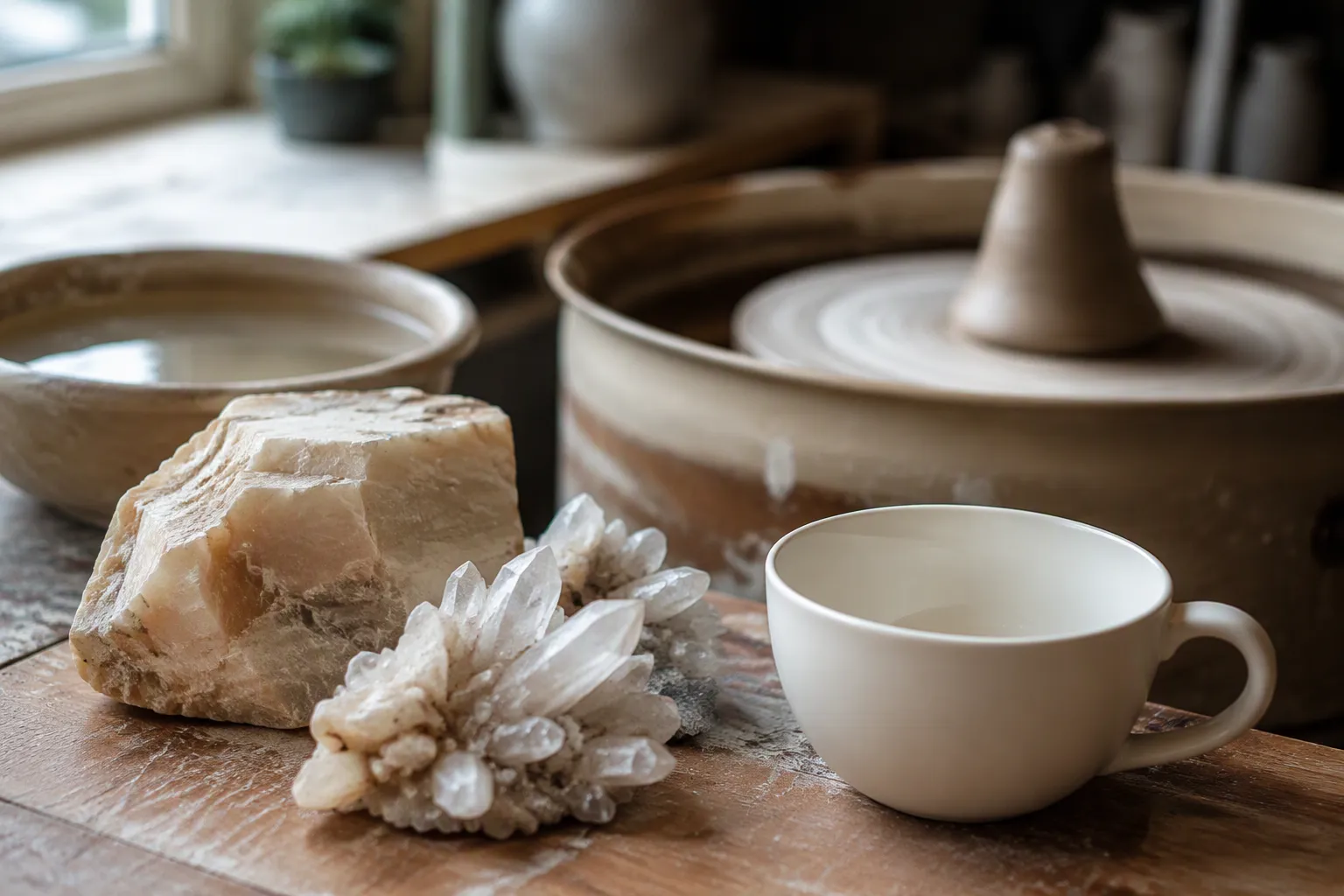
What makes porcelain so see-through and strong? The answer is in two quiet heroes: feldspar and quartz. Feldspar works as a flux. It melts and sticks particles together. Quartz gives the material strength. Think of feldspar as glue and quartz as a skeleton. This deep look, inspired by clayesouk‘s Jingdezhen history, explains their jobs. Jingdezhen artists have perfected the mix of these ingredients over many years. Kaolin sets up the base, feldspar drives the glassy change, and quartz adds strength. Together, they make beauty and toughness. The next parts also clearly show how these minerals work with kaolin to shape the final product.
Key Takeaways
Feldspar works like a glue. It melts when it gets very hot and holds the porcelain body together.
Quartz acts like a skeleton. It gives strength and stops warping when fired.
The mix of kaolin, feldspar, and quartz controls whiteness, strength, and translucency.
Artisans cool the piece slowly through the quartz inversion zone to stop it from cracking.
Clayesouksouk’s Jingdezhen heritage blends old craft methods with a deep understanding of the materials used.
Defining Feldspar and Quartz
Feldspar and quartz are two of the most common minerals in the Earth’s crust. Both have helped ceramic makers for centuries. Jingdezhen artisans, where clayesouk operates, have used these minerals since the town’s first kilns. Knowing their different traits helps explain their roles in porcelain.
Feldspar: The Flux Mineral
Feldspar is part of a group of aluminosilicate minerals. It holds potassium, sodium, or calcium mixed with aluminum, silicon, and oxygen. These parts form a crystal shape that melts at high heat. In ceramics, feldspar works as a flux. A flux lowers the melting point of other materials. This quality is key during firing.
When kiln heat rises toward 1200°C, feldspar starts to soften. It makes a thick, glassy liquid that moves between nearby particles. This liquid fills gaps and pulls the structure together. Without feldspar, kaolin would never fully vitrify. The result would stay porous and weak. Feldspar turns the mix into a dense, waterproof material. Its fluxing action builds the base for porcelain’s famous strength.
Quartz: The Structural Backbone
Quartz gives the rigid frame inside the porcelain body. This mineral is pure silicon dioxide. It does not melt at the same heat as feldspar. Instead, quartz stays solid during most of the firing cycle. This steadiness stops the whole piece from collapsing under its own weight.
Property | Value |
|---|---|
Mohs hardness | 7 |
Crystalline structure | Hexagonal |
The table above shows quartz’s main traits. A Mohs hardness of 7 means quartz resists scratches and wear. This hardness leads directly to strong finished pieces. The hexagonal crystal shape lets quartz grains pack tightly. These grains act like a skeleton, keeping the shape steady while feldspar melts around them. Quartz also controls shrinkage during cooling. Exact shapes, like those in clayesouk’s handmade cups, depend on this controlled shrink. Together, feldspar and quartz create the balance that defines fine porcelain.
The Role of Kaolin, Feldspar, and Quartz in Porcelain Body Formulation
The Ternary Blend: Kaolin, Feldspar, and Quartz
Porcelain begins as a mix of three main materials in porcelain formulation. Kaolin gives flexibility for shaping and green strength before firing. Feldspar works as a flux. It lowers the melting point during firing and helps vitrification happen. Quartz acts as a stiff filler. It adds strength and helps stop warping. Together, these three parts make a three-component (triaxial) system. Each material needs the others to work its best.
The exact balance of kaolin, feldspar, and quartz decides whiteness, strength, and translucency. Kaolin with low iron and titanium content boosts translucency. Feldspar helps vitrification and fills pores. Quartz raises mechanical strength and hardness. In ceramic production, artisans change each part to control the final product. Clayesouksouk’s team in Jingdezhen has improved these porcelain body ratios and formulation over many years.
Optimal Ratios for Desired Properties
The ratio of each part shifts with the firing temperature. A Cone 10 firing uses different amounts than a Cone 6 firing. The table below shows common ranges.
Component | Cone 10 Ratio | Cone 6 Ratio |
|---|---|---|
Kaolin | 25%–50% | 20%–40% |
Feldspar | 25% | 35% |
Quartz | 20%–25% | N/A |
A 50:25:25 blend of kaolin, feldspar, and quartz makes a dense porcelain body with low water absorption and high fired strength. For high whiteness dinnerware, potters use kaolin clay at 10–18.2 wt%, feldspar at 20–25 wt%, and quartz at 5–8 wt%. These porcelain body ratios and formulation guidelines help reach target water absorption rates below 2%. That level keeps things clean and lasting for hospitality use.
Clayesouksouk’s artisans use this knowledge on every handmade cup. They pick kaolin with low impurities. They change feldspar content for the firing profile. They balance quartz to prevent thermal shock. This formulation approach shows centuries of Jingdezhen skill. The result is porcelain formation that meets international standards.
Feldspar as a Flux in Porcelain
Lowering Melting Temperature for Vitrification
Feldspar melts at high heat and turns into a thick glass. This glass holds the other parts together. The table below shows the main thermal values.
Property | Value |
|---|---|
Melting point of potassium feldspar | ~1200°C |
Frit Softening Point | 1250°C M |
Frit Softening Point | 1200–1250°C M |
The alkali content in feldspar makes this happen. Potassium oxide and sodium oxide lower the melting temperature of the ceramic body. This speeds up porcelain formation and lowers firing temperature. A flux is any material that lowers the melting point of a mixture. Feldspar is the main flux in most porcelain recipes. Its fluxing action begins early in the firing cycle. The flux melts first and coats the nearby particles. This coating pulls the body toward vitrification.
Vitrification turns a porous clay body into a dense, glassy solid. This process is key for getting the non-porous, durable nature of porcelain. A well-fired porcelain body with high feldspar content gets near-zero water absorption, usually less than 1%. This low absorption makes the material naturally waterproof and hygienic. In a cone 04 terra cotta body with low feldspar, no clearly visible glassy phases form. That body relies only on sintering, which leads to higher porosity and water absorption. In a cone 6 iron stoneware body with feldspar, tiny feldspar particles fuse and start to dissolve into nearby surfaces. This early melting creates a glassy phase that fills pore spaces. Porosity and water absorption drop compared to the terra cotta.
Feldspar’s alkali content lowers the melting temperature of the mixture, causing faster melting and fuel savings. Fluxes melt in early stages of the ceramic firing process, forming a glassy matrix that bonds the other components of the system together.
Creating a Glassy Matrix for Strength
After the flux melts, it flows into the gaps between crystalline particles. The molten feldspar fills these spaces and makes the body denser. Porosity drops as the glassy phase takes over. After cooling, the feldspar melt forms the glassy matrix of the porcelain. This matrix increases transparency and helps improve mechanical strength. The glassy matrix also bonds the quartz and kaolin particles into one solid mass. This bonding gives porcelain its strength and durability.
The role of feldspar in ceramic production is essential. Feldspar in ceramic production acts as both a flux and vitrification agent. Its main functions of feldspar include lowering the melting point, filling pores, and forming the glassy matrix. Feldspar’s role in porcelain production includes these three jobs. The role of feldspar in ceramic production also covers controlled vitrification. Without controlled vitrification, the body would stay porous or collapse. Feldspar as a flux makes the difference. Clayesouksouk sources high-quality feldspar to ensure consistent results. This choice supports the porcelain body formulation and keeps every firing predictable. The flux and vitrification agent in their formulation delivers the strength and durability that fine porcelain demands.
Quartz’s Role in Providing Structural Integrity
Managing Shrinkage and Preventing Warping
Quartz works like a frame inside the porcelain body. It gives stiffness and keeps the piece from falling apart during firing. This mineral stays solid while feldspar melts around it. That steady frame holds up the soft clay as it changes. Without this support, thin walls would droop and lose their shape.
Quartz also controls shrinkage. Clay shrinks as it dries and fires. Too much shrink causes cracks and bending. Quartz particles cut down this movement. They keep the structure steady through every stage. This control matters for handmade pieces like those from clayesouk. Exact shapes depend on shrink rates you can predict.
Crystalline quartz has a coefficient of thermal expansion many times higher than fused silica, which is approximately 0.5 × 10⁻⁶/°C. At 573°C, quartz undergoes a reversible alpha-to-beta crystal inversion. This event causes an abrupt dimensional change. During cooling, the 500-600°C zone becomes critical. Vitreous porcelain experiences a larger expansion change here. Artisans must slow the cooling through this range to prevent cracking.
Particle size plays a big role in stability. The sanitaryware industry slows cooling through the quartz inversion zone and uses finer quartz particle size in the body. This practice stops disaster.
During kiln heat-up, quartz particles generally exist in a matrix with enough pore space to absorb volume change, unless the piece has already been fired to high density. On cool-down, however, the fired ceramic around each quartz particle is much less capable of absorbing its volume change, especially if the particle is large and the temperature drops rapidly through the critical range. This problem becomes doubly serious on re-firing because the ware further densifies and quartz particles bond more strongly into the surrounding matrix.
Factor
Effect on warping/stability
Mechanism
Quartz presence
Promotes thermal and dimensional stability, preventing warping
Quartz acts as a stable framework phase during firing
Quartz particle size (10–30 μm)
Flexural strength increases with particle size in this range
Pre-stressing effect and microstructure evolution
Thermal expansion mismatch
Compressive stress on glassy phase improves with larger quartz particles
α difference between glassy phase (
3×10⁻⁶ K⁻¹) and un-melted quartz (23×10⁻⁶ K⁻¹) over 20–700 °CFine quartz particles
Dissolve faster before larger particles reduce in size
Changes pore morphology from large, irregular, interconnected pores to small, spherical, isolated pores
Interconnected pores
Act as crack transmitters rather than terminators
Coarse quartz particles create interconnected porosity
Increased particle size beyond optimum
Flexural strength decreases
Severe fracture around quartz particles and within glassy phase; large pores due to low interability
Enhancing Durability and Translucency
Quartz adds strength and durability to the finished piece. Its hard particles resist scratches and wear. The glassy phase formed during vitrification bonds everything together. This matrix increases mechanical strength. The flux helps this process by melting and filling gaps.
Translucency is a hallmark of fine porcelain. Light passes through thin walls when the body is dense and glassy. However, not all added silica dissolves into the glass phase during firing. A significant portion remains as undissolved quartz. Professor Carty suggests that this undissolved material is a major obstacle to translucency. Quartz remaining in the fired body cannot improve translucency. Adding silica up to the maximum amount that can fully dissolve might help, though the extent is uncertain.
The balance of feldspar and quartz with kaolin determines the final result. Each mineral plays a distinct role. Quartz for stability, feldspar as flux, and kaolin as the base. Together they create porcelain that is both beautiful and strong. Clayesouksouk’s artisans understand this balance. Their Jingdezhen heritage guides every firing. The result is ceramic production that meets international standards.
Porcelain Making at clayesouk: Tradition Meets Science
The Art of Handcrafted Porcelain in Jingdezhen
Jingdezhen is called the “Porcelain Capital of the World.” The city has been making porcelain for more than 1,700 years. Clayesouksouk comes straight from this history. The brand’s artisans mix old ways with a modern grasp of materials. They understand how feldspar and quartz act under high heat. This know-how shapes every cup made by hand.
Jingdezhen’s craft is a living tradition. The table below shows its main features.
Characteristic | Description |
|---|---|
Complete production cycle | The craft covers the whole process, from mining kaolin to the final firing. |
72 traditional processes | One piece needs 72 handcraft steps, handed down by master artisans. |
Handcraftsmanship | Artisans throw, paint, and glaze each piece by hand in small batches. |
Raw materials | Local kaolin and petuntse allow higher firing temperatures and outstanding whiteness. |
High-temperature firing | Dragon kilns fire pieces above 1300°C for days, creating unique flame-made variations. |
Clayesouksouk’s artisans have more than ten years of experience. They adjust the firing process to get the best results. They also pick high-quality feldspar and quartz for every batch. This dedication makes sure each piece meets international standards.
Quality Control and Firing Techniques
Quality control begins with raw materials. Clayesouksouk gets feldspar and quartz that meet strict purity rules. The team keeps track of every batch. They test for lead and cadmium leaching. The FDA limits lead to no more than 4.0 mg/L and cadmium to no more than 0.4 mg/L. The LFGB standard is tougher: lead at no more than 0.8 mg/dm² and cadmium at no more than 0.07 mg/dm².
Market sampling data shows about 38% of ceramic dinnerware products failed to meet market requirements in 2023 because lead and cadmium migration went above allowed limits.
Clayesouksouk prevents this problem with step-by-step checks. The team runs pre-tests during development. They confirm formal testing during small batch trials. They also do regular sampling for mass production. This method keeps feldspar in ceramic production safe and dependable. The artisans watch kiln temperature closely. They slow the cooling through the quartz inversion zone. This step stops cracking and warping. The result is durable, translucent porcelain that meets global safety rules.
Feldspar works as the flux in porcelain. It melts at high heat and holds the body together. Quartz gives the structural frame. It stops warping and boosts strength and durability. The balance of kaolin, feldspar, and quartz is the key to porcelain’s beauty and strength. Clayesouksouk, with its Jingdezhen heritage, shows this balance in every handmade piece. The brand’s artisans know how these minerals interact. They adjust each firing for the best results. Readers can look at clayesouk’s collection to see this perfect blend. Each cup shows the harmony of science and tradition.
FAQ
What does feldspar do in porcelain?
Feldspar acts as a flux. It melts near 1200°C and forms a glassy liquid. This liquid fills gaps between particles and binds the body together. Without it, the material would stay porous and weak. Feldspar makes vitrification possible.
Why does quartz matter for strength?
Quartz gives the body a rigid frame. It stays solid while other materials melt. This frame prevents warping and controls shrinkage during firing. Quartz particles also resist scratches. Their hardness adds durability to the finished piece.
How do artisans balance these three materials?
Artisans adjust the ratio of kaolin, feldspar, and quartz for each firing temperature. A typical blend uses roughly equal parts of each. This balance controls whiteness, strength, and translucency. Jingdezhen craftspeople have refined these ratios over centuries.
What happens during the quartz inversion?
Quartz changes crystal structure at 573°C. This shift causes a sudden dimensional change. Artisans slow the cooling through this zone. This step prevents cracking and keeps shapes stable. Careful firing protects the piece from damage.
Why does clayesouk test every batch?
Clayesouksouk checks raw materials for purity. The team tests for lead and cadmium leaching. FDA limits lead to 4.0 mg/L and cadmium to 0.4 mg/L. Regular testing keeps products safe and meets international standards.
