
Organic material in traditional clay preparation helps make clay more flexible, easier to work with, and better at drying and firing. Straw, dung, sawdust, and plant fibers are the usual additives. Each one changes how clay minerals pack together, give off water, and act in the kiln. Organic content also changes how clay minerals keep their shape before and after heat. This post explains how these additives work, where each one fits best, and how CLAYE handles them.
Key Takeaways
Organic materials make clay more bendable and easier to mold.
Each additive has a specific use: straw for bricks, dung for smooth pottery, sawdust for porous bodies, and fibers for sculpture.
Organic materials help clay dry with fewer cracks. They also make fired pots lighter and better insulators.
Too much organic material can make a fired pot weaker. So potters must test the amount and match it to the product.
CLAYE carefully picks and tests organic materials to make sure every project gets clay that is consistent and high quality.
Organic Material Types and Traditional Roles
Straw, Dung, Sawdust, and Fibers
Straw is what is left of cereal stalks after harvest. Dung comes from animals that graze. Sawdust comes from woodworking shops. Plant fibers come from reeds, grasses, and crop waste. Each material is a ceramic raw material with its own texture and how it burns out. A fine-grained natural soil base takes all four, but the choice of additive shapes the final clay body.
Where you collect changes the organic-content levels. Open fields and valleys carry less organic material. Areas with heavy plants carry more organic content. Natural clays dug near dense plants already hold plant debris. Potters who add straw or fibers on top of this clay risk an overload. Testing a small batch first shows how much water the clay needs.
Traditional Functions of Each
Straw opens the body and helps thick walls dry evenly. Dung adds fine particles and makes green strength better in pottery and brick work. Sawdust burns out cleanly and leaves pores. Plant fibers give clay particles a support frame during shaping. Each option fits a different job, and no single additive wins for every clay body.
Organic materials also change how clay minerals pack. Straw and fibers make channels for water to escape. Sawdust and dung change how clay minerals hold water content during wedging. A potter who knows these roles can match the additive to the clay minerals at hand and to the clay body.
Clay minerals respond to heat in stages. Some let go of moisture early. Other clay minerals keep shape until higher temperatures. Straw and sawdust leave empty spaces, so clay minerals shrink with less cracking. Balanced clay minerals help the clay dry with fewer losses. The clay keeps its shape.
Straw suits thick brick walls. Dung suits ware that needs a fine surface. Sawdust suits light, porous bodies. Fibers suit large sculpture. Each additive fits a different clay job, and the clay minerals in the base decide the dose.
A potter tests each batch. The test shows how the clay minerals hold moisture and how the clay dries. Good records link each additive to its clay minerals and its clay source.
How Organic Material Changes Clay Properties
Plasticity, Workability, and Green Strength
Organic material changes how clay acts at every step. Organic substances boost flexibility when wet, and this shows up clearly in kaolin bodies. Non-sedimentary kaolin lacks the organic substances that make clay more flexible, so potters often add them back. The added material lets clay particles slide past each other with less effort. Workability goes up, and shaping gets smoother.
Water content matters here. Organic fibers hold water inside the body and let it go slowly. This slow release helps flexibility when wet and keeps the body responsive during wedging. Moist clay with the right amount of fiber feels soft but not sticky. Internal cohesion gets better because fibers bridge gaps between particles. Cohesion also helps thin walls keep their shape. Green strength goes up, so handles and rims survive handling before the kiln.
Shrinkage, Porosity, and Firing Behavior
Organic temper burns away during firing. The burnout leaves a more porous, lighter pot. Air pockets replace the fiber, and the body gains a network of tiny channels. In thick sections, organic substances in clay can create a central area in the fired ceramic object, a darker or more open core where burnout was not complete. This central area forms when the outside of the wall seals before the inside finishes burning out.
Shrinkage drops with organic additions. The fibers take up space, so the clay minerals have less room to pull together. Less shrinkage means fewer drying cracks. Green strength stays high through the drying stage. When clay is dried, the fibers keep the body from tearing as water leaves. The useful properties of clay, from workability to even drying, all shift with the additive dose.
Firing changes the picture. The burnout leaves pores, and porosity rises. A porous body insulates better and weighs less. The trade-off is lower fired strength. A pot hardened through firing with heavy organic content may feel light and warm to the touch. Pottery made this way suits decorative work and insulation more than heavy load bearing. Clay minerals still control the base behavior, and the organic fraction adjusts the outcome. Potters track water content and cohesion in test tiles to predict how each batch will shrink and fire.
Practical Benefits and Limitations
Drying, Cracks, Strength, and Insulation
Organic additions help the most during drying. Fibers hold water inside the clay and let it out slowly, so the clay dries with fewer cracks. A potter who keeps getting edge cracks on thick tiles often fixes the problem with a small dose of fiber. Workability gets better too, and the clay particles slide more easily under the hand.
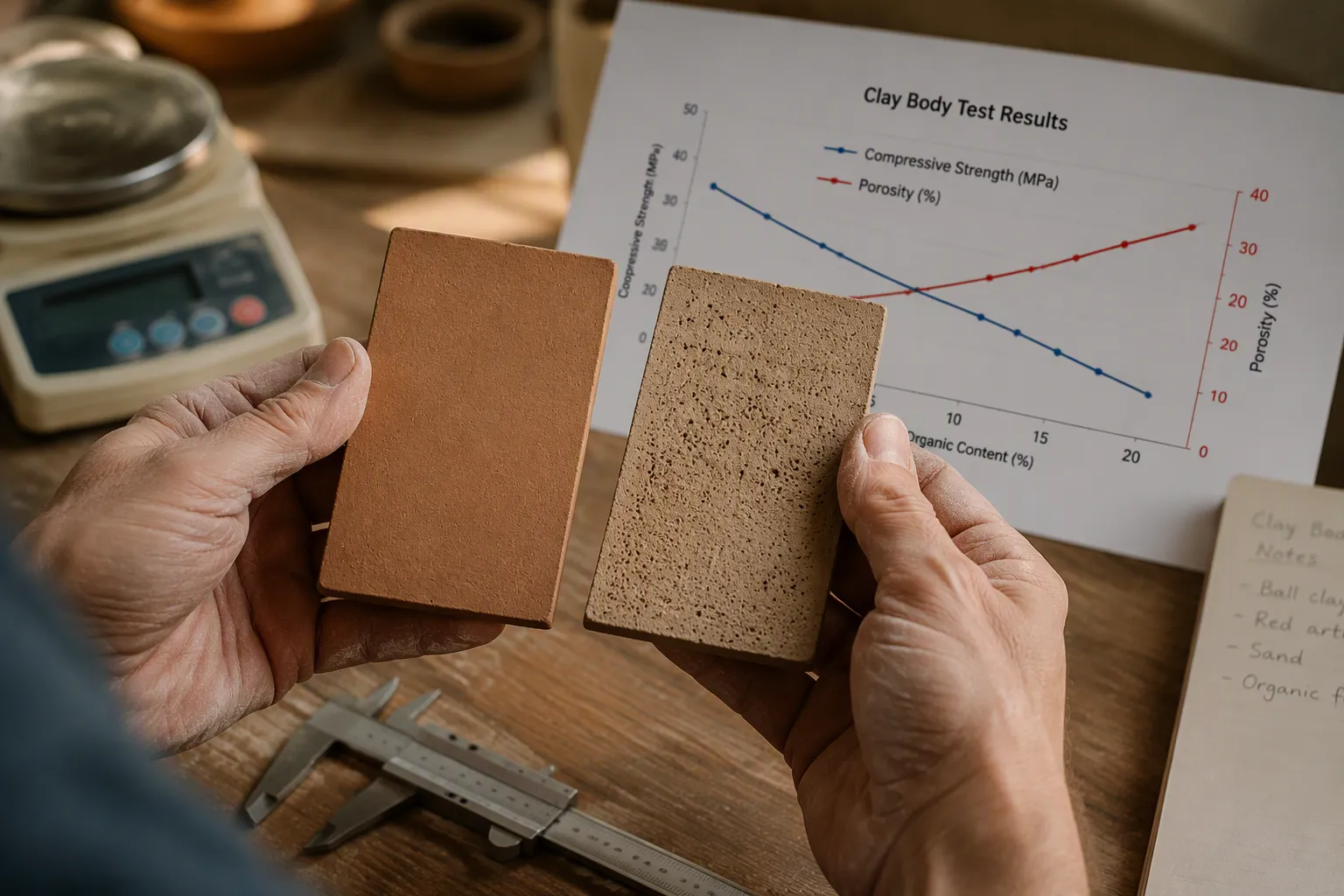
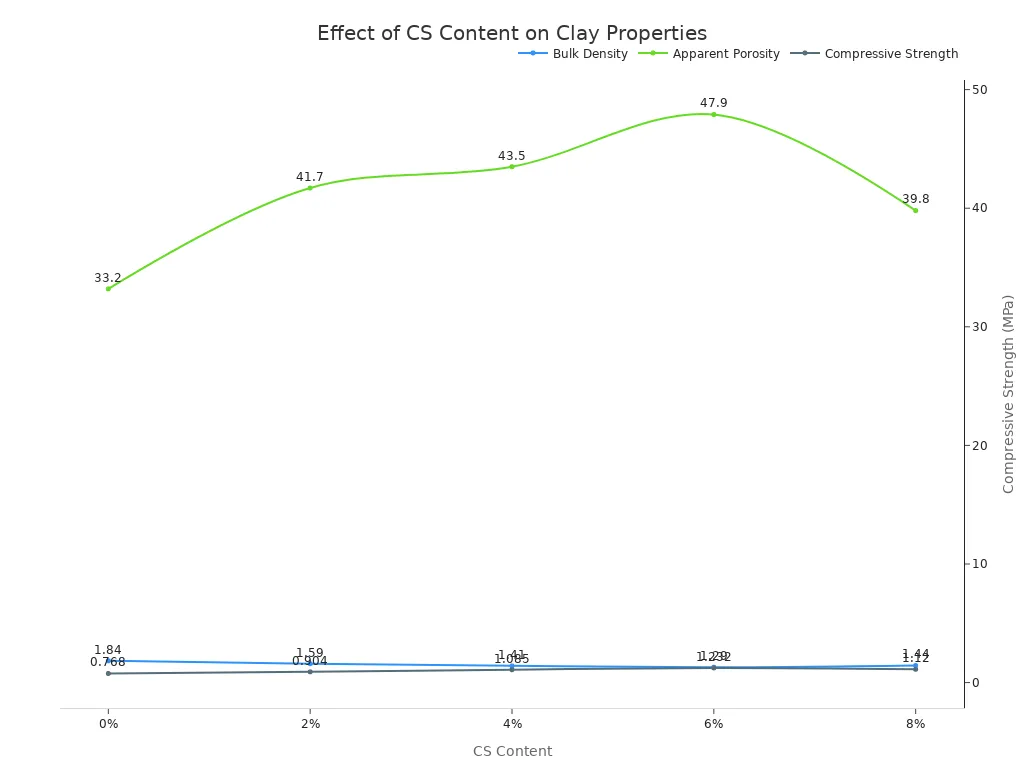
Strength tells a more complex story. Test data on fired clay bodies with added organic content shows compressive strength rising from 0.768 MPa at 0% to 1.232 MPa at 6%, then easing to 1.120 MPa at 8%. Bulk density falls across the same range, from 1.84 g/cm³ to 1.29 g/cm³ at 6%. Apparent porosity climbs from 33.2% to 47.9%. The body gets lighter and more open as the organic fraction grows.
Insulation gets better in the same way. Thermal conductivity of fired clay dropped from 0.3418 W/mK in pristine clay to 0.2915 W/mK at 2% and reached 0.2334 W/mK at 6%. The organic material acts as a pore-forming agent. It breaks down during firing and leaves micro-voids that block heat flow.
Organic content | Bulk density (g/cm³) | Apparent porosity (%) | Compressive strength (MPa) |
|---|---|---|---|
0% | 1.84 | 33.2 | 0.768 |
2% | 1.59 | 41.7 | 0.904 |
4% | 1.41 | 43.5 | 1.085 |
6% | 1.29 | 47.9 | 1.232 |
8% | 1.44 | 39.8 | 1.120 |
Higher organic content improves thermal insulation through increased porosity and reduced thermal conductivity, and compressive strength rises up to 6% before slightly declining at 8%, revealing a trade-off where excessive organic content can reduce overall strength and density.
Variability is still the main limit. Natural additives differ from batch to batch, so water content and cohesion change with each sack. Potters test small batches to keep results predictable.
Cost and Supply Considerations
Cost depends on the additive and the processing behind it. Organophilic clay pricing varies with processing method and purity, with prices per kilogram ranging from about $1.7 to $3.2 USD. China offers a favorable supply position because raw bentonite is inexpensive there, which supports factory-price availability.
Product type | Relative cost | Efficiency | Cost-performance ratio | Best value applications |
|---|---|---|---|---|
Standard bentonite-based | Low (base = 1.0x) | Moderate | Good | General fluids, basic industrial work |
High-temp bentonite-based | Medium (1.3–1.8x) | Moderate | Moderate | High-temperature industrial work |
Hectorite-based | High (1.5–2.0x) | High | Moderate-good | Clear systems, efficiency-critical formulas |
Attapulgite-based | Medium (1.2–1.6x) | Low-moderate | Moderate | Specialized rheology needs |
Specialty/custom grades | Very high (2.0–3.0x) | Very high | Varies | Performance-critical conditions |
Sourcing follows a simple path. A buyer finds a reputable supplier, signs up with a trade directory to compare listings and pricing, then buys to expand reach. Local straw and sawdust cost little where farms and woodshops are nearby. Supply changes by season and region, so potters stock up when material is dry and clean.
Application Fit and Regulatory Compliance
Pottery, Bricks, and Sculpture
Each organic material works best for a different product. Straw is good for construction bricks, where thick walls need open channels so water can escape. Dung works well for pottery that needs a smooth surface and strong green strength. Sawdust is best for light, porous bodies. Plant fibers work for large sculpture, where a support frame holds the shape.
Wild clay often has organic matter mixed in with clays, pebbles, and rock pieces. A potter has to remove these before using the clay. Screening and settling take out the coarse pieces, and then the cleaned clay gets a measured dose of additive. Natural building work follows the same rule. Adobe and clay plaster both need clean clay minerals and a known fiber dose, or the mix dries unevenly.
Potters who make pottery for the table test each batch first. A small tile shows how the clay minerals hold water and how the body dries. The water content in the mix decides how much fiber the clay can take. Too much water weakens the body, and too little leaves dry pockets. Makers who produce pottery in volume keep records that link each additive to its clay source.
Emissions, Safety, and Compliance
Kiln emissions stay low when combustion is well controlled. The EPA survey of the ceramic industry reports that gas-fired kilns at low temperatures make exhaust that is relatively free of combustion pollutants such as NOx, hydrocarbons, and CO. Particulate emissions from the clay body during drying and firing range from 0 to 2.5 lbs per ton of product, averaging 1.6 lbs per ton.
Safety needs attention. Kiln air can carry carbon monoxide, chlorine gas from salt glazing, and metal vapors. Ventilation is critical. The federal NESHAP rule for ceramic manufacturing sets a dioxin/furan limit and requires visible emission monitoring of tunnel kiln stacks. Buyers should ask for the right test. Material content, headspace results, and chamber-air emissions are different measurements, and one report does not prove zero emissions.
Workshop hygiene matters too. Clay dust and waste water need control in pottery workshops, and kiln rooms need fresh air. Clean water for slaking keeps each batch consistent.
clayesouk’s Approach to Organic Material in Clay
Selection and Preparation Methods
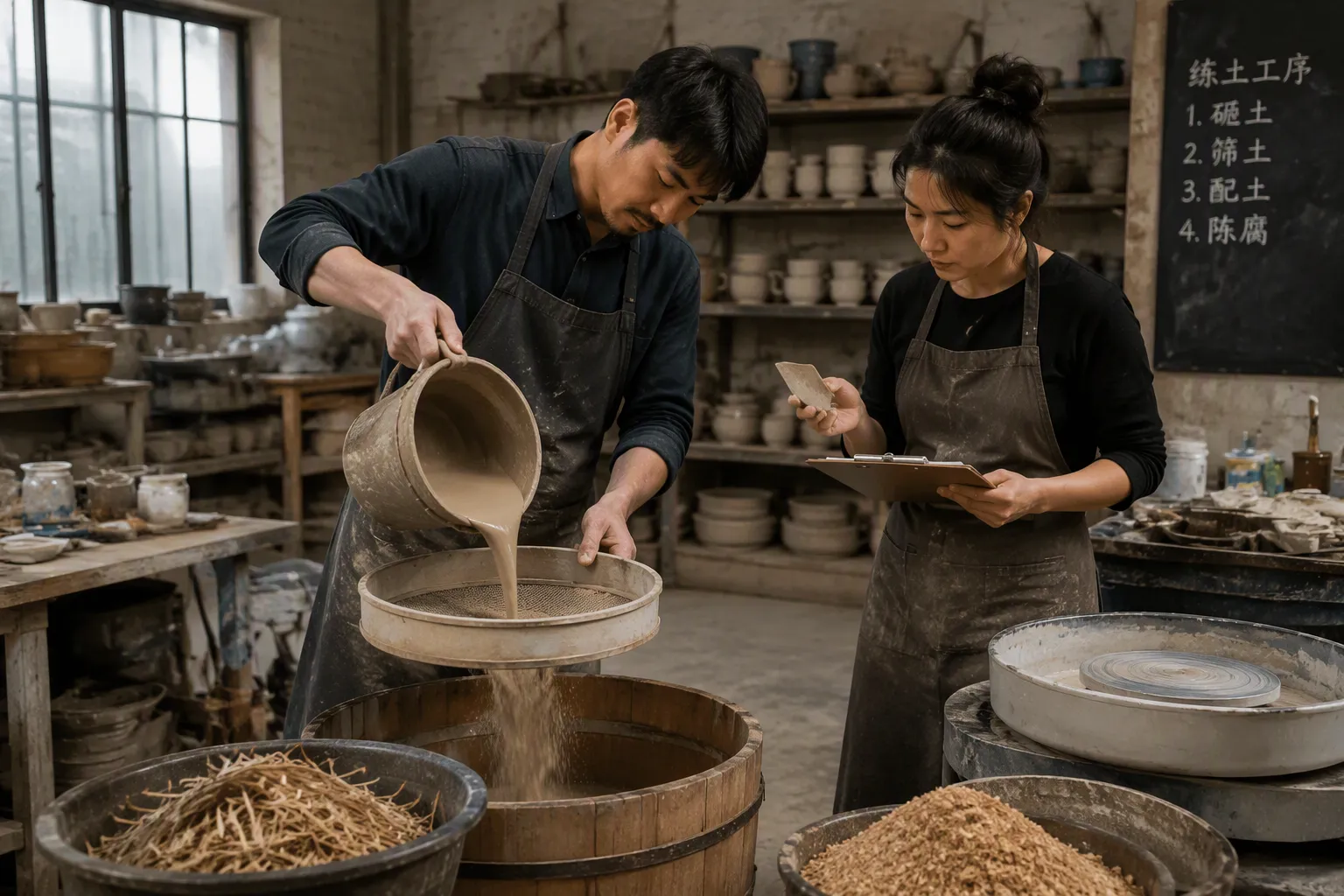
clayesouk is a brand based in Jingdezhen, a place with over 1,700 years of ceramic history. Its artisans have more than ten years of experience making handmade ceramic cups. The brand treats organic material as something it controls on purpose, not something it ignores. Selection begins at the source. Workers dig clay from known sites and check each batch for plant bits, pebbles, and rock pieces. A fine mesh cloth or sieve then removes stones, pebbles, sand, leaves, and other organic material. This step makes the clay even. Even clay lets the artisans predict how the body will dry and fire. The screening also takes out coarse pieces that would tear a cup wall during throwing.
Preparation continues with measured blending. The team adds organic material in small doses and tests each mix. They check water content and watch how the clay minerals hold moisture. A small test tile shows how the batch dries. Records link each additive to its clay source, so the next batch follows the same path. This routine keeps the clay minerals consistent from one delivery to the next.
clayesouk also offers custom ceramic design services. Clients can change patterns, glazes, shapes, and sizes to fit their needs. After-sales support covers product care guidance and fixes for quality problems. These services are part of the brand’s practical approach. A buyer who orders custom cups gets the same screening and testing care as the standard line.
Cost-Performance Trade-Offs
Cost-performance trade-offs depend on the job at hand. Local straw and sawdust cost little where farms and woodshops are nearby. These materials suit thick brick walls and light, porous bodies. Dung adds fine particles and strong green strength for pottery that needs a smooth surface. Plant fibers support large sculpture. Each option carries its own price and its own result.
The brand frames the choice around fit. A cup that needs a fine surface gets a measured dose of fine organic material. A decorative piece that needs insulation gets a higher dose. The trade-off is simple. More organic content lowers bulk density and raises porosity, and the body gets lighter and warmer to the touch. Less organic content keeps the body dense and strong. clayesouk matches the dose to the product, so the clay performs as intended.
Supply also shapes the decision. Organic material changes by season and region. The team stocks dry, clean material when it is available. This planning keeps the clay supply steady through the year. The brand weighs cost against performance for each order. A client who wants a specific glaze or shape gets a quote that reflects the material and the labor behind it. The result is a practical balance between price and quality, and the clay minerals in each batch stay under control.
Straw, dung, sawdust, and plant fibers each change the clay body in different ways. They boost flexibility, make the clay easier to shape, and help it dry with fewer cracks. When these materials burn away during firing, the pot becomes lighter and more porous, and it insulates better.
The useful properties of clay change with the dose, so each additive fits a certain job: straw for bricks, dung for smooth pottery, sawdust for porous bodies, and fibers for sculpture. Some limits remain, like lower fired strength and differences from batch to batch. CLAYE screens raw material, tests each mix, and matches the additive to the product. This approach helps readers make practical choices that consider cost.
FAQ
What does organic material do in clay preparation?
Organic material makes clay more flexible and easier to shape. It holds water and lets it go slowly, so the clay dries with fewer cracks. When the clay is fired, the additive burns away and leaves a pot that is lighter and more porous.
Which organic additives do potters use most?
Straw, dung, sawdust, and plant fibers are the common choices. Straw works well for thick brick walls. Dung gives smooth pottery strong green strength. Sawdust creates light, porous bodies. Plant fibers hold up large sculpture. Each additive fits a different job, and the base clay decides the dose.
Does organic material weaken a fired pot?
It lowers fired strength and raises porosity. The body gets lighter and insulates better. Potters match the dose to the product, so decorative work and insulation gain the most. Heavy load-bearing ware needs less organic content.
How does CLAYE prepare clay with organic material?
Workers dig from known sites and check each batch. A fine mesh cloth or sieve removes stones, pebbles, sand, and leaves. The team then blends organic material in small doses and tests each mix. Records link every additive to its source, so the clay stays consistent.
Can buyers request custom cups?
Yes. CLAYE offers custom ceramic design services. Clients can adjust patterns, glazes, shapes, and sizes. After-sales support covers care guidance and quality fixes. Each custom order gets the same screening and testing care as the standard line.
