

A European hotel group secured sourced custom ceramic tableware through an OEM/ODM partnership — 50,000+ pieces, a defect rate under 0.3%, and 35-day delivery. That is a lot of plates, bowls, and mugs arriving on time and unbroken.
This case study walks through the whole journey step by step: the client, the customization scope, the sourcing process, the compliance checks, and the final numbers. Think of it as a map. Any hotel, restaurant, or retailer can follow the same path for their own sourced custom ceramic tableware project — and skip the guesswork.
Key Takeaways
A European hotel group bought more than 50,000 custom ceramic pieces. Fewer than 0.3% of them had defects, and they were delivered in 35 days.
Working straight with a factory through OEM/ODM lowers costs and speeds up design and production.
Always check food-contact safety certificates, such as FDA and EU compliance, before you order tableware.
Quick sample approval (12 days) and production (35 days) help buyers reorder before their stock runs out.
Use a sourcing plan you can repeat: set the specs, test samples, and plan orders so quality stays the same.
The Client and the Goal
A Multi-Property Hotel Group
Imagine a hotel company with locations all over Europe. Each place ran its own food and drink spots. Each spot ordered dishes on its own schedule, from its own supplier, in its own style. The result was a mix. A guest could eat breakfast in one city and dinner in another and never guess the two places were part of the same company.
Leaders took notice. A multi-location european brand depends on being recognized, and mismatched plates slowly wear that down meal by meal. The group needed a partner who could supply every property from one source. That partner also had to know the brand well enough to turn its identity into clay.
One Branded Dining Experience
The goal was easy to say but harder to do: swap the mismatched dishes for one consistent ceramic tableware collection. Every plate, bowl, and mug would share the same look. The collection had to show the brand identity at all outlets, from rooftop bars to lobby cafés.
This was a big request. A european restaurant group this size needs volume, consistency, and a look that holds up to daily commercial dishwashing. The group wanted a cohesive branded dining experience, not a random mix from a catalog. One collection, one glaze story, one logo treatment — repeated at every table in every property. The tableware had to feel premium enough for five-star guests and tough enough for a busy kitchen. That balance became the brief for the sourcing project.
How the Group Sourced Custom Ceramic Tableware
Custom Plates, Bowls, and Mugs
The group picked an OEM/ODM partnership. This model takes care of everything from start to finish: ideas, tooling, glaze work, branding, and delivery ready for the shelf. You get one partner, one contract, and one person to talk to. There are no middlemen adding extra fees. No trading company is passing messages back and forth with the factory.
Direct factory access made a real difference. Engineers answered questions right away. Mold changes and logo work moved quickly, and test rounds took under 10 days. The group could also see the kiln firing temperatures and glazing in full. Standard pre-shipment inspection reports checked structural strength and glaze matching. Batch control stayed tight, so the 1,000th piece matched the first one. That steady quality matters when fifty properties pour coffee from the same mug design.
The customization covered custom restaurant tableware for the whole service. Dinner plates, salad plates, bread plates, and specialty plates held the table together. Soup bowls, pasta bowls, and serving bowls handled the wet courses. Mugs and cup-and-saucer sets carried the coffee service. Every piece shared one glaze story and one logo treatment. The group asked for custom plates, bowls and mugs with a reactive glaze finish and branded decoration. Reactive glaze gives each piece small differences, so no two look machine-made. Guests notice that. It feels like craft, not a mass product.
Reactive Glaze and Branding
The partner on this project was clayesouk, based in Jingdezhen, the Porcelain Capital of the World. That city holds over 1,700 years of porcelain history. clayesouk’s artisans bring more than ten years of skill to every piece. The brand offers custom design for patterns, glazes, shapes, and sizes. It is also recognized as a national-level ICH productive protection demonstration base.
This mattered for the sourcing choice. A partner with deep ceramic roots can create a reactive glaze that works the same way at large scale. Branding went past a stamped logo. The group’s identity showed up in glaze tone, rim treatment, and form language. The result was a cohesive branded dining experience, not a catalog order with a decal stuck on.
The OEM/ODM route also cut the total cost of ownership. Durable ceramic tableware works as a business asset, not a repeating cost. Hidden reordering costs and quality-inconsistency costs go down. For a group with many properties, that math adds up fast.
Timeline and Production Metrics
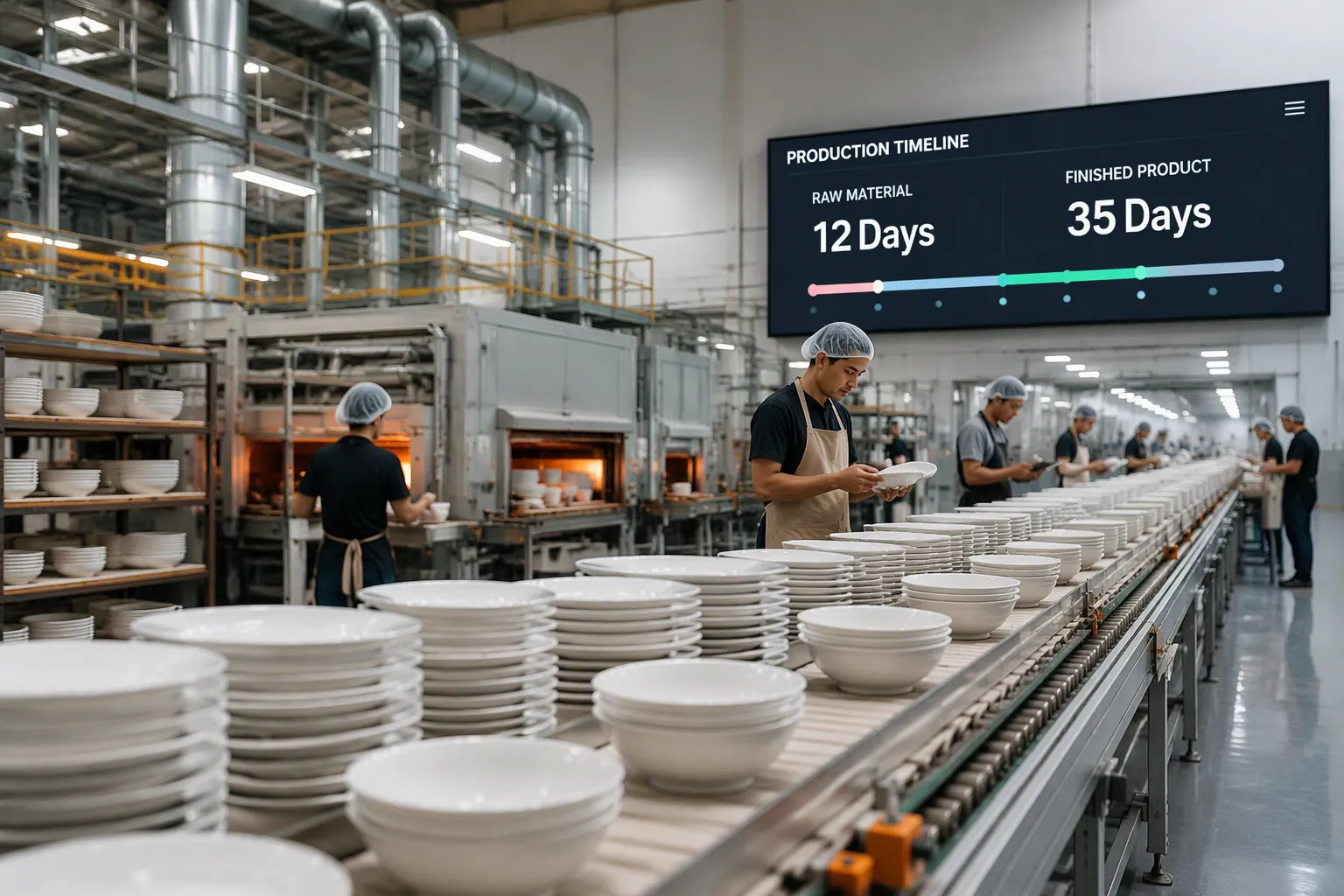
Speed shows what this partnership really did. The group went from approved samples to finished ceramic tableware faster than most industry timelines allow. Here is how the clock ran, stage by stage, with no drama and no missed dates.
Sample Approval in 12 Days
The sample stage usually takes a long time. Industry norms put design at 2–4 weeks and sampling at 4–6 weeks. Custom samples often take 20 days to produce, counting design confirmation, sample production, and quality inspection. This project cleared sample approval in 12 days. The clock started on day one. Designers refined the reactive glaze, locked the logo placement, and shipped physical prototypes for sign-off in under two weeks.
That pace came from direct factory access. Engineers adjusted glaze recipes on the spot. The group’s team reviewed prototypes and sent feedback the same day. Questions got answers in hours, not days. No trading company sat in the middle slowing the conversation. Twelve days is not luck. It is a tight loop between the people who design and the people who fire the kiln.
The group also avoided a common trap: approving a sample that looks right but cannot scale. Every prototype here went through firing on production equipment. The approved glaze behaved the same way at volume. That single decision saved weeks later, when the full run started without a second round of glaze corrections.
35-Day Mass Production
Mass production for more than 50,000 pieces wrapped in 35 days. Compare that to the standard path. Mold preparation takes 10–15 days. Sample production and approval take 15–20 days. Bulk production runs 30–45 days, and shipping adds 10–15 days. First orders commonly stretch to 75–105 days total. This group finished the bulk run alone in 35 days, then delivered shelf-ready ceramic tableware without the usual buffer. The factory ran the line in tight batches and checked glaze matching at every shift change.
The numbers landed clean. The group received 50,000+ pieces with a defect rate under 0.3%. Delivery hit the 35-day mark. A follow-up reorder confirmed the result was repeatable, not a one-time sprint. That margin of error is tiny for handmade ceramic tableware, where glaze variation is normal. That reorder matters too. Commercial kitchens lose 15–25% of dinnerware annually to chips, cracks, and walk-offs. Seasonal peaks push usage up 30–40%. A supplier who delivers in 35 days instead of 75–105 days gives buyers room to reorder before stock runs dry. The group’s second order was a planned move, not a panic buy.
“The process felt reliable from the first sample to the last pallet,” said the group’s Head of Procurement. “Quality held steady across every batch, and the timeline never slipped.”
Reliability like that turns tableware sourcing into a predictable routine. The group now treats its ceramic tableware collection as a fixed asset with a known replacement rhythm. Buyers can plan their tableware orders around a 35-day window instead of gambling on a three-month wait. For a multi-property group, that predictability is worth as much as the plates themselves. No guesswork. No emergency air freight. Just a schedule that holds, order after order. That is the quiet win behind every fast delivery.
Ceramic Tableware Compliance
EU Food-Contact Standards
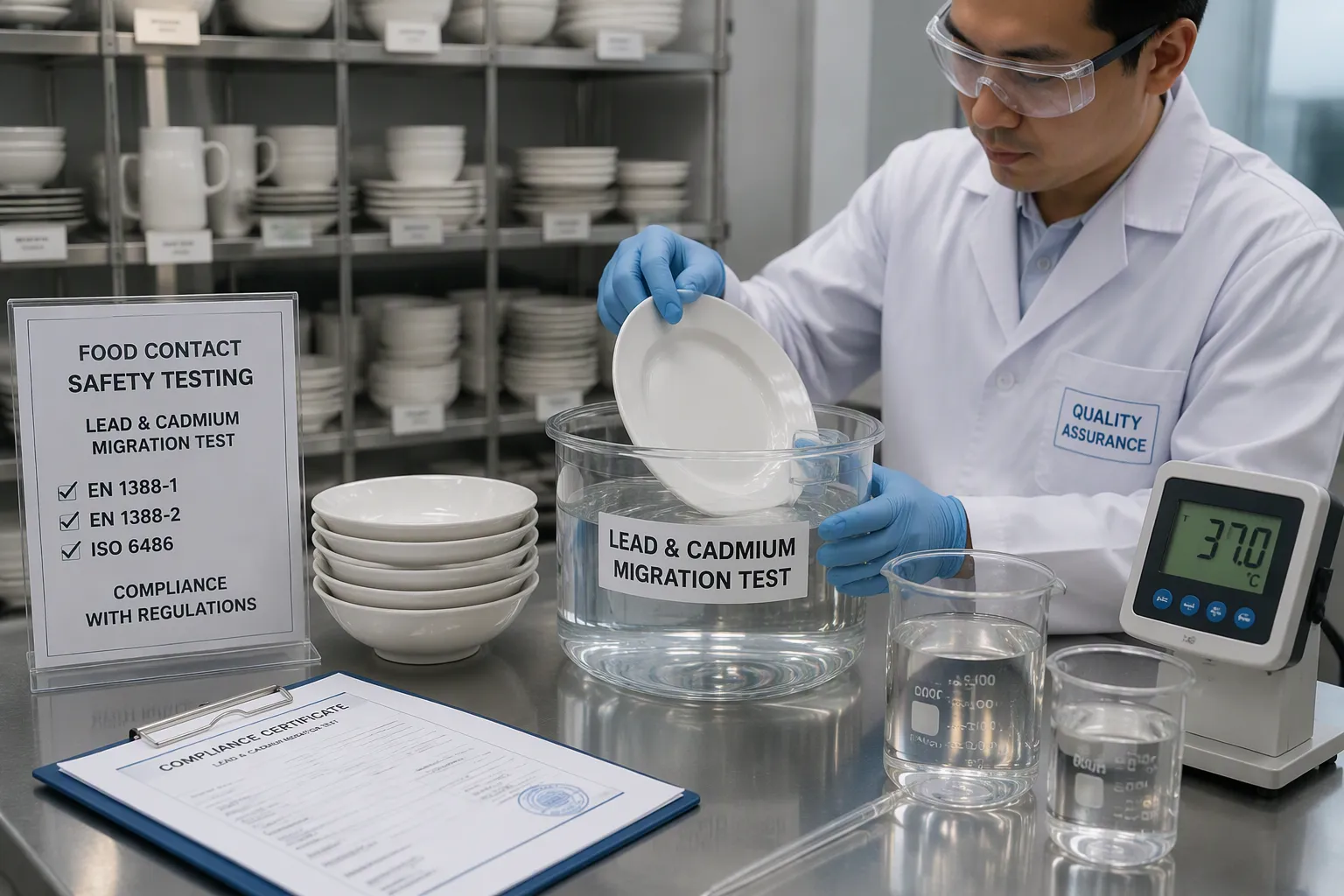
Selling ceramic tableware in Europe means you must follow strict food-contact safety rules. Regulation (EC) No 1935/2004 sets the general safety principles for all food-contact materials. It bans harmful release into food and any unacceptable change to taste, smell, or composition. Ceramic tableware compliance then points to a specific rule: Commission Directive 84/500/EEC. That directive covers ceramics directly. It requires a Declaration of Compliance under Annex III. This document travels with every shipment. Buyers who ignore ceramic tableware compliance risk rejected containers and lost seasons. Smart buyers treat ceramic tableware compliance as a design input, not an afterthought.
The directive sets clear limits for lead and cadmium release. Category 1 covers flat or shallow fillable articles with internal depth of 25 mm or less. The lead limit is 0.8 mg/dm² and the cadmium limit is 0.07 mg/dm². Category 2 covers all other fillable articles. Lead tops out at 4.0 mg/liter and cadmium at 0.3 mg/liter. Category 3 covers cookware and storage vessels over 3 liters. There, lead is capped at 1.5 mg/liter and cadmium at 0.1 mg/liter. These limits govern lead and cadmium release at every firing. They also anchor eu food contact compliance for importers. Clear eu food contact compliance starts with these tables. Each tableware piece must clear its category before it ships.
Lead Migration Testing and Lab Reports
Testing proves the numbers hold. Lead migration testing and cadmium migration testing use 4% acetic acid as the food simulant. Samples sit in the acid for 24 hours at 22 ± 2 °C in the dark. Labs then measure the elements with Flame Atomic Absorption Spectrometry under an accredited method. Rigorous lead migration testing catches problems early. Repeat lead migration testing on each batch keeps the record clean. Equally strict cadmium migration testing protects the glaze story. Repeat cadmium migration testing does the same for cadmium. This is real food contact safety testing, not a paper promise. Food-contact safety drives every sourcing decision. Five-star hotels ask for lab reports before they sign. They want certified lead-free porcelain and full ceramic tableware certification in hand. Without that ceramic tableware certification, a supplier never reaches the shortlist.
Properties serving California guests need more. They must verify Prop 65 alongside fda compliance. Some groups also request fda certification for the united states and proof of fda 21 cfr alignment. Others demand fda certification for the united states before they approve a single sample. A proper food-contact material safety assessment maps every market’s rules before production starts. Regulatory requirements across markets vary, so the assessment must cover each destination. clayesouk runs fda-compliant ceramic tableware production for its US-bound lines. Every order ships with documentation covering lead and cadmium risk control. That paperwork makes ceramic tableware compliance simple to audit. Food-contact safety is the first question a hotel buyer asks. Strong food-contact safety protects guests, brands, and bottom lines. Reliable ceramic tableware certification turns safety from a worry into a checklist item. A hotel group that orders ceramic tableware in bulk needs this paper trail. The right ceramic tableware partner supplies the paperwork upfront. The tableware collection tells the brand story at every meal.
Results and Start Your Custom Project
A Repeatable Sourcing Path
The numbers tell a clear story. The group got 50,000+ pieces with a defect rate under 0.3%, delivery in 35 days, and a follow-up reorder. That mix proves the process works, not just once, but again and again. Any hotel, restaurant, or retailer can copy the same path for their own sourced custom ceramic tableware project.
Here is the repeatable playbook in simple terms:
Sourcing Step | Replicable Action |
|---|---|
Define plate weight | Aim for 650–850 g for dinner plates |
Specify rim durability | Reinforced rim 3.5–4.5 mm thick |
Test before production | Ask for rim samples; drop test from 90 cm |
Maintain brand consistency | Use one body shape across room tiers |
Check dishwasher compatibility | Test metallic rim accents first |
Plan MOQ by customization level | Match volume to glaze and mold choices |
Specify packaging | Individual foam separators, no bulk stacking |
Set par levels | 2.5x daily room count |
A few habits keep the path steady. Color repeatability depends on a signed sample kept as the reference, so reorders match the original shade. Certifications for hotel dinnerware — FDA, LFGB, ISO 9001, and EC — cover material safety and quality management. Factory verification, whether by visit or documentation, confirms capacity and QC. Realistic MOQ per item keeps the par plan affordable. These steps turn sourcing into a routine, not a gamble.
Real Projects Showcase
The European hotel group is one proof point. clayesouk also serves boutique hotels and premium tea suppliers who value traditional craftsmanship and steady quality. Those clients share one need: ceramic tableware that carries a brand story at every table.
Starting a custom ceramic tableware project takes one conversation. Share the brand positioning, the piece list, and the target market. clayesouk handles design, glaze development, branding, and shelf-ready delivery from Jingdezhen. Every order ships with documentation covering ceramic tableware compliance and ceramic tableware certification, so food-contact safety stays easy to check. The real projects showcase offers more proof of what a repeatable process delivers. A buyer’s own tableware collection can follow the same route — from first sample to final pallet, with safety and speed built in.
The numbers speak for themselves: 50,000+ pieces, a defect rate under 0.3%, and 35-day delivery. That trio proves the sourcing process works, and it works again on every reorder. A hotel group can copy this path for its own ceramic tableware project.
Ready to start? Share the brand story, the piece list, and the target market with clayesouk. The team handles design, glaze work, and delivery from Jingdezhen. Buyers who want more proof can browse the real projects showcase, where boutique hotels and premium tea suppliers tell their own tableware success stories. The next custom ceramic tableware collection could carry a brand to every table.
FAQ
How many pieces must a hotel group order?
The amount you need depends on how much you customize. Your glaze and mold choices set the smallest order you can place for each item. The European group in this case ordered more than 50,000 pieces. Smaller hotels can begin with a shorter list of items and add more when they reorder.
How fast can a buyer see a physical sample?
The group got its samples approved in 12 days. Talking straight to the factory made that speed possible. Engineers changed glaze recipes right away, and the client gave feedback the same day. Buyers should expect quick back-and-forth between the design team and the kiln.
Which certificates should a hotel request?
Five-star hotels ask for lab reports and proof that the porcelain is lead-free. Orders going to the EU need a Declaration of Compliance under Directive 84/500/EEC. Hotels with guests from California should also check Prop 65. clayesouk sends paperwork with every order, so checking ceramic tableware compliance stays simple.
What defect rate is realistic for handmade ceramic tableware?
Glaze differences are normal in handmade work. The group’s run came in under 0.3%, a very small number for an order of 50,000+ pieces. Batch control and glaze matching at every shift change kept quality steady. A second order proved the result could be repeated.
Why does delivery speed matter for tableware buyers?
Commercial kitchens lose dishes to chips and cracks every year, and busy seasons make the loss worse. A 35-day delivery window lets buyers reorder before stock runs out. The group planned its second order ahead of time instead of rushing to buy.