


How can your restaurant get handmade cups that match without feeling mass-produced?” That’s the question every careful owner asks. The answer: source uniform handmade cups from a production-focused studio like clayesouk, then agree on specific tolerances. You’re not demanding perfect copies; you’re defining acceptable differences. That difference changes everything.
You need a practical path: define specs first, choose the right partner. Order a small sample batch and compare each cup against your spec sheet. Sort acceptable cups from rejects, and run simple QC checks on every delivery. This avoids that fake, factory look and keeps your tabletop consistent while the handmade texture still shines through.
Key Takeaways
Set clear details for the rim, height, volume, weight, handle, and glaze. Write down the handwork differences you will accept. This helps keep your brand consistent.
Work with a production studio like clayesouk that mixes large clay and glaze batches to keep handmade cups uniform.
Order five to ten sample cups. Check each cup against your spec sheet. Set apart the good cups from the bad ones.
Make a pass/fail checklist for each delivery. Send reports of failures to your supplier. This helps make future batches better.
Group cups by the batch they were fired in. Teach servers the story behind the handmade process. Turn small differences into a brand strength.
Define Brand Consistency for Handmade Cups
When you define brand consistency for your restaurant, you set a range of acceptable differences instead of one exact target. You do not need perfect copies of every cup. Perfect copies are not possible when hands shape each piece. Factory-style sameness kills the charm of handmade items. Decide what “close enough” means for every cup on your table.
Specs That Must Match
Brand consistency starts with a short list of specs that protect how cups work and look. Keep these differences small:
Rim diameter, so cups fit under spouts and lids.
Height, because it shapes how your tabletop looks.
Volume, since it controls drink recipes and pricing.
Weight, because servers need to feel a full cup.
Handle placement, for a comfortable grip and even stacking.
Glaze color, which holds your brand palette together.
That sameness gives your floor staff tools they can count on. When every cup pours and stacks the same way, your service stays smooth during a busy brunch rush. This kind of brand consistency builds trust across your whole restaurant group.
Specs That Can Vary
Other differences stay inside the range on purpose. Glaze depth changes with each dip, so surface tone can shift a little. Throwing ridges and finger marks stay visible. Firing creates soft blush marks and uneven edges. Potter’s marks on the base sign each piece. You can list these as okay traits on your spec sheet. That variation becomes the proof of handwork and the story your servers can tell.
Factory-sprayed coatings look too even. Next to real handmade pieces, they seem fake. Guests may not name the reason, but they sense the missing touch. So protect variety in the details, while keeping consistency on the functional specs. Over time, that balance brings brand consistency across every delivery. Your baristas count on it, and your guests feel it in every sip.
Meet Your Brand Consistency Requirements
You have your must-match and can-vary lists. Now you need to turn those lists into numbers your maker can hit and your floor staff can check. This is where brand consistency requirements become real. You set tolerances, write them down, and share them with everyone who touches a cup.
Volume, Weight, and Handle Placement
Start with clear tolerance ranges. Height can change by plus or minus 3 mm. Volume can shift by 5 percent. Weight should stay within a small gram range. These numbers give your maker room to work by hand while keeping your drinks consistent.
Write a one-page spec sheet. Include a simple drawing with labeled measurements. List the acceptable range for each spec. Add a photo of your master sample. Your maker reads the same sheet your floor staff uses. That shared reference keeps everyone aligned.
clayesouk offers custom adjustments of patterns, glazes, shapes, and sizes to fit your restaurant specs. You send your requirements, and they match them. This kind of specification standardization processes keeps your brand consistency across every order.
Stacking and Dishwasher Safety
Your cups face heat, detergent, and constant handling. Dishwasher safety is not a legal standard but a practical requirement. Ask your supplier for dishwasher cycle test data. Plan to run your own 500-cycle test before full deployment. Glazes that craze or fade after 200 cycles will embarrass your brand.
Fully vitrified ceramic is defined by a water absorption rate below 0.5 percent. Vitrified ceramic is fired above 2,300°F, fusing clay particles into a glass-like, essentially non-porous matrix. Standard stoneware fired between 1,800°F and 2,100°F remains porous, absorbs moisture, harbors bacteria, and degrades under repeated commercial dishwasher cycles. High-fired porcelain fired between 1,280°C and 1,350°C develops a fully vitrified, non-porous surface that prevents bacterial absorption.
Check these sourcing points before you commit:
Commercial dishwasher rating confirms the glaze and body can withstand repeated high-temperature wash cycles without degradation.
Lead-free and cadmium-free certification protects your guests.
Thermal shock resistance keeps cups from cracking when temperatures swing.
FDA food-contact safety compliance is non-negotiable.
Standard
Region
Purpose
International
Tests lead and cadmium release from ceramics
ASTM C738
United States
US equivalent for lead/cadmium release testing
FDA CPGs
United States
Referenced in compliance reporting for ceramic food-contact safety
EU Directive 84/500/EEC
European Union
Rule on lead and cadmium in dinnerware
LFGB
Germany
Stricter positive-list approach; often considered most stringent
Commercial dishwasher endurance tests run at least 500 cycles. Thermal-shock resistance tests go from 180°C to 20°C. Edge-chip resistance evaluations matter too. Quality control systems should meet international standards such as FDA, CE, LFGB, and ISO.
Stacking matters for storage and service. Cups with consistent rim diameter and height stack evenly. Uneven stacks waste shelf space and risk chips. Add stacking height to your master specification documentation. Test a stack of ten cups. If they wobble or lean, adjust the tolerance.
Your consistency across every delivery depends on these checks. Run them once, document the results, and repeat them for each batch. That routine protects your uniformity and your reputation.
Source Uniform Handmade Cups from the Right Studio
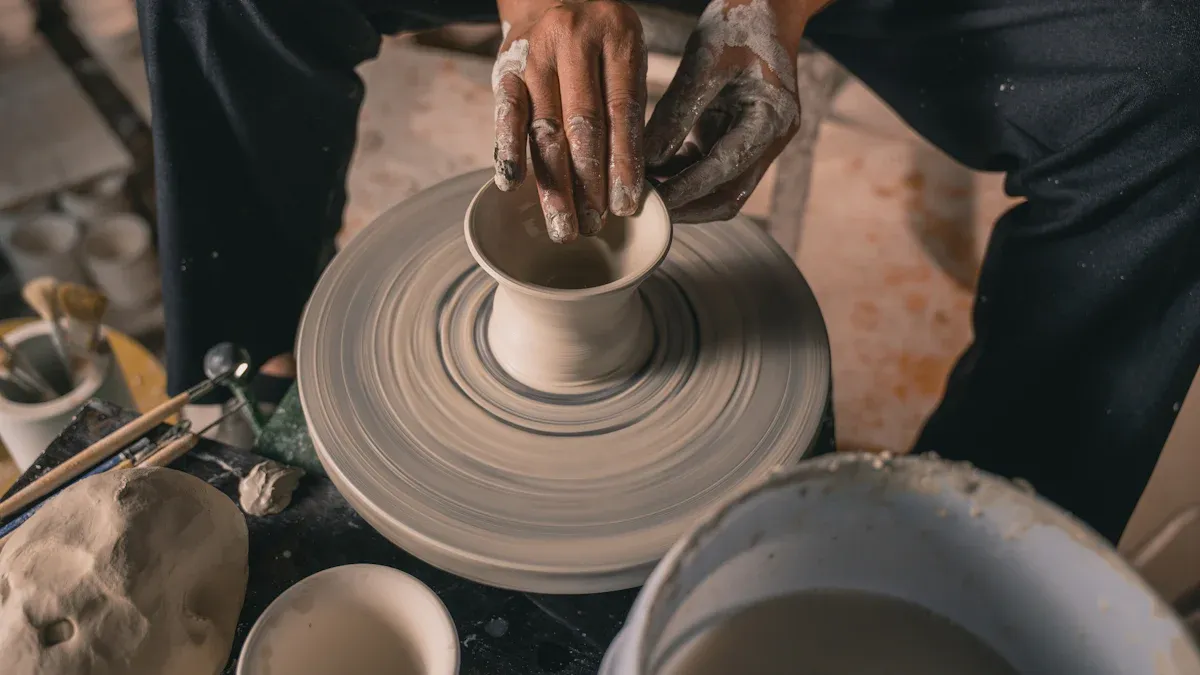
One-off potters make beautiful pieces, but they cannot fill a restaurant order. Their clay comes in small batches, and their glazes change from week to week. Their kiln loads also vary. When you source uniform handmade cups, you get a great first dozen and then a struggle for consistency. A production-focused studio like clayesouk mixes clay and glaze in batches. So every run starts from the same base formula. That documented handmade production matters more than any single perfect cup.
Jingdezhen is a city in Jiangxi province, China. It is widely known as the birthplace of porcelain and the world’s “Porcelain Capital.” For over 1,700 years, it has been the top center of ceramic production. It is famous for its pure kaolin clay, imperial kilns, and a long tradition of handcraftsmanship.
clayesouk works in Jingdezhen, and that heritage runs deep. Han dynasty kilns fired simple stoneware. Song potters mastered thin qingbai. Yuan artisans perfected blue and white. Ming emperors built Imperial Kilns. Qing craftsmen pushed glazes to new technical heights. clayesouk’s artisans bring over a decade of hands-on experience. The studio also holds a national-level ICH productive protection demonstration base status. It complies with international quality standards too, so European and American buyers can trust the paperwork.
Why clayesouk Fits Restaurant Production
When you buy from a production-focused studio, you get consistency plus flexible custom work. clayesouk adjusts patterns, glazes, shapes, and sizes to match your spec sheet. That is critical for supplier selection for chain operations. You need suppliers who can hold a tolerance across hundreds or thousands of pieces. You do not want just one lucky firing. Generic ceramic suppliers cannot match that. clayesouk serves boutique hotels and premium tea suppliers who expect that reliability. Their pricing model keeps per-unit costs predictable without cutting the handcrafted feel.
Paper Cups vs. Handmade Ceramic
Now compare disposables with ceramic. Light, cheap, and easy to store, disposables work in fast-service settings. Your paper cup sourcing strategies should account for hidden costs, but ceramic changes the equation. For every reason a manager reaches for disposables, ceramic offers a better long-term answer.
Paper cups for chains win on volume pricing because a single order can run into the millions.
Paper cups for chains keep labor low, and that labor savings feels like volume pricing at the register.
Paper cups for chains avoid breakage, which protects volume pricing across busy shifts.
Paper cups for chains remove the dishwasher cycle, lowering utility bills and reinforcing volume pricing.
Paper cups for chains offer simple storage, and compact boxes make volume pricing attractive to franchise owners.
Paper cups for chains allow quick menu changes, so marketing teams use volume pricing to test new designs.
Paper cups for chains reduce weight during deliveries, and that freight efficiency adds to volume pricing.
Paper cups for chains need no training for handling, letting volume pricing dominate cost-per-service metrics.
Paper cups for chains meet basic hygiene expectations, and their per-use price falls comfortably into volume pricing models.
Paper cups for chains solve short-term budgets, but volume pricing cannot buy brand permanence.
Many restaurants pick disposables for speed, yet they miss the moment a ceramic cup creates. By choosing the right studio, you can source uniform handmade cups that stay within your tolerances while keeping a human signature. That connection is your brand signature.
Sample, Test, and QC for Foodservice Chains
Foodservice chains and multi-location foodservice operations need a repeatable quality control loop. You do not need one perfect cup. You need a process that catches problems before they reach your guests. That loop protects your brand across every location.
Start with a 5–10 Cup Sample Batch
Order 5 to 10 cups from your supplier. Compare each one against your spec sheet. Check rim diameter, height, volume, and weight. Sort them into acceptable and reject piles. If too many cups fail, adjust the master sample with clayesouk. They can tweak the glaze, shape, or size until the batch matches your needs.
This step saves you money later. A small batch reveals problems early. You avoid a full order of cups that do not fit your shelves or your drink recipes. Think of it as a test run for your whole quality control system.
Build a Simple Pass/Fail Checklist
Your floor staff needs a quick way to check every delivery. Build a checklist with clear pass or fail items. Here is what to include:
Rim diameter fits your standard range.
Height stays within plus or minus 3 mm.
Volume holds your target pour.
Glaze shows no cracks, chips, or bare spots.
Handle feels comfortable and sits in the right spot.
Base marks look clean and consistent.
Dishwasher test passes after repeated cycles.
Track issues per delivery. Write down what failed and how many cups failed. Send that feedback to your supplier. This keeps future batches on target. Your quality control improves with every order.
Good suppliers welcome this feedback. They want your business long term. That partnership keeps your quality control tight and your brand strong.
Style the Differences as a Brand Strength

At this point you have a spec sheet, a trusted studio, and a working QC loop. Now comes the fun part, styling the small differences. The subtle variation inside your agreed tolerances is a feature, not a defect. Guests never see identical cups from a ceramic line. That is exactly what you want. Your job is to arrange human marks so they feel deliberate.
Set Tables by Firing or Batch
Every firing load has its own personality. Cups from the same batch share glaze tone, rim texture, and kiln mood. When your order arrives, sort cups by firing or batch. Set one group per table. The table then looks planned, never random. Walk past a fully set table and you see rhythm. Look closer and each one is unique. That balance is the goal.
Rotation matters. Keep each batch together through service and washing. If floor staff mix batches during reset, tiny shifts look untidy. A few seconds of sorting solves this. This small habit protects brand consistency. It also gives your tables visual consistency during a busy weekend rush.
Train Staff to Tell the Handmade Story
Your servers can turn those marks into a story. Give them one or two honest lines. They might say, “This cup came from Jingdezhen, the porcelain capital. One artisan shaped it, and the kiln finished it.” That sentence invites guests to look closer. The throwing ridges and kiln marks become conversation pieces. Guests feel the story before they sip.
Use the same variation language across your team. Instead of “every cup is different,” have them say “the artisan’s hand made this cup.” That wording changes how guests react. A tiny imperfection becomes proof of authenticity. Managers across locations can share the same phrase. This shared phrasing builds a consistent guest experience at every table.
The story needs consistency. When every server describes the same craft, guests receive the same brand message. That repeated message creates brand consistency across your restaurant group. Your quality checks guard the numbers. This training guards the guest’s perception. Consistency across deliveries begins with that simple sentence.
You now know how to source uniform handmade cups the right way. Clear specs, a production partner like clayesouk, and tolerance-based QC get you there. You never need identical copies. Subtle variation inside your agreed tolerances is a brand strength. It proves real hands shaped every cup on your table.
So take the next step. Contact clayesouk for a sample range and custom specs built for your restaurant. You can source uniform handmade cups that fit your brand, your menu, and your guests. Your tabletop deserves that kind of care.
FAQ
How close can handmade cups actually match?
You can keep height within plus or minus 3 mm and volume within 5 percent. Weight stays in a small gram range. Rim diameter, handle placement, and glaze color stay the same too. These tolerances give you a matching set that still shows real handwork.
What should I check on every delivery?
Run a quick pass or fail check. Measure rim diameter, height, and volume against your spec sheet. Look for glaze cracks, chips, or bare spots. Test handle comfort and base marks. Run a dishwasher cycle test. Track failures per delivery and send feedback to your supplier.
Why not just use paper cups instead?
Paper cups work for fast service, but they leave no lasting impression. Handmade ceramic cups become a brand asset your guests remember. They carry the Jingdezhen story and the artisan’s touch. That story builds brand value that disposables simply cannot match.
How do I handle natural variation between cups?
Sort cups by firing or batch and set one group per table. The table looks intentional, not random. Train servers to describe the handmade process. A simple line about Jingdezhen heritage and kiln marks turns small differences into a guest experience.
Can clayesouk match my existing cup specs?
Yes. clayesouk adjusts patterns, glazes, shapes, and sizes to fit your restaurant requirements. Send your spec sheet and master sample. They match your tolerances across full production runs. Their Jingdezhen studio holds ICH demonstration base status and complies with international quality standards.
