
Firing temperature decides how dense a ceramic becomes. Heat causes densification through three connected steps: sintering, pore reduction, and grain growth. Sintering joins particles together. Pore reduction closes the open spaces between them. Grain growth happens next as the body tightens even more.
These changes have real effects. A denser body resists breaking, soaks up less water, and works for different uses than a porous one. Potters and buyers both see density as a sign of quality. The sections below look at how each step works and how firing choices shape the final result in ceramics.
Key Takeaways
When you fire ceramics at higher temperatures, they become denser. This happens because the heat closes up the tiny holes and joins the particles together.
Try out different top temperatures to find the best density for each clay body.
Overfiring causes warping and bloating, so stay within the tested range.
Manage the heating speed and the kiln’s air to get even, dense results.
Ceramics that are dense keep out water and resist breaking better than ceramics that are porous.
How Sintering Builds Density
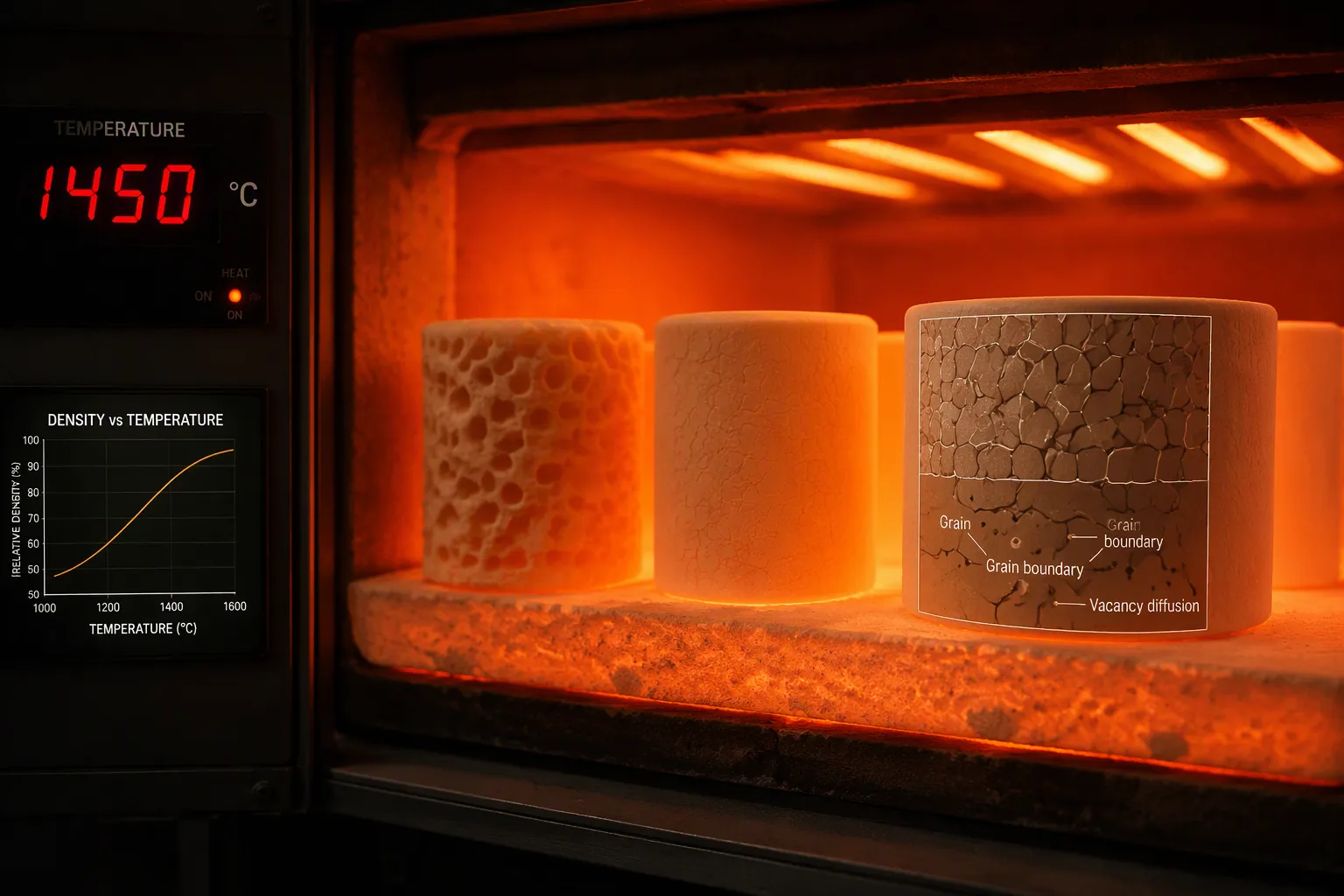
Sintering is when particles join together under heat. This process makes the body tighter and raises its density. Particles stick together where they touch, and the gaps between them get smaller. A well-sintered body keeps its shape with much less empty space inside.
The Effect of Sintering Temperatures
The effect of sintering temperatures on mass transport explains most of what happens inside the kiln. Atoms move in several ways, and each way needs a different amount of thermal energy:
Surface diffusion: atoms travel along particle surfaces and form necks between particles. This way dominates at lower temperatures because it needs less activation energy. It does not, by itself, cause shrinkage or densification.
Lattice diffusion: atoms move through the crystal lattice and pull particle centers closer together. True densification depends on this way, and it requires higher temperatures.
Grain boundary diffusion: grain boundaries act as paths for atoms and control pore removal. The ratio of pore size to grain size shapes how well this works.
Rising sintering temperatures slowly close open pores. Vacancies leave the pores and annihilate at grain boundaries, so the body shrinks and water absorption falls. The link between sintering temperature and density is therefore direct: more heat, up to a limit, means less open porosity and lower water absorption. Published data on 5YSZ shows volume density reaching 5.961 g/cm³ at 1450 °C, while two-step sintering of the same material reached 98.55% relative density at lower temperatures. The impact of sintering temperature on structure is clear in these numbers.
Pore Reduction and Grain Growth
Pore reduction comes first. Open porosity closes off, and the body approaches near-full density. Grain growth follows pore elimination, and this stage decides the final microstructure. Fine, uniform grains support near-theoretical density and maximum fracture strength. Coarse grains from over-sintering keep density high but slow further pore migration and reduce room-temperature strength. Abnormal grain growth caps density outright, because migrating boundaries break away and trap pores inside large grains. Those trapped pores create stress concentrators and cause strength scatter. Fracture strength scales inversely with the square root of grain size, so uncontrolled grain growth after pore elimination directly reduces toughness. The optimum is a dense, fine-grained, uniform microstructure.
Density Across the Firing Stages
From Bisque to Maturity
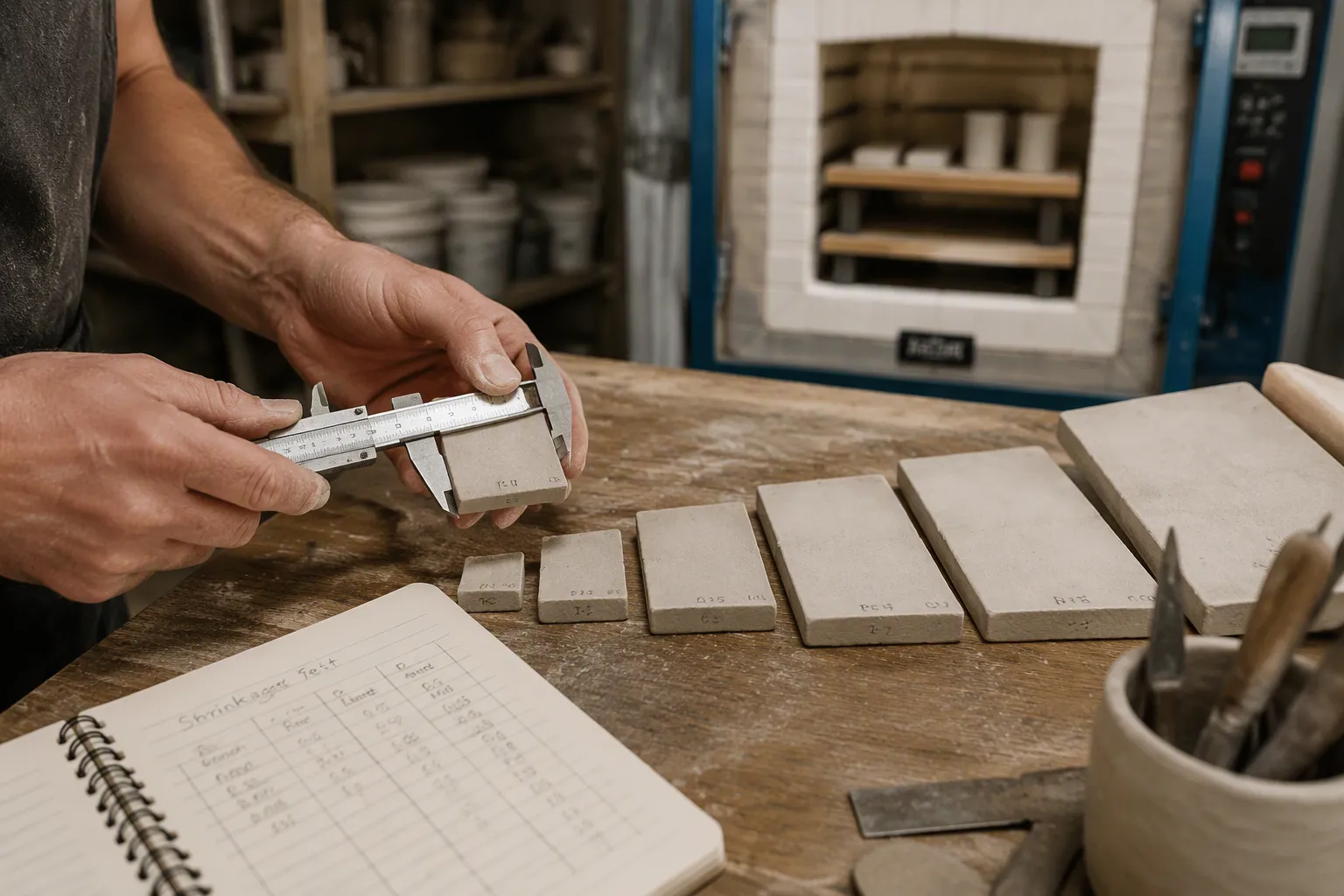
Bisque firing makes a shaped piece strong but still porous. Maturity firing takes it further. The body keeps shrinking as open pores close, and it stops only at maximum density. Shrinkage shows this progress, and the amount depends on the clay body.
Clay Body | |
|---|---|
Whitewares | 7–8% |
Vitreous porcelains | more than 10% |
Stonewares | about 5–6% |
Earthenwares | 3–4% or less |
These values are dry-to-fired shrinkage, not total wet-to-fired shrinkage. A potter who measures a test tile at bisque and again at maturity sees how shrinkage changes with temperature. That measurement shows the direct link with sintering temperature for a specific body.
Optimal Sintering Temperatures and Overfiring
Testing firing temperatures finds the best range for a given clay body. A potter fires a series of test tiles across a range of peak temperatures, then checks each tile for water absorption, open porosity, and shrinkage. The tile with the lowest water absorption and a sound, uncracked body marks the practical ceiling. The firing process should stop there. Going past it invites trouble.
Overfiring means firing a ceramic body so hot that it starts to distort from melting. It is the easiest cause of bloating to recognize. Every body is meant to hold its shape from room temperature through firing, and a firing that runs too hot destroys that shape as the body starts to melt. Near peak temperature, a liquid glass phase with almost no strength forms. Small bubbles of kiln gas remain, and they expand as temperature rises. The clay body must hold them in, or bloating follows.
Two failures often appear together:
Warping happens during firing when vitrification runs high and the maker has taken inadequate measures during forming and firing to prevent it. Unexpected warping often hits unstable shapes and overfired ware.
Bloating occurs when off-gassing of decomposing particles has not finished by the time density and impermeability set in through vitrification or overfiring.
A stoneware fired in a gas kiln past cone 10 shows both problems at once. The pieces bloated and warped badly. The lesson is simple: record the maximum heating temperature for every firing and compare it with the tested optimum. Small sintering temperature changes near the top of the range cause large shifts in shrinkage and porosity. A body that looks fine at one peak can slump at the next.
What Changes the Firing Temperature Effect
Clay Composition and Fluxes
A clay body almost never reaches high density at just one set temperature. Purity and flux content move that point. Pure refractory materials need more heat before sintering starts. Fluxes like feldspar melt sooner and bring the densification temperature down. Ceramics with a lot of flux reach density faster. A porcelain body with more flux matures at a lower peak than a lean stoneware. Phase transformations during firing also change how the body responds. Quartz inversion and other microstructural changes alter shrinkage and open porosity along the way. So the impact of sintering temperature on structure depends on what the body contains. The effect of sintering temperatures is never the same for two ceramics.
Heating Rate and Kiln Atmosphere
Heating rate controls how evenly sintering proceeds. A fast ramp makes the surface densify first and form a nearly impermeable shell. That shell traps porosity inside a cooler core. The result is a dense outside and a weak, porous inside. A moderate rate lets the whole part heat evenly, so diffusion closes open porosity before the surface hardens. Slow heating keeps the body uniform but coarsens the microstructure and weakens the driving force for densification. Lower water absorption signals a tighter body.
Effect on uniformity | Effect on final density | |
|---|---|---|
Very fast (~700 °C/min) | Severe surface–core gradients; dense edges, porous interior | Residual porosity; non-uniform microstructure |
Moderate (200–400 °C/min) | Even temperature field; homogeneous shrinkage | Near-theoretical density (>99%) with fine grains |
Slow (<~100 °C/min) | Uniform but coarsened | Low density from diminished driving force |
Kiln atmosphere matters too.
The firing atmosphere critically influences densification and functional performance.
Oxidation and reduction change how gases escape and how the surface seals. A potter who records firing temperatures, water absorption, and changes in shrinkage across test tiles sees these effects directly. Water absorption falls as density rises. The sintered body reflects every choice made during the firing process. Dense ceramics reward careful control of every variable.
Putting Density to Work with clayesouk
Density and Ceramic Properties
Density connects directly to how a finished piece performs. A tightly packed body carries load across more contact area, so strength goes up. Fracture toughness follows the same path, because fewer pores mean fewer places for a crack to start. Lower porosity also limits how much moisture the body can take in.
Absorption or desorption of water (or other solvents) can change the size of many common materials; many organic materials change size much more due to this effect than due to thermal expansion.
That matters for ceramics. A dense body shows almost no water absorption, while a porous one soaks up moisture and swells. A 96% alumina body shows the target: density of 3.7–3.8 g/cm³, water absorption of 0%, and a coefficient of thermal expansion near 6.5–7.7 ×10⁻⁶/°C. The lesson is clear. Push porosity down, and water absorption, moisture movement, and thermal movement all shrink with it.
Hitting Your Target Density
clayesouk‘s Jingdezhen handmade ceramic cups show how a firing curve maps to a density goal. A solar kiln run at 16.2 °C/min, a 1100 °C set point, and a 60-minute hold reached a measured peak of 1107.8 °C. The result was a bulk density of 2.210 g/cm³, water absorption of 4.25%, open porosity of 9.93%, and bending strength of 88.96 MPa — enough to meet GB/T 5001-2018, which caps water absorption below 5%.
Repeatable results come from three habits. Fire test tiles across a range of peaks and measure water absorption and open porosity on each one. Write a firing schedule that fixes the heating rate and the hold time. Record the measured peak temperature for every run, not just the set point. Those records turn a single good result into a dependable firing process, and they let the next batch land on the same optimal density.
Temperature controls density in ceramics through three linked steps: sintering, pore removal, and grain growth. Heat drives each step forward, and ceramics tighten as a result.
Composition, heating rate, and kiln atmosphere fine-tune where that density lands. Fluxes shift the temperature at which a body densifies, and a steady ramp keeps the sintered structure even and strong.
The practical move is simple. Test firing curves across a range of peaks and measure water absorption on each tile. Then match the peak temperature to the piece’s intended use, since water absorption tracks density closely. That habit turns one good firing process into a repeatable one.
FAQ
Does a higher peak always mean a denser body?
No. Density goes up as the peak rises, until the open pores close. After that point, overfiring takes over. The body warps, bloats, and loses its shape. A tested optimum marks the practical ceiling for each clay body.
How does a potter find the best temperature for a clay body?
They fire test tiles across a range of peaks. Then they measure water absorption, open porosity, and shrinkage on each tile. The tile with the lowest water absorption and a sound body sets the target. Records of the measured peak keep later firings repeatable.
Why does water absorption matter for ceramics?
Water absorption tracks open porosity. A dense body takes in almost no moisture, so it stays stable in size and strength. A porous body soaks up water and swells. Buyers can read absorption as a direct sign of how tight the fired body became.
Can a fast ramp reach the same density?
Not reliably. A fast ramp densifies the surface first and seals it. That shell traps porosity inside a cooler core. A moderate rate heats the whole part evenly, so diffusion closes pores before the surface hardens. Even heating gives a uniform, dense result.
What role do fluxes play in reaching density?
Fluxes such as feldspar melt sooner and pull the densification temperature down. A body rich in flux matures at a lower peak than a lean stoneware. Purity and flux content shift where high density lands, so no single temperature fits every body.
