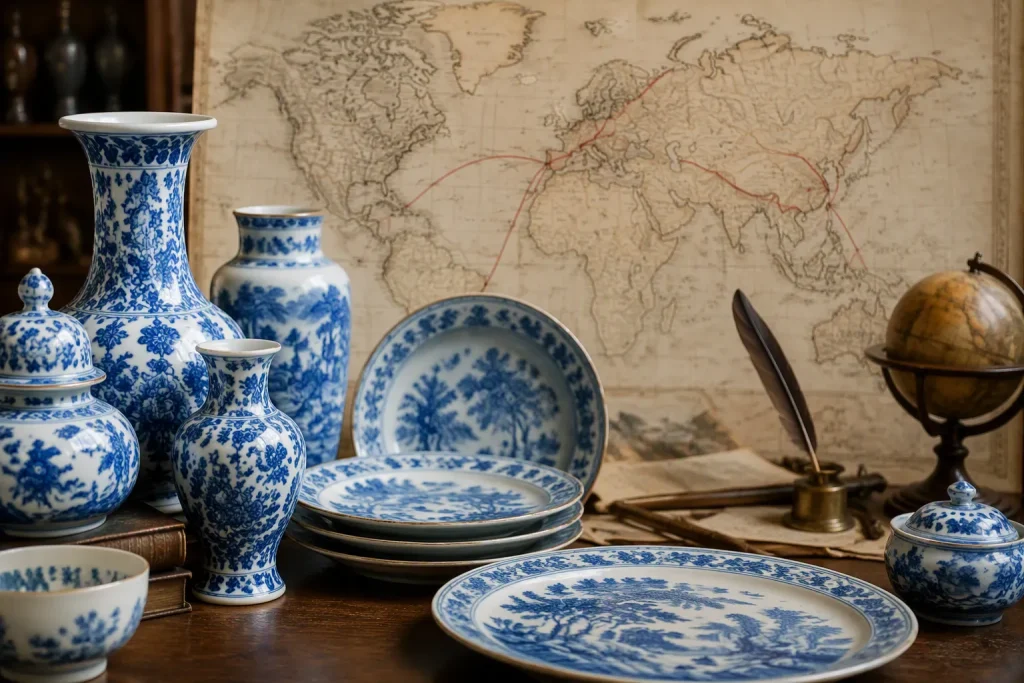
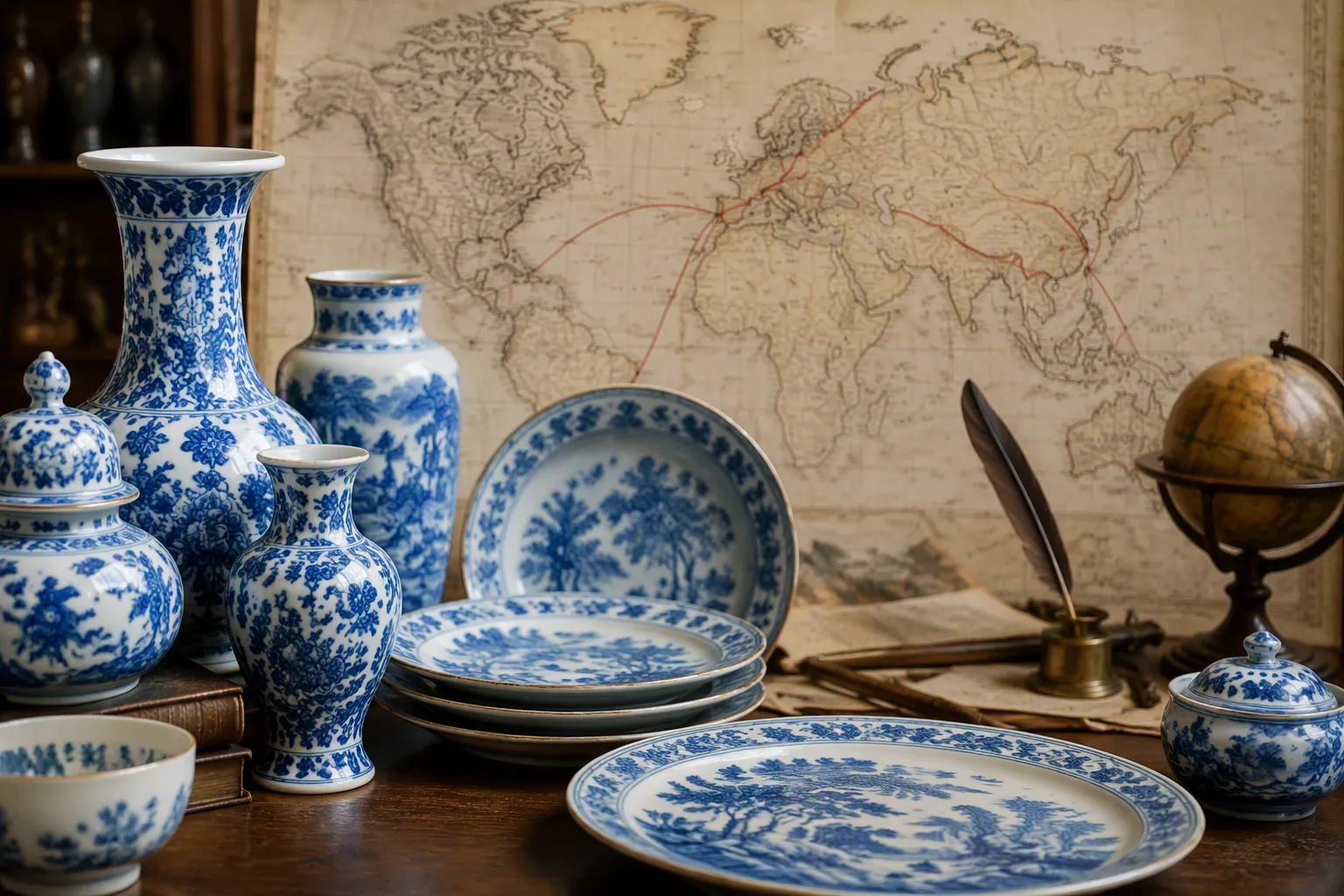
In 1752, a Dutch ship called Geldermalsen sank in the South China Sea. It was carrying over 150,000 pieces of Chinese porcelain. The cargo sat underwater for more than 200 years. Christie’s sold the pieces they found. The sale earned $15,255,102. This story shows the amazing trip of Chinese export porcelain around the world.
How did this ceramic ware shape trade, culture, and art across the globe? The answer starts in Jingdezhen, China. Workers there fired blue-and-white vessels for European courts. Later, these goods reached American homes and today’s collectors. The global influence of export porcelain tells a story of connection and exchange.
Key Takeaways
Chinese export porcelain linked the world through trade for hundreds of years.
Blue-and-white porcelain became well known thanks to Persian cobalt and talented Jingdezhen potters.
European people wanted porcelain so much that they made their own versions, like Delftware and Meissen porcelain.
Shipwrecks give useful clues about the porcelain trade and help figure out when pieces were made.
Today, craft workers in Jingdezhen carry on the tradition with ceramics made by hand.
Origins of Chinese Blue and White Porcelain
Jingdezhen and the Cobalt Trade
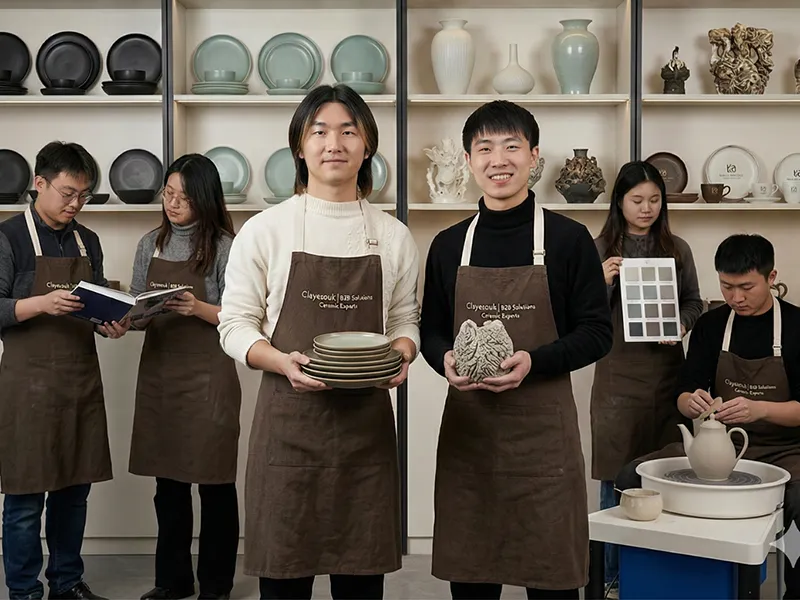
Jingdezhen is a city in Jiangxi Province, China, and it has made ceramics for over 1,700 years. Potters there created the methods that made chinese blue and white porcelain famous around the world. The city got the name “Porcelain Capital” because of its rare clay and skilled workers. Today, clayesouk continues this long tradition. The brand’s artisans have more than ten years of experience, and they make handmade ceramic cups that honor Jingdezhen’s heritage.
The first blue-and-white wares relied on a special material brought in from elsewhere. Persian merchants brought cobalt to Jingdezhen during the Yuan Dynasty. Chinese potters named this pigment huihui qing, which means “Islamic blue.” The table below shows key facts about this trade.
Aspect | Detail |
|---|---|
Cobalt origin | Exported from Persia; called huihui qing |
Trade route | Mongol empire routes linked Jingdezhen to Islamic markets |
Value | Considered worth about twice its weight in gold |
This cobalt was so valuable that it shaped the whole industry. Without it, the unique blue-and-white look would not exist.
Huihui Qing and Technological Mastery
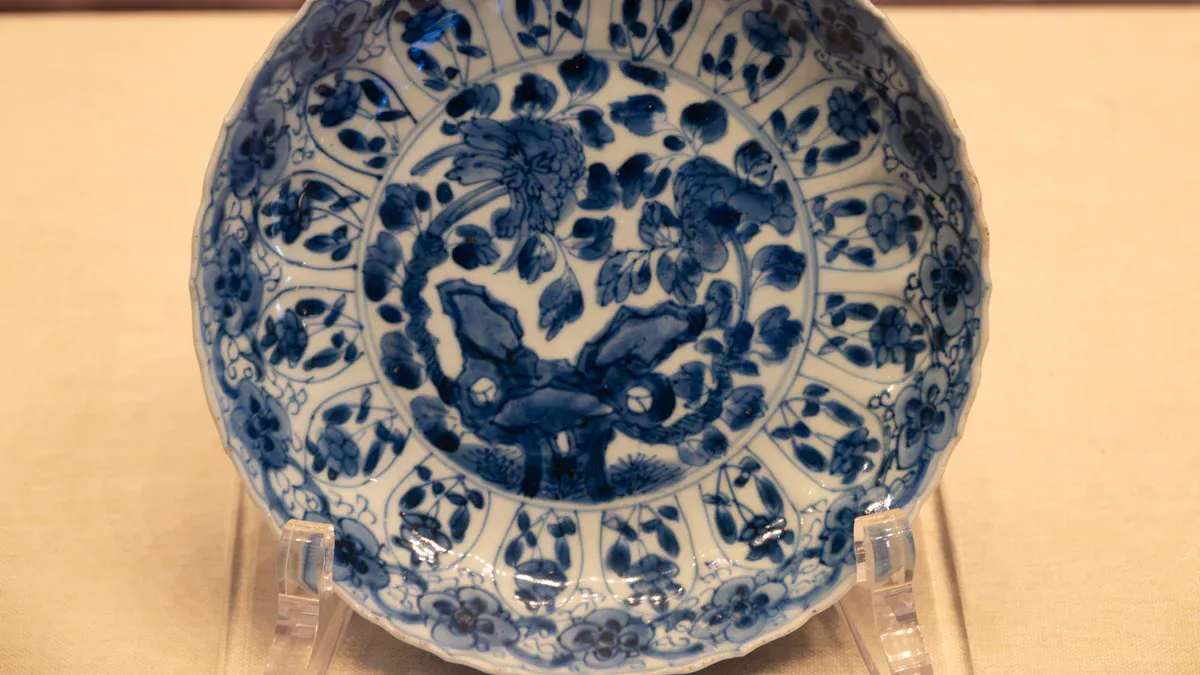
The Persian cobalt had high iron and low manganese content. This chemical makeup made a deep, inky blue with darker pooled spots. Potters called this effect “heaped and piled.” The result was a bold, confident style that was different from earlier Asian ceramics. Yuan-era brushwork reached very high quality very quickly.
Blue-and-white decoration became common in chinese porcelain in the 14th century. Persian traders brought dye materials and minerals, including cobalt oxide. Chinese potters took the pigment and made intricate designs on large bowls, vases, and ewers. Demand from overseas grew fast, and prices rose a lot. The Mongol empire’s trade routes linked Jingdezhen’s kilns to Islamic markets. This exchange mixed a Persian palette with Chinese porcelain technology. The finished wares traveled west in large amounts. Later, during the ming dynasty, blue-and-white porcelain reached new levels of refinement. The ming dynasty potters perfected glazes and shapes that collectors still admire today. Clayesouk’s artisans carry on this legacy through handmade ceramic cups, mixing traditional techniques with modern aesthetics.
Trade Networks and the Rise of Chinese Porcelain
From Silk Road to Maritime Routes
For hundreds of years, camel caravans carried Chinese porcelain west along the overland Silk Road. This route was a dangerous, dusty path through deserts and mountain passes. By the Tang Dynasty, a much larger maritime Silk Route had formed. Monsoon winds controlled trade on this shifting sea highway. This change from pack animals to monsoon-driven shipping allowed a huge rise in export volume.
A few things caused this change. The Mongol Empire fell around the mid-14th century. Political division ended unified protection. Overland travel became unsafe and expensive for luxury goods. The Black Death in the 1340s killed many people along the Silk Road. It broke up trade networks and lowered demand. The fall of Constantinople in 1453 cut off the western endpoint. Growing dryness in Central Asia made some routes harder to cross. Tamerlane’s destruction of rival routes and the Ming Dynasty’s closing of the eastern end also blocked overland trade.
Sea routes had clear benefits. They offered bigger cargo space and lower costs per unit. Better ship design and navigation made voyages more dependable. The Portuguese voyage around the world in 1498 gave Europeans direct sea access to Asian markets. Shipwrecks show the size of this trade. The Belitung shipwreck from 826 A.D. carried over 60,000 pieces. The Cirebon wreck from 968 A.D. held over 300,000 Yue wares. These numbers show how sea transport moved bulk ceramics across oceans.
Major sea routes linked China to the world. These included the East Seas route to Korea and Japan, the South Seas route to Southeast Asia, and the Sea Silk Road to India, the Persian Gulf, the Red Sea, and Egypt. The Portuguese route went around the Cape of Good Hope, across the Indian Ocean to Macao through the straits of Malacca. By the 16th century, safer sea routes between Asia and Europe were set up. The Portuguese controlled this porcelain trade during the 16th century. The Dutch followed in the early to mid-17th century. The English took over at the end of the 17th century.
East India Companies and Global Demand
The Dutch East India Company, called the VOC, brought in tens of millions of porcelain pieces during its run from 1602 to 1799. This flood of Chinese porcelain became a worldwide product. Porcelain was prized for being thin, light, strong, and easy to clean. In the 17th century, it also gave status to its owner. When Chinese porcelain became hard to find in the 1640s due to political trouble in China, Delftware appeared as a local substitute.
The VOC trade changed over time. After 1685, private trade grew so much that the VOC faced competition. Profits dropped, and in 1690 the Heren XVII stopped buying porcelain for the Netherlands. Private traders then took over nearly the whole supply. From 1728, the VOC went back to buying porcelain directly in China. Canton had become a hub for overseas trade. Western companies bought tea, which was becoming Europe’s favorite drink. Porcelain was a useful extra product. It was packed in wooden crates as a base layer in the hold, keeping tea crates safe from moisture.
Orders listed types, models, color schemes, amounts, and budgets. The VOC focused on everyday wares for the Netherlands, including plates, bowls, tableware, and coffee and tea ware. Over 200,000 pieces could be loaded per ship. Each ship’s porcelain cargo was worth about 35,000 to 40,000 guilders. This made up about 5% to 8% of total cargo value. Porcelain was sold at auction in Amsterdam and other VOC cities. If a type made less than 40% profit, it was dropped from the assortment.
By the late 18th century, VOC purchases fell. English wars, high operating costs, and fading interest in Chinese porcelain hurt the trade. German and French porcelain and English pottery became more stylish. In 1799 the VOC went bankrupt. Chinese porcelain stayed a key part of China’s export economy for centuries. The porcelain trade linked Jingdezhen’s kilns to buyers across Europe and the Americas. This exchange made Chinese export porcelain a true global commodity.
Export Porcelain Types and Foreign Tastes
Kraak, Armorial, and Canton Wares
Kraak porcelain was the first type of Chinese export porcelain made in large amounts. Its name came from “carrack,” a kind of European ship used to carry goods. Kraak ware came in four main forms: dishes, klaptmutsen, bowls, and closed shapes like bottles and wine pots. Klaptmutsen were deep dishes or bowls with flat rims, possibly made to suit Dutch tastes. Footings often had sand scars from being fired on a sand bed. Small bare spots, called “moth-eaten,” showed up along rim edges where glaze shrank during firing. A common mark on 17th-century Kraak pieces was the lingzhi, or sacred fungus, on the back of the vessel.
Canton porcelain worked in a different way. Workers at jingdezhen made plain “blanks.” Artists in Guangzhou then painted these blanks at the Thirteen Factories. They made styles for Western markets. Armorial porcelain carried family coats of arms sent from Europe. Painters copied these designs onto dining wares. After 1800, Canton-decorated porcelain showed figures, birds, flowers, and insects. This system showed clear give-and-take between cultures. Importers ordered specific shapes like mugs, ewers, and tazze. This history shows how chinese porcelain changed to fit foreign needs.
Clayesouk carries on this tradition today. The brand offers custom ceramic design services. Clients can change patterns, glazes, shapes, and sizes. This personal approach mirrors the historic export trade between china and the West.
Famille Rose and Utilitarian Forms
New enamel colors came from technological innovation in the early 18th century. Imperial workshops at the Forbidden City opened in 1693 to make cloisonné enamels. A glass workshop began in 1696 under German Jesuit Kilian Stumpf. A special enameling workshop opened in 1716. Guangzhou also became a center for painted enamels.
These developments produced the famille rose palette. Chinese potters called it yangcai because of European influence. Firing techniques allowed pink, white, and opaque yellow enamels. The rose color came from colloidal gold nanoparticles. Ming dynasty potters had already perfected blue-and-white designs. Qing dynasty craftsmen added these new enamel colors. This mix of blue-and-white tradition with new palettes expanded chinese porcelain possibilities.
Utilitarian forms for Western use included coffee cups, teapots, and dinner services. The shapes followed European customs while the decoration stayed Chinese. This blend served daily needs in foreign homes while carrying Chinese artistic traditions. The jingdezhen kilns kept producing these wares through the 19th century. Collectors today prize these examples of chinese porcelain shaped by global exchange. This export porcelain tradition linked East and West for centuries. Trade routes from china carried these wares across the globe.
Cultural Impact and European Imitation
Chinoiserie and the Allure of the East
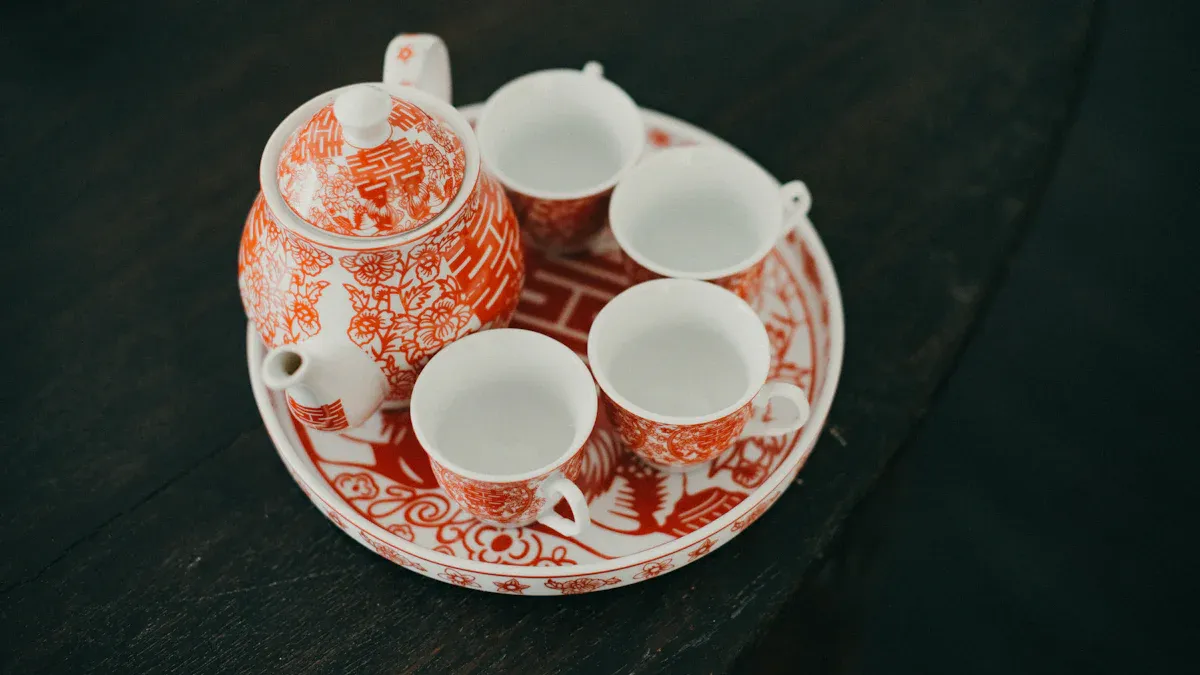
Chinoiserie reshaped European interior design through the influence of chinese export porcelain. Wealthy families collected chinese porcelain and displayed it in special cabinets. These cabinets signaled social status and refined taste. European royalty adopted the style with great enthusiasm.
King Louis XIV built the Trianon de Porcelaine at Versailles in 1670. This small palace used blue-and-white earthenware tiles and imported Chinese jars. Electress Maria Amalia of Bavaria lined her kitchen at Amalienburg with Delft-style tiles. The Peacock Room by James McNeill Whistler displayed Kangxi porcelain within a European setting. Frederick the Great built the Chinese Tea Pavilion at Sanssouci in 1745.
Example | Description |
|---|---|
Trianon de Porcelaine (1670) | Built for Louis XIV at Versailles, sheathed in blue-and-white earthenware and studded with imported Chinese jars. |
Delftware tiles in Amalienburg | Electress Maria Amalia lined her kitchen with Delft-style tiles featuring chinoiserie imagery. |
Peacock Room (1876–77) | James McNeill Whistler’s interior designed to display Kangxi porcelain within a European room. |
Chinese Tea Pavilion (1745) | Frederick the Great’s summer palace with porcelain brackets and painted friezes. |
Scholars note that chinoiserie did not simply copy Chinese art. European artisans selected motifs and recombined them within Rococo conventions. Pagodas, dragons, and phoenixes appeared alongside C-shaped curves. Chinese figures became elegant caricatures in fantasy pavilions. Painters created fake Chinese characters for decorative effect. Common motifs included foo dogs, pagodas, and flowers like peonies and chrysanthemums. These designs came directly from chinese porcelain.
Chinoiserie increased demand for both authentic pieces and European copies. The appeal of export porcelain grew with each new shipment to Europe. Imitations cost less and became widely available. Local goods eventually dominated the European market over time.
Meissen and the Birth of European Porcelain
The search for the porcelain formula drove innovation across Europe. Johann Friedrich Böttger succeeded in January 1709 after seven years of experiments. He combined kaolin clay with feldspathic-rich petuntse. This produced hard-paste porcelain outside of china for the first time.
Augustus the Strong owned large collections of Asian export porcelain. He wanted Saxony to produce its own wares. Böttger worked with scholar Tschirnhaus on the project. Their early work pursued gold, but the focus shifted to porcelain. By 1707 they made red stoneware. By 1709 they achieved white porcelain.
The Meissen factory opened in 1710. Its earliest products copied Asian shapes. Böttger ware imitated Chinese Yixing teapots. The painting department copied designs from export porcelain sent from China and Japan. Meissen combined Japanese Kakiemon floral decoration with Chinese famille verte. This created the Indianische Blume style. The Blue Onion pattern, introduced in 1739, copied Chinese pomegranate motifs from a Kangxi-period bowl.
Böttger claimed in March 1709 that he made porcelain as good as that of the Chinese, if not better. This statement was premature. The factory only fired white porcelains reliably by 1713. Perfecting glazes and enamels took much longer. Over time, Meissen added European scenes and developed its own distinct style.
European porcelain production reduced reliance on imported chinese porcelain. Jingdezhen kilns continued producing for global markets but faced new competition. Clayesouk carries this tradition forward today. The brand’s handmade cups honor jingdezhen heritage and bring authentic craftsmanship to modern homes worldwide.
Collecting Chinese Export Porcelain and Its Legacy
Shipwrecks, Museums, and Modern Appreciation
Shipwreck discoveries have changed what we know about chinese porcelain over the centuries. Many big finds reveal new details about how to date pieces and how trade worked.
Shipwreck | Approx. Date | Key Evidence |
|---|---|---|
Hatcher Cargo | c. 1643 | A jar cover marked with spring 1643; serpent dishes matched pieces dated 1644–1645 |
Vung Tau Cargo | c. 1690–1700 | 70% meant to be shipped to Holland through Batavia; from the Kangxi period |
Nanking Cargo | c. 1752 | VOC records; the Geldermalsen was sold at auction in 1986 |
Hoi An Hoard | c. 1450–1500 | The only large Vietnamese cargo; dug up by archaeologists |
Ca Mau Cargo | c. 1725 | 76,000 pieces of chinese export porcelain; sold in 2007 |
Diana Cargo | 1817 | Survivors told the story of the sinking; mostly low-quality ceramics |
These wrecks help us understand chinese export porcelain varieties better. Dating methods use more than one approach. Coins set a “not before” date for a wreck. Objects with writing on them give direct proof. Comparing porcelain with museum pieces confirms the dating. Historical records from the VOC add more context. Shipwrecks keep cargo in its original setting. They let us rebuild the story from potters’ wheels to packing to final resting place.
The field of collecting chinese export porcelain has grown a lot. Museum collections show these recovered pieces to the public. They spark modern interest and appreciation among scholars. Collectors value the authenticity each piece carries. The historical depth of these objects draws serious study. Today, collecting chinese export porcelain attracts both academic researchers and private fans.
Economic Significance and Enduring Influence
The export porcelain trade shaped global commerce for centuries. China supplied millions of pieces through the VOC and other companies. This trade built Jingdezhen’s reputation as the world’s porcelain capital. The legacy of china’s porcelain tradition lives on through modern artisans.
Jingdezhen-based brands keep this economic legacy alive for today’s luxury markets. clayesouk is a clear example of this continuity. Its artisans use centuries-old skills passed down through generations. They preserve traditional craftsmanship while making authentic handmade ceramics. Mixing old techniques with new designs keeps export porcelain relevant. The global market for export porcelain now includes handmade works from Jingdezhen.
clayesouk makes handmade ceramic cups and mugs. These pieces keep the artisanal quality that earns premium positioning. The brand sells through its own website, reaching modern consumers directly. It also teaches ceramics-making and uses earth-friendly materials.
The brand connects past and present in each piece. Its products have served as national gifts. The brand holds status as a national-level ICH productive protection demonstration base. This authenticity appeals to collectors and fine living enthusiasts worldwide.
Collecting chinese export porcelain remains a lively pursuit. The legacy continues through Jingdezhen’s kilns and brands like clayesouk. The tradition of chinese porcelain lives on in every handmade cup.
Chinese export porcelain linked people from different continents. The VOC trade helped drive world commerce for hundreds of years. Blue-and-white designs shaped European tastes through chinoiserie and royal display cabinets. This sharing of culture affected both East and West. Chinese porcelain gave ideas to European pottery at Meissen. Export porcelain changed everyday life in other countries. Export porcelain became a sign of high status. The back-and-forth flow of ideas made everyone richer. Chinese porcelain is still highly valued by collectors today. Jingdezhen kilns made goods for the whole world. Today, china’s porcelain tradition lives on through skilled artisans. Porcelain is still a timeless symbol of global connection. It links historic kilns to modern homes. Collectors still treasure these handmade pieces.
FAQ
What makes Chinese blue and white porcelain so special?
Persian cobalt gave it a deep blue color. Jingdezhen potters fired this pigment at very high heat. This created a bold, inky blue with darker spots. The look made chinese porcelain stand out from other pottery.
How did export porcelain change daily life in Europe?
Europeans used export porcelain for coffee, tea, and meals. These pieces were thin, strong, and easy to wash. They became status symbols in rich homes. Demand rose with every new shipment.
Why are shipwrecks important for today’s collectors?
Shipwrecks keep cargo in its original setting. The Nanking Cargo held more than 150,000 pieces. Christie’s sold these chinese export porcelain items in 1986. Such finds help date other works and confirm trade details.
What role does clayesouk play in this tradition?
Clayesouk continues the Jingdezhen tradition. Its artisans make handmade ceramic cups with over ten years of skill. The brand offers custom designs and holds national-level ICH status. This links china’s porcelain heritage to modern homes.
How did chinese porcelain affect European manufacturing?
Meissen opened in 1710 after Böttger found the formula. Early Meissen wares copied Asian shapes and designs. The Blue Onion pattern came from a Kangxi-period bowl. European production eventually cut reliance on imports.