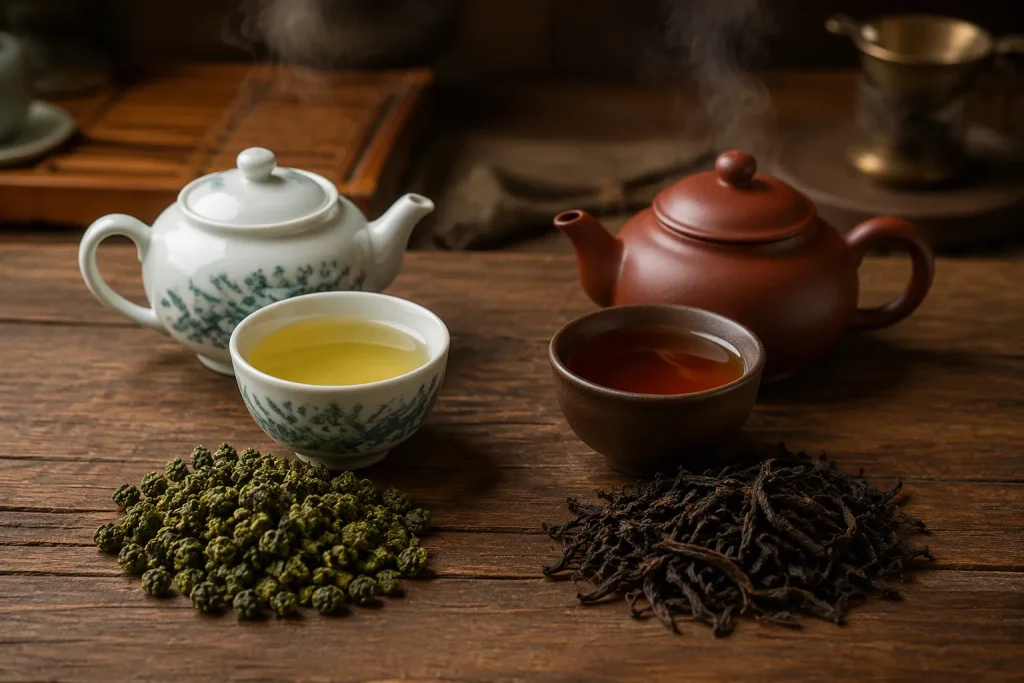
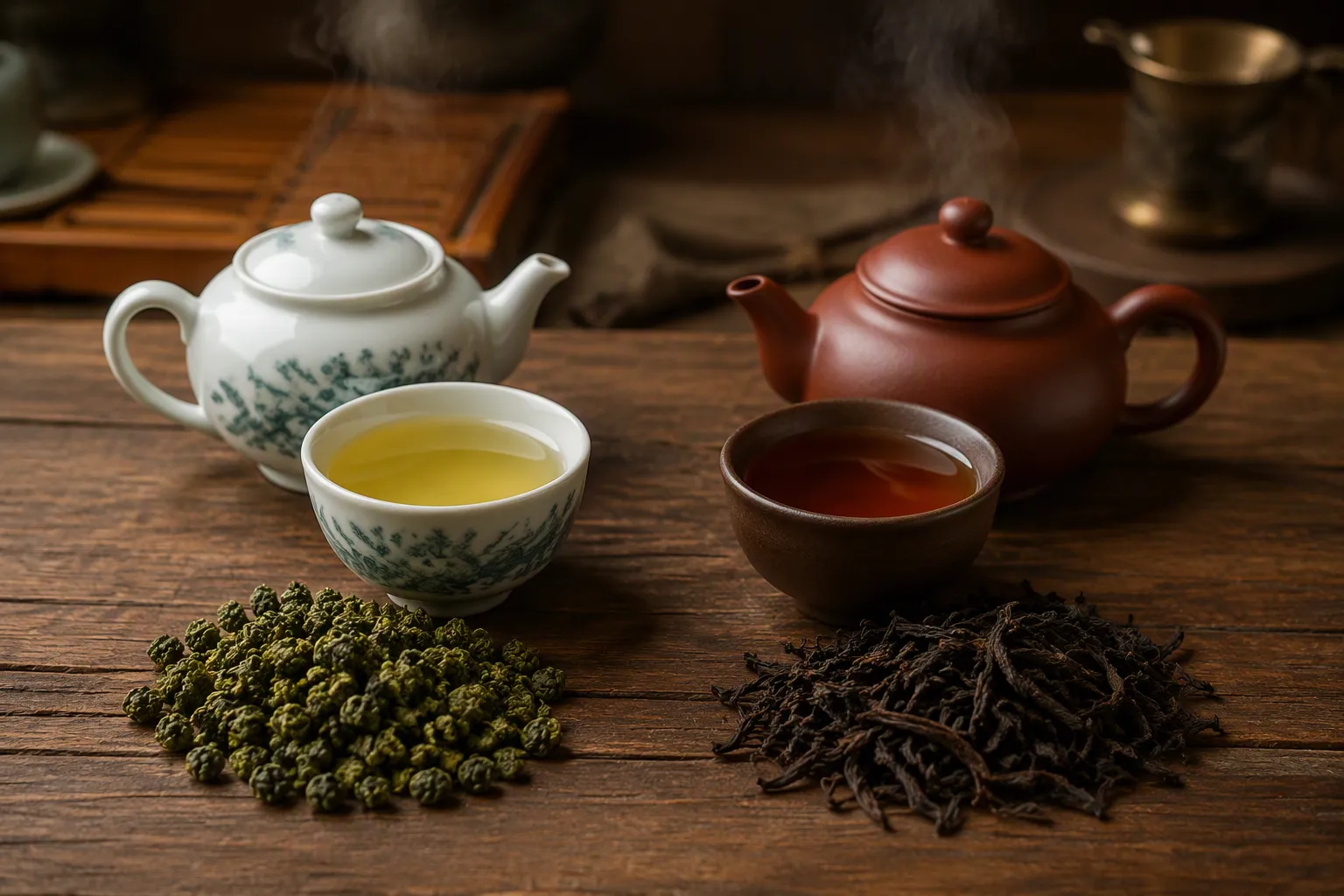
One sip of a Taiwanese high mountain oolong gives you a light, floral sweetness with a creamy finish. A Chinese oolong tastes deeper, roasted, and earthy. What makes these two styles of oolong tea taste and smell so different?
You will find the answer in two places. First, the growing environment shapes every leaf. Second, the processing method changes it. These differences set Taiwanese oolong tea apart from its Chinese cousins. Brewing also matters, especially in ceramic and clay teaware. The right cup can lift a high mountain oolong’s aroma or soften a roasted note.
Key Takeaways
Taiwanese high mountain oolong has a light taste with floral and creamy notes. This comes from the high altitude where it grows.
Chinese oolong has a deeper taste. It tastes roasted and earthy. This is because it grows at lower elevations and is roasted more heavily.
The way the tea is grown and made creates the main differences between these two oolong styles.
The temperature of the water and the material of your teaware change the smell and taste of your oolong tea.
Try both kinds to find out which one you like better and enjoy the many different oolong teas.
Why Terroir Shapes Taiwanese High Mountain Oolong
Altitude and Slow Growth
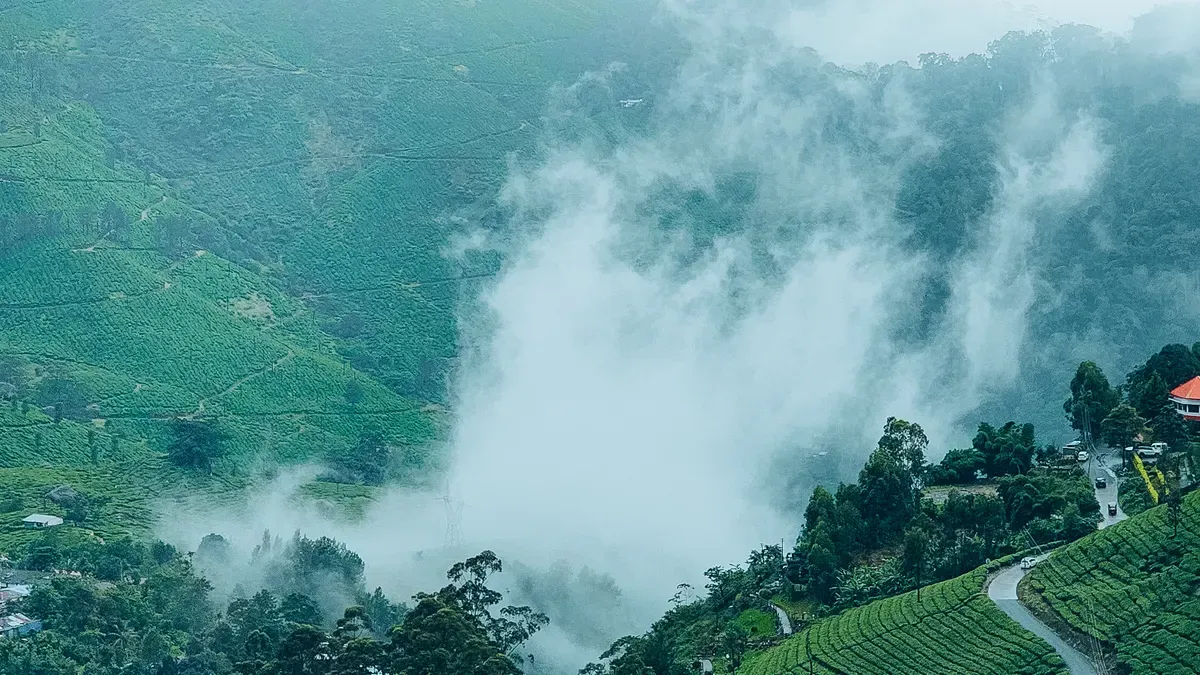
Taiwan’s high mountain tea regions sit at very great heights. Ali Shan covers 1,200–1,600 m, Li Shan goes up to 1,800–2,400 m, and Da Yu Ling rises above 2,400 m. The general high mountain label starts above 1,000 m. Compare this to Anxi Tieguanyin in China, which usually grows at 300–800 m. This height gap makes big differences in the growing environment.
Cooler temperatures at altitude slow down the tea plant’s growth cycle. The plant gets more time to make amino acids like L-theanine and fewer bitter catechins. One study found homoproline levels about 2.4 times higher in high-altitude leaves. You taste this as floral-honey sweetness and a brothy, umami quality. Lower-altitude teas make more polyphenols, which turn into astringency and bitterness. The slow-growth effect builds up sugars and amino acids, giving taiwanese high mountain oolong its signature softness.
Soft, Thick Leaves at Elevation
High mountain oolong tea leaves feel clearly different from their low-elevation cousins. The rocky soil and natural drainage lower the water content in the leaves. This packs flavor compounds into the sprouts that come out. The leaves also grow thicker, stronger structures full of essential oils. These oils hold more flavor and support many infusions.
Frequent mountain mist keeps leaves tender and slows water evaporation. This lets natural sugars develop more fully. The result is a creamy, silky mouthfeel typical of taiwanese high mountain tea. Low-elevation leaves hold more water, which waters down flavor and makes crafting harder. The physical differences in leaf structure directly shape the taste differences you feel in the cup. This terroir-driven contrast sets taiwanese oolong tea apart from Chinese styles grown at lower elevations.
Chinese vs. Taiwanese Oolong Growing Regions
China’s Diverse Terroirs
China grows its oolong tea in several different areas. Each place gives the leaves its own special character. Wuyi in Fujian Province has rocky soil full of minerals. This soil creates a special mineral “rock taste” called yan yun. Farmers twist the leaves into long, thin strands and roast them more to help them last. Anxi sits a little lower than Wuyi and closer to the coast. The soil there is richer, and the air is more humid. Growers roll and roast their oolongs to shrink the exposed surface and keep the tea fresh in that damp climate. Phoenix in Guangdong Province is a faraway area that only makes Phoenix dancong. Farmers grow tea from cuttings or clones to save the genes of the original trees. This method makes dancong, or “single grove,” teas with their own special flavors.
Taiwan’s oolongs, on the other hand, come from an island with many different landscapes. Rolling hills and fields cover the west, while rough mountains rise in the east. Differences in location and especially height create special local types. The first tea plants and rolled oolong methods actually came from Anxi County. Taiwan then went its own way.
Region | Terroir Characteristics | Processing Distinction |
|---|---|---|
Wuyi | Rocky, mineral-rich soil | Twisted wiry strands, heavier roast |
Anxi | Lower elevation, richer soil, higher humidity | Rolled and roasted for freshness |
Phoenix | Remote, unique dancong production | Cuttings or clones preserve genetics |
Taiwan high mountain | Diverse island, rugged eastern mountains | Rolled oolong from Anxi origins |
Scent of Species vs. Scent of Territories
You can think about chinese vs. taiwanese oolong in a simple way. Taiwanese high mountain oolong shows what some call the “scent of species.” The tea plant type itself drives much of the smell. Taiwan’s tight high-mountain zones let a few cultivars shine across many gardens. Chinese oolongs, meanwhile, show the “scent of territories.” Wuyi rock tea tastes of its cliffs. Anxi tieguanyin tastes of its coastal hills. Phoenix dancong tastes of its faraway groves.
Yan Cha (rock tea, yán chá) means rock tea; it is a name given to the teas of Wu Yi Shan because the tea plants there are known to thrive in the rocky soils of the area. This unique terroir is responsible for the “rock taste” that gives these teas their fame. Known as Yan Yun (rock rhyme, yán yùn) literally rock rhyme, this is a way of describing the distinctive aftertaste yan cha is famous for.
This difference matters when you taste oolong tea side by side. The differences between taiwanese vs chinese oolong start in the soil and the air. Neither way is better. Each one shows what the land gives.
Processing Differences in Chinese and Taiwanese Oolong Tea
Oxidation and Ball-Rolling
You will see a clear difference in how makers handle oxidation. Taiwanese high mountain oolong usually sits below 30% oxidation. Anxi Tieguanyin also often falls in that same range today. But the two teas still taste different. The gap comes from processing and terroir working together.
Taiwanese oolong tea makers ball-roll their leaves. They wrap the leaves in cloth and press them into tight pellets over and over. These compact balls open slowly across many steeps. Fujian-style oolongs like Wuyi Yan Cha use strip-rolling instead. That method makes long, twisted leaves. Phoenix Dan Cong also follows the strip-rolled path.
Oxidation Level | Tea Examples | Flavor Profile |
|---|---|---|
8–15% | Pouchong, very light high mountain oolong | Delicate, clean floral, honeyed |
Light oolong, some green-style Taiwanese oolong | Soft, creamy, mild floral sweetness | |
25–50% | Tie Guan Yin, high mountain oolong | Floral, orchid, creamy, light stone fruit |
50–70% | Dong Ding, Da Hong Pao | Roasted, caramel, dried fruit, woody |
70–80% | Oriental Beauty, Dan Cong | Honey, stone fruit, muscatel, complex |
Roasting and Leaf Structure
Roast levels make another big difference between chinese and taiwanese oolong tea. Taiwanese high mountain oolong gets very little to no roasting. This choice keeps bright floral and creamy notes. Anxi Tieguanyin covers a wide range. Some batches get light roasting for a green, floral style. Others get heavier roasting for a warm, toasty cup.
Leaf structure also sets these styles apart. Taiwanese high mountain oolong keeps stems attached as a whole-leaf system. Anxi Tieguanyin has stems removed. That one step changes how the leaf opens and releases flavor.
Chinese oolong teas show more variety across regions. Wuyi Yan Cha goes through heavy charcoal roasting in many rounds. Phoenix Dan Cong gets moderate to heavy roasting. These oolong tea processing methods shape the deep, roasted character you taste in chinese oolong. The elevation and cultivar set the base. Processing decides the final cup.
Taiwanese vs Chinese Oolong: Differences in Taste and Aroma
Floral, Creamy, Sweet Profile
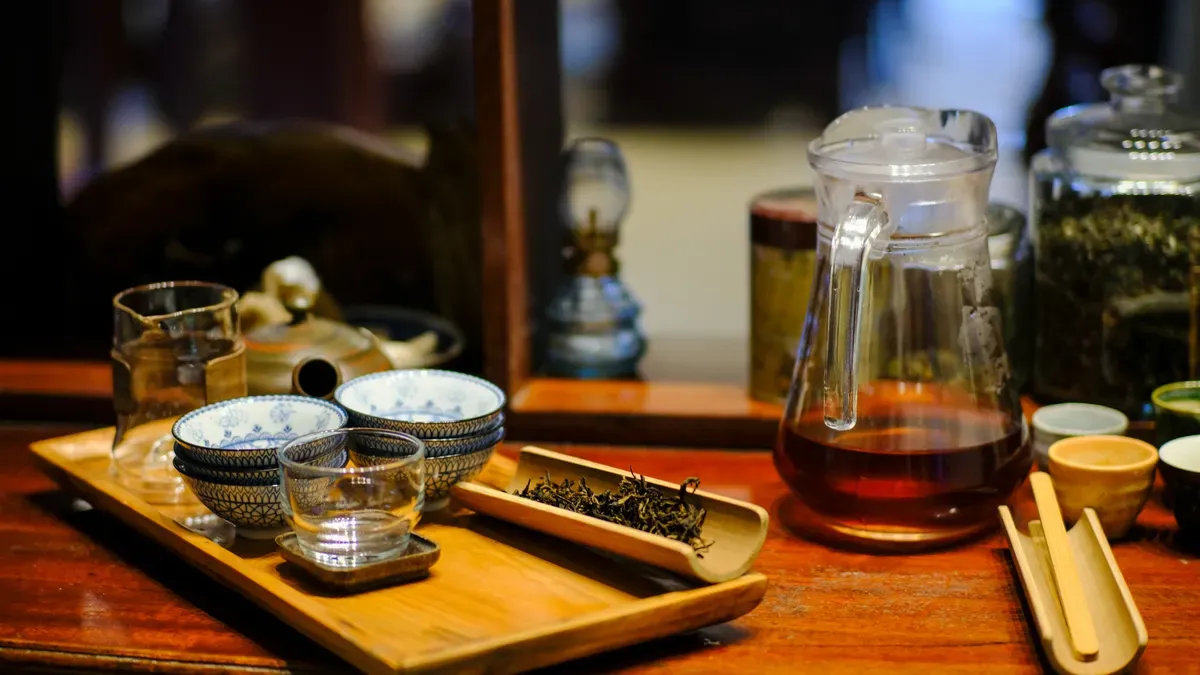
You notice the differences in taste and aroma right when a taiwanese high mountain oolong hits your tongue. The tea feels light and smooth. A pale golden color fills your cup. Orchid-like and jasmine smells come up first. Then a buttery, milky feel follows. This creamy quality comes from cultivars like Jin Xuan, which adds a natural milky note. The Qing Xin cultivar brings more delicate florals instead.
Alishan high mountain oolong tea, grown between 1,200 and 1,600 meters, shows these traits clearly. You taste a sweet finish that stays with you. Stone fruit hints show up — peach or apricot — with a little honey too. The height slows how the leaf grows. That slow growth packs in amino acids and sugars. The result is that soft, silky feel you get across your palate.
Flavor/Aroma Category | Characteristic Notes |
|---|---|
Floral | Orchid-like or jasmine notes |
Creamy | Buttery, milky textures from cultivars like Jin Xuan |
Fruity | Sweet hints of stone fruits, honey, or citrus |
Nutty or Roasted | Warm, toasty depth found in darker, roasted oolongs |
This flavor and aroma profile stays the same across Ali Shan, Li Shan, and Shan Lin Xi. Each mountain brings its own terroir signature. Yet the main character stays clean, fresh, and floral. You can steep these leaves many times. The ball-rolled shape opens slowly. Each infusion shows another layer of sweetness.
Roasted, Earthy, Robust Profile
Now turn your attention to chinese oolong. The cup feels heavier. The aroma fills the room before you even take a sip. Wuyi Yan Cha leads this style. Its mineral-rich soil creates a special yan yun, or rock flavor. You taste wet granite, roasted nuts, and dried fruit. A light smokiness moves through the finish. Da Hong Pao shows this depth perfectly. Golden Peony brings more floral notes, yet keeps rich roasted undertones and lasting citrus.
The roast level shapes everything in chinese oolong tea. Light roast gives you bright, green-vegetal notes with floral freshness. Medium roast adds stone-fruit depth and toasted almond. Dark roast brings dark chocolate, caramelized sugar, and a rich body. Charcoal-roasted versions layer gentle smoke over mineral notes.
Roast Level | Taste Profile | Aroma Profile |
|---|---|---|
Light roast | Bright, green-vegetal, smooth, creamy | Floral and fresh |
Medium roast | Stone-fruit depth, toasted almond, rounded body | Tropical fruit, honey-like fragrances |
Dark roast | Robust, dark chocolate, roasted nuts, caramelized sugar, smoky, cocoa-like bitterness, burnt sugar, rich body | Roasty, smoky, nutty, resinous, subtly smoky |
Charcoal-roasted | Deep, layered, gently smoky, mineral-rich | Nutty, resinous, subtly smoky |
Specific aroma compounds drive these roasted notes. 2,5-dimethyl-pyrazine creates that roasted peanutty quality in Wuyi rock teas. Other pyrazines like 2-ethyl-3,5-dimethylpyrazine and 3,5-diethyl-2-methylpyrazine add important roasted odors. These compounds form during the roasting process. They give chinese oolong its deep, earthy character.
When you compare taiwanese vs chinese oolong side by side, the contrast becomes clear. One lifts you up with floral sweetness. The other grounds you with roasted depth. Neither style is better. Each one shows what its growing region and processing method create. The differences between chinese and taiwanese oolong tea come down to elevation, oxidation, and roast. Your personal preference decides which cup you reach for.
Examples That Show the Contrast
High Mountain Oolong vs Wuyi Yan Cha
You can clearly taste the difference when you compare a taiwanese high mountain oolong with chinese wuyi yan cha. A high mountain oolong from Li Shan or Alishan gives you orchid flower notes and a creamy, milky sweetness. The flavor stays light and smooth even after you brew it many times. Now try a Wuyi rock tea like Da Hong Pao. You taste roasted toast, sweet caramel, and jammy currants. The mouthfeel becomes drying and full of minerals. This mineral quality comes from the rocky soil of the Wuyi area. Tea drinkers call it yan yun, which means rock rhyme.
Shui Xian is another well-known Wuyi Yan Cha. It has a strong, sharp smell that some people say is like a farmyard. The tea feels bold and thick. It covers your whole tongue. A long roasted charcoal taste stays with you. The first brews of any chinese wuyi rock tea have strong roasted notes. Later brews bring out floral, sweet, fruity, and mineral layers. This change is different from taiwanese oolong tea, which starts with floral notes right away. The table below sums up these main differences.
Attribute | Taiwanese High Mountain Oolong | Wuyi Yan Cha |
|---|---|---|
Taste | Floral, sweet, creamy, no bitterness | Stone fruits, spices, roasted charcoal, mineral |
Aroma | Orchid, creamy, milky | Leather, tobacco, cinnamon, roasted toast |
Mouthfeel | Creamy, smooth, coating | Crisp, mineral, drying, full-bodied |
High Mountain Oolong vs Anxi Tie Guan Yin
Anxi Tieguanyin gives you another helpful comparison. This tea comes from Anxi County in Fujian. Modern Qing Xiang style Anxi Tieguanyin uses light oxidation and very little roasting. This method focuses on smell. The tea gives off a big floral scent with strong orchid and lilac notes. You also taste a soft vegetal sweetness and a clean, fragrant finish. The mouthfeel feels juicy but can sometimes be a bit thin.
A taiwanese high mountain oolong shares some floral qualities. But the terroir and height create real differences. Taiwanese high mountain oolong brings a smooth creaminess and a sweet aftertaste. The Jin Xuan cultivar adds a natural milky note. The Qing Xin cultivar offers more delicate, subtle florals. Anxi Tieguanyin has its stems removed during processing. Taiwanese high mountain oolong keeps stems attached as a whole-leaf system. This difference in structure changes how each tea opens and releases flavor. Both styles show how processing and origin shape the final cup. You can explore these taiwanese vs chinese oolong contrasts with Phoenix Dancong too, which brings its own special character.
Brewing Oolong in Clay and Ceramic Ware
Water Temperature and Steeping
Water temperature controls which things end up in your cup. Amino acids that make sweetness and umami come out best between 140–175°F (60–80°C). Floral smell compounds need medium temperatures to show up well. Tannins and caffeine come out more fully above 175°F (80°C). This balance shapes your final cup.
Light oolong tea works well at 180–190°F (82–88°C). This range brings out floral, creamy, and fruity notes. Dark roasted oolong needs 190–205°F (88–96°C) to pull out toasted, nutty complexity. A taiwanese high mountain oolong falls in the lighter group. A chinese oolong like wuyi yan cha or anxi tieguanyin often needs the higher range.
Steeping time works together with temperature. Higher temperatures pull out tannins faster. You need shorter steeps of 2.5–3 minutes to avoid astringency. Lower temperatures need longer steeps of 3–4 minutes to pull out floral compounds. For gongfu brewing, start with 20–30 seconds and add 5–10 seconds each infusion.
How clayesouk Ceramic Cups Shape Aroma
Your cup material changes how you feel flavor and aroma. Porous clay soaks up smelly compounds. This lowers aroma strength but softens harsh notes. The tea feels smoother and more rounded. Vitrified porcelain and glass keep aroma true. They give nothing and take nothing away.
“Initial reaction is that the tea is smoother less harsh from the clay. The glass tea seems sharp. I’m getting more aroma on the nose from the glass.”
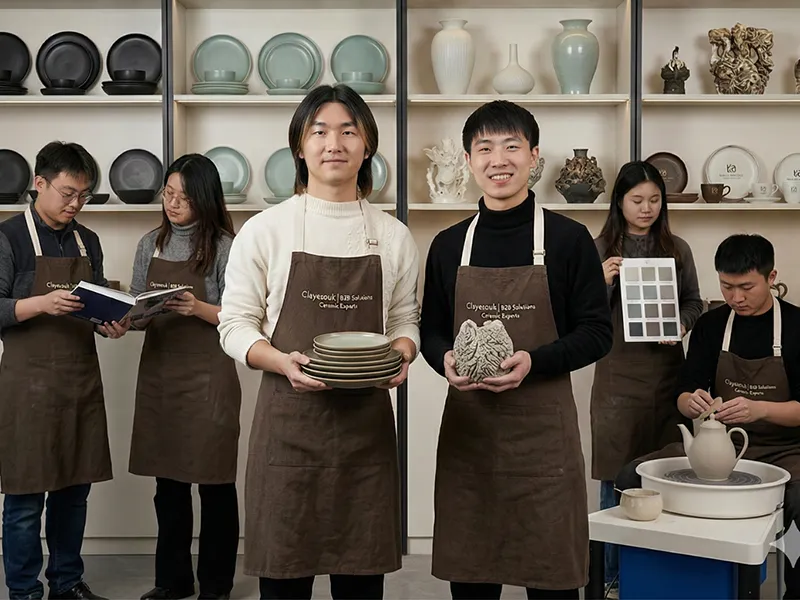
clayesouk handmade ceramic cups from Jingdezhen offer a middle path. Jingdezhen holds over 1,700 years of ceramic heritage. The brand’s artisans bring more than a decade of experience to each piece. These cups suit tea lovers who value traditional craftsmanship. The vitrified ceramic keeps the terroir-driven character of your oolong tea. You taste the floral lift of taiwanese oolong tea or the roasted depth of chinese oolong without interference. Each cup works as a piece of art for daily brewing.
Taiwanese high mountain oolong tastes light and sweet, with floral notes. Chinese oolong tastes deeper, roasted, and earthy. Terroir and processing methods cause these differences. Your own taste should decide what you pick. Try both kinds and find out which one you like.
You can also brew the same oolong tea in different vessels. A 60 ml gaiwan works well for any type. Rolled oolong fits most pots. Twisted leaves need more space. Each cup changes the aroma in its own way.
Taiwanese oolong tea and wuyi yan cha show how varied oolong can be. Anxi tieguanyin adds another layer. Explore taiwanese high mountain and high mountain oolong with an open mind. Celebrate how many kinds of oolong exist.
FAQ
What makes Taiwanese high mountain oolong taste so light and floral?
Growing at high altitudes slows down how the tea plant grows. This gives amino acids and sugars time to build up in the leaves. You taste this as a sweet floral-honey flavor with a creamy, silky feel. The ball-rolled shape also opens up slowly, so each steep gives you gentle layers of flavor.
Why does chinese oolong often taste roasted and earthy?
Roasting is what creates those deep flavors. Wuyi rock teas get heavy charcoal roasting through many rounds. This makes compounds like pyrazines that give roasted, nutty, and mineral tastes. The rocky soil adds a special mineral quality called yan yun.
How does anxi tieguanyin differ from Taiwanese high mountain oolong?
Anxi tieguanyin has its stems taken off during processing. Taiwanese high mountain oolong keeps stems on as a whole-leaf system. This changes how each tea opens up and lets out flavor. Roast levels also differ more in Anxi tieguanyin, from light and floral to warm and toasty.
Does the cup I use really change how oolong tea tastes?
Yes. Porous clay softens harsh notes and makes the body feel more rounded. Vitrified porcelain and glass keep the aroma true without adding or removing anything. Each material shapes your experience in a different way. Try the same tea in both to feel the difference.
Can I brew Taiwanese and Chinese oolong the same way?
Not exactly. Light oolong like Taiwanese high mountain tea works well at 180–190°F. Dark roasted chinese oolong needs 190–205°F to bring out toasted complexity. Start with shorter steeps and add time with each infusion. Adjust based on what you taste.