Many people think filtered water is the normal choice for making tea. Yet some tea enthusiasts prefer tap water, and their reasons deserve a fair look. Three points come up often. Minerals in tap water can boost flavor. People often misunderstand what chlorine does when water boils. Cost and convenience matter too. Filtered water removes impurities, and that works for many drinkers. Still, the choice is not settled. Both options have real value. You will find thoughtful people on both sides. Each one shapes the cup in a different way, and the flavor you notice depends on what you value.
Key Takeaways
Tap water has minerals in it that can make tea taste better and feel fuller in your mouth.
Boiling takes out free chlorine, but chloramine remains and can change the taste.
Water hardness is different from place to place, and it changes how tea brews.
Filtered water takes out impurities and works well for delicate teas, but it may not have minerals.
Try both tap water and filtered water with the same tea to find the cup you like best.
Why Tea Enthusiasts Prefer Tap Water
Minerals and Tea Flavor
Here is the surprising part. The minerals dissolved in tap water really do something in your cup. Calcium and magnesium mix with tea compounds, and that mixing can smooth out flavor in ways purified water cannot. Magnesium sticks to flavor molecules better than calcium does, and many drinkers notice a fuller, richer brew because of it. Minerals also help pull out taste ingredients such as glutamic acids, which can boost the savory taste of a green tea brew.
The picture is not one-sided, though. High calcium levels can bind with pectin in the leaves and cut down on how much soluble solid gets pulled out. Calcium also reacts with organic acids and can form tea cream and sediment. A 2019 study by Franks and colleagues in Nutrients found that water type greatly changed the sensory properties of green tea, and tap-water brews came out cloudier and darker. That same study noted that brewing with purified water could roughly double EGCG content compared with tap water. So if you brew for health-related compounds, filtered water has an edge. If you brew for taste, the minerals may work in your favor.
Hard Water and Regional Differences
Water quality changes a lot from one place to another, and water hardness is the clearest example. The standard scale sorts supplies by calcium carbonate content:
0 to 60 mg/L is soft; 61 to 120 mg/L is moderately hard; 121 to 180 mg/L is hard; and more than 180 mg/L is very hard.
Soft water can pull out too little tea flavor. Moderately hard water often gives the best balance for tea brewing. Very hard water turns the liquor cloudy and leaves a film on the surface. The EPA notes that hard water is most common in the Southwest and Midwest, especially in homes on groundwater. Arizona and Nevada often run 200–350+ ppm, while Maine and New Hampshire sit around 20–100 ppm. That gap explains why two tea enthusiasts prefer tap water for opposite reasons — one gets plenty of minerals, the other gets a gentler profile. Neither is wrong. Your local supply simply sets the starting point, and you adjust from there.
Chlorine and Tea
Chlorine During Boiling
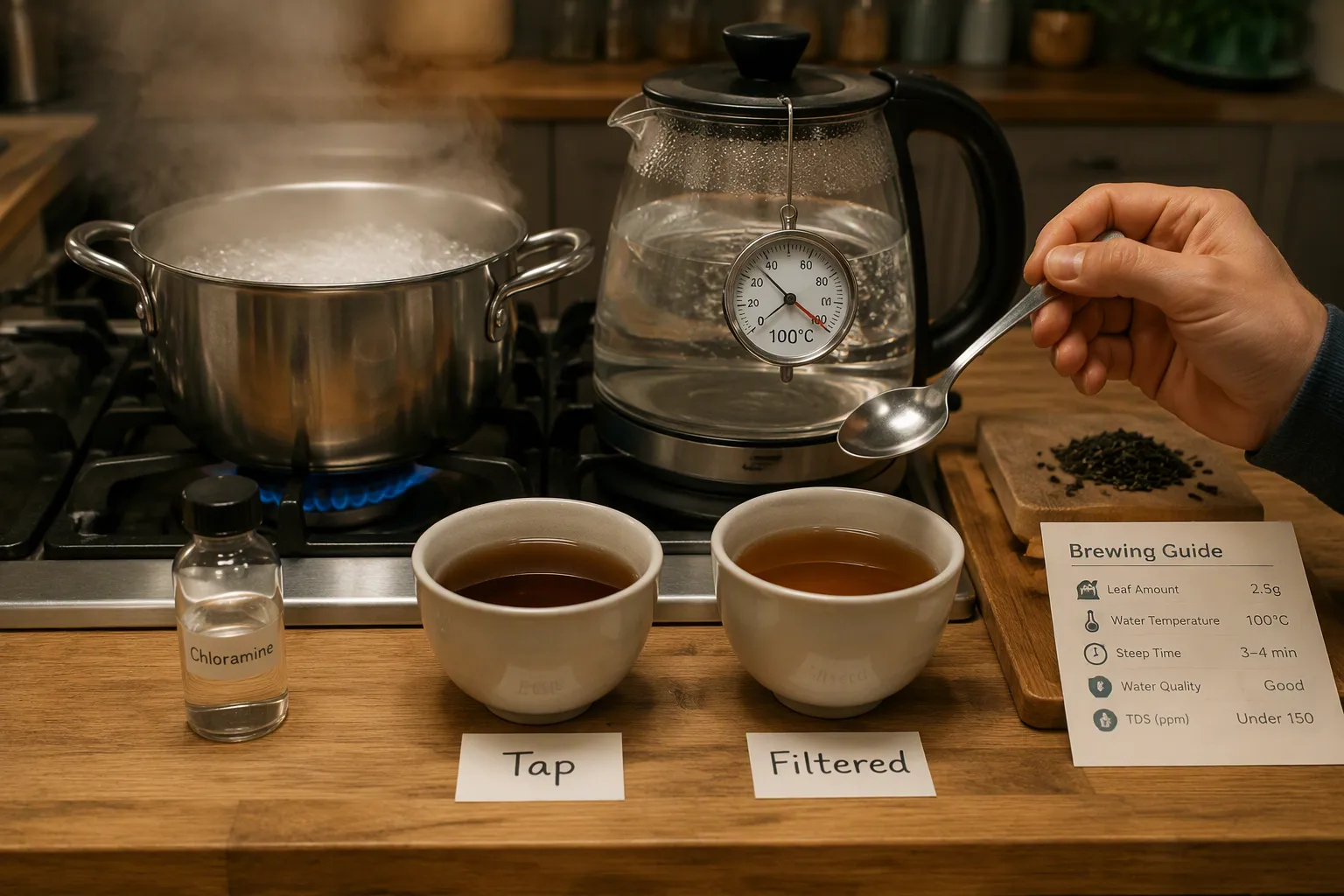
Chlorine acts in a way you might not expect when you heat your water. At 100°C, chlorine basically cannot stay dissolved, so just getting to a boil should push most of it out. It starts to fade above about 20°C, and the hotter it gets, the faster and more fully it leaves. Tap water kept overnight at 30°C had no free chlorine left by morning. If your goal is to remove it, heating to 40–45°C may be enough. A rolling boil for 15–20 minutes removes a large amount of it.
Chloramine is a whole different case, and this is where the usual belief falls apart. Chloramine holds steady at boiling temperatures and can last for hours or days. It also keeps a clear taste and smell. So if your local supply uses chloramine, boiling won’t get rid of it.
Aspect | Free Chlorine | Chloramine |
|---|---|---|
At boiling point | Turns into gas and escapes into the air | Stays stable |
Time to dissipate | 15–20 minutes of rolling boil for a big reduction | Hours or days |
Residual note | Very little | Distinct |
Chlorine and Certain Teas
How people sense it matters here, and drinkers disagree on this point. Some think chlorine fits certain teas or goes unnoticed in them. Others find it unpleasant in the cup. A strong roasted oolong or a bold black tea can cover up a faint chemical note. A delicate green tea may let it show clearly.
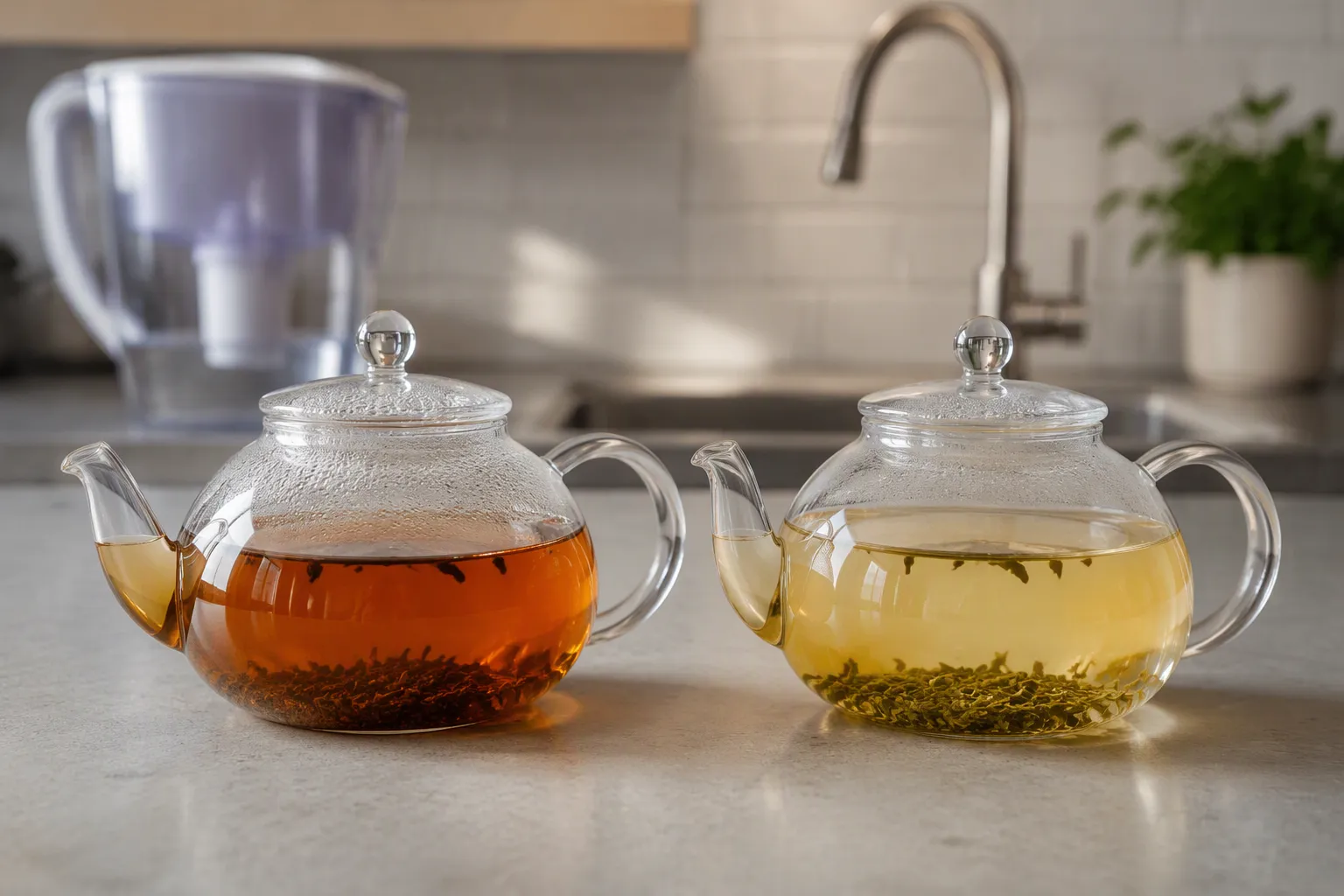
Try a side-by-side test with the water you normally brew with. Make one cup with freshly boiled tap water and another with filtered water. Compare the smell, the taste, and the finish. Some blind tastings find no difference you can detect at all. Others show a clear gap. Your local water quality and how sensitive you are decide the result.
Flavor is the true test. Once it turns to gas, it leaves very little taste behind, so boiled water often tastes clean. Chloramine water, on the other hand, keeps its flavor mark through the boil. Light, floral teas bring out delicate flavor notes, and any bad note stands out. Dark, roasted teas carry more flavor weight of their own. A quick sniff of your hot water tells you a lot before you even add leaves. Sip the water plain first. Your tea will taste like whatever base you pour.
Tap Water vs Filtered Water Performance
Extraction Efficiency
Extraction works differently depending on your base water. Tap water carries minerals that help pull compounds from the leaves. Filtered water strips many of those minerals out, so the leaves give up their contents at a different rate. Reverse-osmosis filtered water removes almost everything, and ro water can leave a tea tasting flat or thin. Distilled water behaves much like ro water here. You get clean extraction, but you lose the mineral push that rounds out flavor. Filtered water also removes the trace elements that build body. The leaf still releases caffeine and catechins, yet the brew can feel hollow on the tongue.
Some blind taste tests find no detectable difference between the two. That result surprises people. Filtered water does remove impurities and excess minerals, and that matters for consistency. Still, a well-made cup from tap can match a filtered one. Your palate and your local water quality decide the outcome. Neither option wins every time. A trained tongue may catch a gap that a casual drinker misses. That gap often comes down to minerals, not purity.
Speed matters too. Soft water pulls flavor fast, and a short steep can taste weak. Hard water pulls slower, and you may need a longer steep to reach the same strength. Adjust your timing and you close much of the gap. This is the practical side of brewing that few guides mention.
Matching Water to Tea Style
The right base depends on what you brew. Light green teas and delicate whites show off soft, low-mineral water. Bold blacks and roasted oolongs handle harder tap water without losing their character. This is where the process becomes personal. You match the water to the leaf, and the cup improves. A floral oolong with heavy minerals can taste muddy. The same leaf with soft water can taste bright and clean. A filtered water base suits light leaves best.
Here is a practical angle. clayesouk‘s handmade ceramic cups from Jingdezhen are designed to let tea flavor come through, so your water choice and your vessel work together in tasting. A good cup does not hide a thin brew. It shows you what the water did. That honesty helps you learn.
Think about coffee and tea’s taste side by side. Both drinks depend on water chemistry. Coffee and tea taste better when the base supports the bean or leaf. Quality filtered water gives you a repeatable starting point. Ro water gives you a blank slate. Ro water also removes the chlorine question entirely. Tap gives you character. Each one fits a different drinker. A dark roast and a roasted oolong both like a base with some body. A delicate white tea and a light roast both prefer a cleaner base. That is why better-tasting coffee and tea often starts with matching the base to the drink.
You can test this yourself. Brew the same tea with tap and with filtered water. Use the same leaf, the same temperature, and the same steep time. Then compare. Some days the tap cup wins. Other days the filtered cup does. That is the honest result, and it keeps the hobby interesting. Keep notes on your water quality and your results. Over time you will see a pattern, and that pattern becomes your own guide. Add a touch of flavour contrast by trying a second leaf with the same base.
Safety, Cost, and Convenience of Tap Water
Regulatory Compliance and Local Quality
You can trust the rules behind your tap water. The Safe Drinking Water Act lets the EPA set minimum standards, and public water systems must meet the health-related ones. Those National Primary Drinking Water Regulations limit more than 90 contaminants. Secondary standards cover 15 chemicals that affect taste, color, and smell, but utilities don’t have to follow them. So your water quality depends on where you live. Mountain reservoir systems often run cleaner than river or groundwater supplies. Older cities may still have lead service lines. Check your local water quality report before you brew.
The Practical Appeal
Turn on the faucet and you have your base in seconds. Tap water costs little or nothing, and that simplicity appeals to many drinkers. Some use a pitcher filter like Brita and see no reason to pay for pricier filtration. That’s a fair call. Filtered water removes impurities and excess minerals, and it suits delicate leaves. Still, tap gives you character for free. The taste of water shapes every cup, so test both with your own tea. Try the same leaf with tap and with filtered water, then compare. Some days tap wins. Other days filtered water does. That honest result keeps tea brewing interesting. Your choice comes down to local water quality and your own palate.
Flavor is the real test. Ro water strips everything, and ro water can taste flat. Many drinkers find ro water too empty for tea. Ro water also removes the minerals that build body. So ro water suits some setups, yet it isn’t the only answer. Coffee and tea’s taste both depend on the base. Coffee and tea’s taste shifts with hardness. Better-tasting coffee and tea starts with matching base to leaf. Coffee and tea taste better when you test both. Filtered water gives you a repeatable start, and filtered water suits light leaves. A filtered pitcher works fine too. Test your water quality at home, then try filtered water last. Flavor drives the choice, and flavor varies with your base. Water alone can shift flavor.
Filtered water keeps helpful minerals while taking out things you don’t want. Tap water has its own character, and carbon-filtered tap works fine for everyday drinking. Your taste and your local water quality make the call.
Try the same tea the same way with each water, then do a blind taste test. The water you use changes flavor in small ways. Test your water at home, because water quality differs by region. Water quality guides your choice.
Some tea enthusiasts like tap water. Others pick filtered water every time. So tea enthusiasts choose tap water for its minerals and flavor, and filtered water works well for delicate tea leaves. Compare filtered water with tap and enjoy.
FAQ
Is tap water safe for brewing tea?
In the U.S., the Safe Drinking Water Act requires public water systems to meet EPA health standards for more than 90 contaminants. Your local water quality still matters, though. Check your utility’s yearly water quality report before you brew. Most tap water works fine for tea. Old plumbing can add lead, so test if you are unsure.
Does boiling water remove chlorine?
Mostly, yes, for free chlorine. It turns into gas and leaves the water as it heats. Chloramine is different. It stays stable through a rolling boil for hours or days. Ask your utility which one it uses. If your water contains chloramine, boiling alone won’t clear it from your brewing water.
Does hard water ruin tea?
Not always. Moderately hard water often gives the best balance for tea. Very hard water turns the liquor cloudy and leaves a film. Soft water can pull out too little flavor. Your local water hardness sets the starting point. Adjust your steep time and your tea choice to match the water you have.
Is filtered water worth it for tea?
It depends on your goals and your local water. Filtered water removes impurities and excess minerals, and it suits delicate green and white teas. Tap water keeps minerals that build body and round out flavor. Some blind tastings find no detectable difference. Try both with the same leaf and let your own taste decide.
Can I just use a pitcher filter instead of a full system?
Sure. Many drinkers use a pitcher filter like Brita and see no reason to pay for pricier filtration. That is a fair call. A pitcher filter reduces chlorine and some minerals in your water. It won’t remove everything, but it gives you a repeatable base for brewing. Test it against plain tap water side by side.