

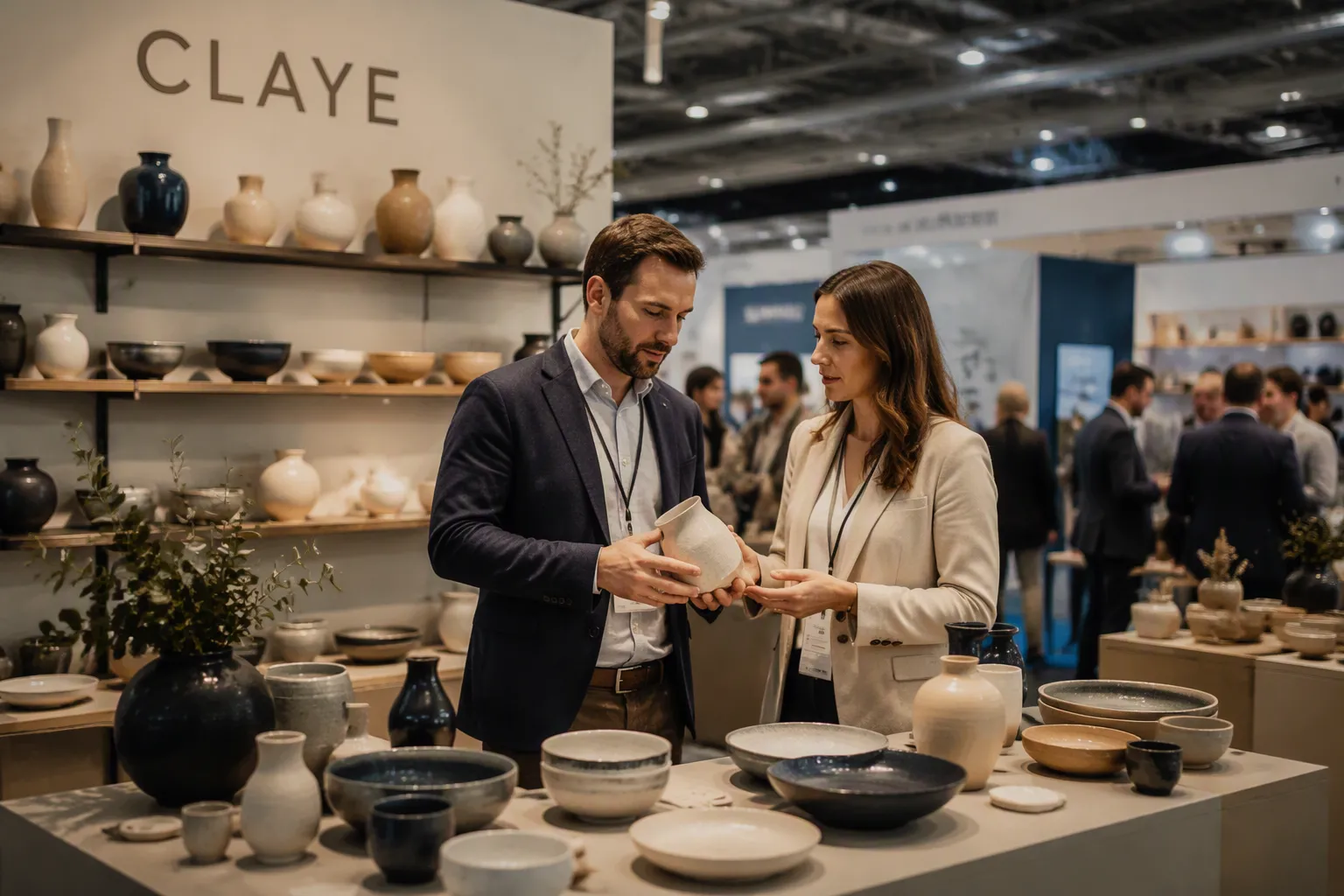
Trade shows give you one room to meet, check out, and make deals with ceramic suppliers face to face. CLAYE makes that trip smoother, from your first contact to a signed partnership.
Searching for suppliers online wastes your time. You wait for samples, guess at how much they can make, and have a hard time checking if they are really qualified. The risk adds up fast.
The Business Show London reports that the average exhibitor gets about 182 leads over a two-day event. That number shows how much you can get done in person.
A clear plan helps: make your target list, ask smart questions at each booth, and count on CLAYE for matching and follow-up. Wholesale buyers and retailers both win when they plan ahead.
Key Takeaways
Trade shows let you meet many ceramic suppliers in person in one place. This saves time and builds trust faster than online sourcing.
Make a target list and know your product and volume needs before the show, so every booth visit counts.
Ask suppliers about how much they can produce, how long orders take, and what quality certifications they have. This helps you tell real makers apart from resellers.
Don’t make common mistakes like skipping follow-up or chasing low prices; focus on quality and fit for long-term partnerships.
CLAYE helps you before, during, and after the show with matching, vetting, and follow-up. This helps you secure reliable wholesale partners.
Why Trade Shows Beat Online Sourcing

Industry sourcing research shows that trade shows are a cost-effective way to meet customers, prospects, and suppliers in one place. You walk one hall and shake hands with dozens of qualified contacts. Online sourcing cannot match that many chances in one spot.
Budget planning stays predictable. Most exhibitors spend somewhere between $20,000 and $150,000, depending on exhibit size, host city, and booth construction. Two simple rules help you estimate:
Total show costs average about three times the cost of exhibit space, so a $20,000 space rental means a total budget of about $60,000.
Booth space usually runs $100 to $150 per square foot, so a 10′ x 10′ booth costs about $10,000 to $15,000.
Touch, Test, and Verify in Person
Online sourcing slows you down at every step. You wait days for sample shipments, struggle to confirm real production capacity, and chase documents across time zones. Checking facts becomes a guessing game.
A booth visit removes that friction. You lift the cup, check the glaze under real light, and read body language across the table. Human communication relies heavily on nonverbal signals, and face-to-face contact lets you read them fast. One sourcing team reported that talks which once took several weeks of emails were finished in just one meeting.
Faster Trust and Real Negotiation
Trust forms quickly when you meet in person. In-person communication is widely described as the best way to build human trust. That matters when you compare wholesalers and weigh long-term commitments.
The numbers back this up. Freeman’s 2025 commerce study found that 57% of attendees say hands-on demonstrations help solidify purchase decisions, 51% say speaking with subject-matter experts improves decision certainty, and 70% say events make it easier to advocate internally for a purchase. CEIR research also shows 81% of attendees have buying authority. You spend your day with decision-makers, not gatekeepers.
For importers and retailers, show selection directly shapes sourcing efficiency and partner quality. The right event puts serious wholesale buyers and wholesale customers in front of you. It also beats generating new leads through cold outreach, where most messages go unanswered. Strong leads come from conversations, not inboxes.
Know Your Wholesale Trade Shows
Wholesale trade shows are private events for businesses that buy goods to resell, not for personal use. You need that filter. A consumer fair fills the hall with casual shoppers. An industry trade show fills it with people who have real buying power.
The Difference Between Trade Shows and Consumer Shows
Learn the difference between trade shows and consumer shows before you book travel. B2B events only let industry professionals in. You show proof of business affiliation or pay a registration fee. Consumer shows open their doors to the general public, and no professional qualification is required.
A business-to-consumer show attracts visitors who may browse, compare, and buy for personal use. A B2B trade exhibition attracts professionals who assess products for resale, distribution, private label, or category expansion.
That distinction shapes your whole day. You meet relevant buyers in the industry, including distributors, marketplace teams, and wholesalers or retailers who understand sell-through and channel pricing. You write orders on the floor at wholesale pricing. You also network with buyers who hold signing authority. Remember the difference between trade shows and consumer shows when you set goals: one rewards browsing, the other rewards negotiation.
Picking the Right Show for Ceramic Wholesale
Ceramic-specific expos serve businesses that target other businesses. You meet suppliers, studio owners, and retailers in one hall. These wholesale events let you compare glaze work and production capacity side by side.
Budget shapes your choice. A regional show runs roughly $10,000–$25,000 total for booth space, basic design, freight, and two staff. A mid-size presence at a major national show runs $40,000–$120,000 or more. Hold a contingency of 15–20% above your line-item total. Booth fabrication, drayage, and last-minute service orders cause the biggest swings. Trade shows reward the buyer who plans the numbers first.
Prepare Before the Show
Define Product and Volume Needs
You can’t judge a supplier without a clear plan. Write down the exact products you need before you travel. List the cup types, glaze finishes, sizes, and packaging formats that fit your shelves. A handmade ceramic master cup and a hand-painted blue and white porcelain tea cup have different prices and attract different shoppers. Your plan keeps every booth talk on track and stops you from collecting catalogs you will never use.
Set your volume ranges next. Decide a starting order quantity, a realistic yearly forecast, and a top limit you will not cross. Wholesale buyers who bring numbers get clear answers about minimum order quantities, lead times, and wholesale pricing tiers. Suppliers respect a buyer who knows the difference between a test order and a full production run. Compare those numbers against your storage space and your cash flow. A large minimum order looks cheap per unit until the stock sits unsold for a season. Print the plan and keep a copy on your phone.
Build a Target List and Schedule
Build your target list from the exhibitor directory, not from the show floor. Pick ceramic wholesale suppliers that match your product plan and your volume range. Rank each one as a must-see, a maybe, or a skip. Retailers and importers who do this research walk in with a plan instead of a pamphlet. Two hours of planning at your desk saves half a day of wandering.
Map the hall layout and group your must-see booths by aisle. Book meetings with your top suppliers before the doors open. Leave gaps between meetings for walk-ups and sample handling. Confirm each meeting by email and note the booth number in your calendar. A tight schedule with no buffer drains your energy by midday. Save the last hour of each day for notes and business card sorting. Suppliers who reply fast before the show usually reply fast after it.
Evaluate Partners at Trade Shows and Exhibitions

A talk at a booth is your best chance to tell real makers apart from resellers. Use trade shows and exhibitions to test what suppliers claim, not to gather brochures. Asking the right questions and watching for warning signs can turn a quick chat into a lasting partnership.
Questions That Reveal Capacity
Start with size. Ask if the maker can raise output to match your order amounts. Then ask for business registration details and the factory address, plus production photos. A video factory tour or a live inspection proves the site is real. Ask about monthly production capacity and the average lead time. Request the quality inspection process and a list of major export markets. Reference customers or a verified transaction history complete the picture. These questions work at any industry trade show, and they work fast.
Paperwork matters just as much. Ask for the quality manual, ISO 9001 certification, inspection procedures, AQL requirements, and product tolerance standards. Request packaging specs and production records. Clear records show how the supplier checks quality and fixes problems. A structured system covers raw material control, forming, glazing, firing, decoration, inspection, and packaging.
Red Flags to Watch For
Some signals should end the talk. A real maker shows its business license within 24 hours. Excuses about a “renewing” license point to hiding something. Prices far below market deserve a closer look: most suppliers quote $8–$12 for 12-piece ceramic dinnerware sets, so a $3.50 quote points to bad product or a bait-and-switch. Lead-free glazes and food-grade certification cost real money.
A buyer picked a supplier quoting 37% below the market average and skipped sample testing, factory visits, and certificate checks. The result was a 22% leak and defect rate, a second container that never shipped, and a full loss with no payment protection.
Refusing a live video factory tour is another warning. A real factory allows a short walkthrough showing running equipment, workers, and QC areas. Check test reports through SGS, Bureau Veritas, Intertek, or TÜV portals. Reports should be recent, issued to the specific factory, and cover the exact SKU. Pressure to pay outside Trade Assurance takes away your dispute recourse. Vague answers about sample quality control or hidden subcontracting also raise concern, especially for food-contact ceramics.
Walk the floor of trade shows and conferences with a comparing mindset. Compare glaze quality and firing process across exhibitors. Build real-time price bands and spot outliers. Ask which factories do in-house casting versus outsourced work. Confirm compliance with CE or local equivalents. Book follow-up appointments before you leave. Many events are attended by businesses with signing authority, so a booth talk can become a sales meeting. Buyers, retailers, and wholesale suppliers all gain from this discipline. Treat wholesale pricing talks as the start of a wholesale relationship, and let wholesale terms guide your decision.
How clayesouk and CLAYE Help You Secure Partners
clayesouk connects you with a partner that has deep roots in ceramic craft. The brand works out of Jingdezhen, a city with more than 1,700 years of porcelain history behind its kilns. Its artisans each have over 10 years of hands-on experience. That background matters when you need a wholesale supplier who understands quality at the source.
The product range covers the pieces your shelves and clients demand. You can source the Handmade Ceramic Master Cup, the Handmade Ceramic Coffee Cup, Handmade Ceramic Mugs, and Hand-Painted Blue and White Porcelain Tea Cups. Each line uses traditional techniques and modern looks. CLAYE also offers custom ceramic design services. You can adjust patterns, glazes, shapes, and sizes to match your market. Full after-sales support covers product care guidance and fixes for quality problems.
Credibility backs every order. CLAYE is recognized as a national-level ICH productive protection demonstration base. Several works have been chosen as national gifts. Products meet international quality standards. These markers give you confidence when you present the line to your own wholesale customers.
Pre-Show Matching and Research
CLAYE supports you before you book a flight. The team helps you define your product and volume needs, then matches you with the right ceramic lines. You get research on glaze styles, firing methods, and capacity before you walk the hall. This preparation shortens your target list and sharpens your questions. You enter the show with a clear plan for building relationships with partners who fit your business.
On-Site and Follow-Up Support
CLAYE stands with you during the event. The team helps you vet suppliers, compare samples, and read the details that separate real makers from resellers. You ask better questions about lead times, minimum order quantities, and custom options. After the doors close, CLAYE handles follow-up. The team tracks sample requests, confirms pricing tiers, and keeps communication moving. This support protects the relationships you start on the floor.
Strong partnerships grow from steady contact. CLAYE helps you move from a booth conversation to a signed agreement without losing momentum. You gain a partner focused on forming and maintaining relationships that last beyond a single order. Retailers and buyers who work with CLAYE report smoother sourcing cycles and clearer terms. The brand treats every wholesale deal as the start of a long partnership, not a one-time transaction.
Common Mistakes to Avoid
Skipping Follow-Up and Documentation
You walk the hall, gather a pile of cards, and fly home. Two weeks later, half those contacts are gone. This is the most common mistake at any show. A booth talk means nothing without a system behind it.
Set up your CRM before you travel. Make groups by buyer type and by market segment, so you can tag each lead the moment you get it. Use a tablet form or a QR scan at the booth instead of paper cards. Every contact then lands in one place with a label on it. Start automated follow-up the morning after the show, split by profile type. Add timed sequences for post-show outreach, new collection news, RFQ response-time alerts, and weekly pipeline reports. With relationship-type groups and automated sequences in place, no contact or RFQ gets lost. You turn show-floor contacts into active accounts through steady follow-up, not cold outreach.
Chasing Price Over Fit
A low quote feels like a win. It often hides the real cost. Ceramic quality depends on raw material mix, molding precision, drying control, high-temperature firing stability, and glaze consistency. Suppliers with very low prices often cut corners in materials, firing temperature, or quality inspection. The result shows up later: hairline cracks, warping, uneven surfaces, inconsistent dimensions, and poor glaze durability.
True procurement costs include transportation, returns, quality complaints, and inventory risk, not just the unit price. For established brands, steady quality often matters more than saving a few cents per product. Check factory scale, kiln type, firing temperature, production capacity, and the quality control system. Look at development capabilities, management level, and willingness to cooperate. Long-term partnerships give you a more stable pricing system, priority production, faster new product development, and greater supply chain transparency. Strong wholesale relationships protect your margins better than the cheapest quote on the floor. Retailers who buy on fit, not price alone, keep their shelves full and their customers loyal.
Trade shows put you in front of ceramic wholesalers face to face. CLAYE makes finding, vetting, and securing those partners faster and safer.
Your path is clear. Prepare a target list before you travel. Ask the right questions on the floor about capacity, lead times, and glaze consistency. Then lean on CLAYE before, during, and after the show. This approach serves importers and retailers alike, and it turns a busy hall into a short list of wholesale partners you trust.
Ready to start? Visit clayesouk.com or plan your next show with CLAYE’s matching tools.
FAQ
How many trade shows should you attend each year?
Start with one or two events that fit your product plan and budget. A focused schedule works better than a crowded calendar. This way, you give each show enough time for preparation and follow-up. Many buyers add a second show only after the first one brings signed partners.
What should you bring to a supplier meeting?
Bring your product and volume plan, your target list, and your questions about capacity and lead times. Carry business cards and a tablet to capture leads. Samples help you compare glaze and finish right on the spot. Retailers who come with numbers get clear answers about pricing tiers.
How do you verify a ceramic supplier after the show?
Ask for the business license, factory address, and recent test reports from named labs. Request a live video tour of the production line. Compare samples against your quality standards. Before you commit, confirm lead times and minimum order quantities in writing.
Why choose CLAYE as your ceramic wholesale partner?
CLAYE works out of Jingdezhen, a city with over 1,700 years of porcelain history. Its artisans each bring more than 10 years of experience. The brand holds national-level ICH status, and its products meet international quality standards. Custom design and after-sales support round out the offer.
