You find a porcelain piece. You ask: “Is it an old heirloom or a modern copy?” This question helps you tell antique from contemporary Jingdezhen ware. Antique means made before the Republican period. Contemporary means modern ceramic creations. The market tells the difference between honest copies and illegal fakes. This blog explains the differences in clay, technique, design, marks, and value. You will learn to spot real Jingdezhen ceramics. You will also learn about Chinese porcelain history and today’s ceramic making. Whether you worry about fakes or like modern ceramic art, this guide helps you collect ceramics. Knowing antique and contemporary Jingdezhen ware protects your money and helps you value Jingdezhen’s ceramic history. Porcelain collecting becomes simpler.
Key Takeaways
Old Jingdezhen pieces used natural kaolin and porcelain stone. Today’s items use treated clays to keep them the same.
Antiques were made by hand on a potter’s wheel and fired with wood. Modern pieces often use molds and electric kilns to work faster.
Look for reign marks, patina, and wear to identify antiques. Modern pieces do not have signs of natural aging.
Antiques can sell for millions at auction. Modern handmade Jingdezhen gives you affordable, quality art you can use every day.
Materials and Clay in Antique and Contemporary Jingdezhen Ware
Antique Formula: Kaolin and Porcelain Stone
You can trace the soul of antique Jingdezhen porcelain to two raw materials. Potters combined kaolin clay with porcelain stone. This blend created a strong, white body that could handle high heat. The discovery of kaolin happened toward the end of the South Song Dynasty. Potters mined it in Gaoling, a village about 45 km northeast of Jingdezhen City. They turned to this new material when top-layer china stone ran low. Kaolin brought high density, thermostability, and high alumina content. These traits allowed firing at higher temperatures and produced whiter porcelain. This shift moved ceramic production from soft to hard porcelain. The region also held natural resources of kaolin clay, manganese, coal, and lime. Those resources helped Jingdezhen become a center for ceramic manufacture in the earliest years of the Han Dynasty.
The resulting body carried a distinct iron oxide signature. Jingdezhen ware shows Fe₂O₃ content of 0.8–1.5%. You can compare this to other famous wares:
Dehua (Ming): <0.5%
Jingdezhen: 0.8–1.5%
Ding (Song): 1–2%
Meissen: 0.5–1%
Scientists today use portable X-ray fluorescence (pXRF) to measure this chemistry without damaging a piece. The tool reads the body, glaze, and blue areas. It reports elemental oxides like Al₂O₃, SiO₂, and Fe₂O₃. These readings reflect clay composition and historical formula changes. Researchers also apply machine learning to classify porcelains by dynasty. This method sharpens authentication and provenance studies.
Modern Materials: Processed Clays and Uniformity
Most contemporary ceramic production uses processed clays. Manufacturers blend and purify materials to achieve consistent results. This approach gives you uniformity across large batches. The trade-off appears in feel, weight, and translucency. Processed bodies often feel denser and more regular. Antique ceramic pieces carry natural variations from hand-dug materials. Those variations show in subtle color shifts and texture.
Not all modern ware follows this industrial path. Some workshops in Jingdezhen still honor traditional craftsmanship. They select raw materials with care and fire pieces to mimic old formulas. This revival connects you to the living tradition of the city. You can find handmade ceramic cups that use local clay and stone. These pieces bridge old methods and modern demand for authentic quality.
Production: Handcrafted Roots vs. Industrial Scale
Wheel-Throwing and Wood-Firing in Antiques
Antique Jingdezhen ceramic making depended on skilled hands and special workshops. Old records show a clear split of jobs. The Qianlong-era Tao Ye Tu picture shows court painters with different roles: Tang Dai painted trees and rocks, Sun Hu drew buildings, and Ding Guanpeng made figures. Written records of the Imperial Kiln Factory describe separate shops for body turning, painting, glazing, and firing. The 2014 digs at the Imperial Kiln Factory site uncovered remains of shops for low-temperature colored glaze work, overglaze painting, vessel throwing and shaping, and firing kilns. Courtyard spaces fell into three types: forming shops for body making and refining, decorating shops for glazing and decoration, and firing shops. This system made porcelain with unique character. Wood-fired kilns left small ash marks and glaze differences. Each piece showed the maker’s hand.
Modern Methods: Molds, Decals, and Electric Kilns
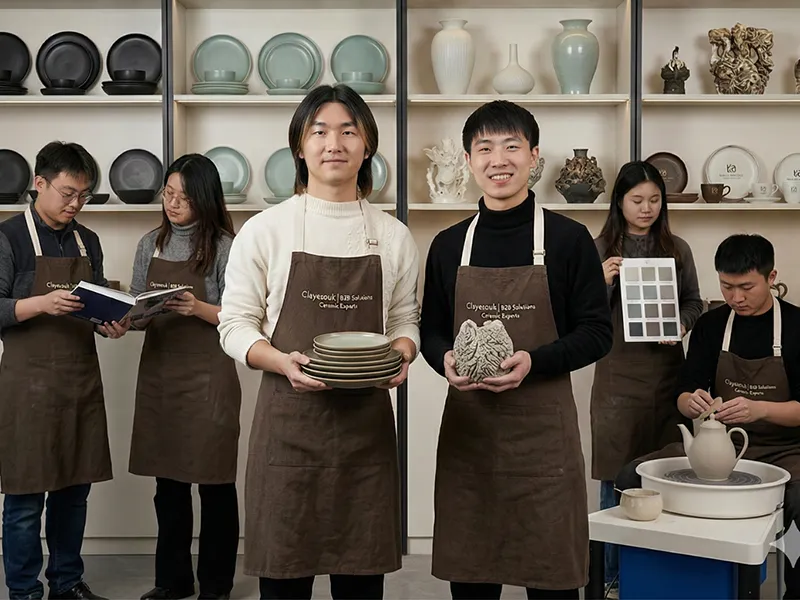
Today’s ceramic making often uses molds, decals, and electric kilns. These methods give speed and sameness. You get even shapes and reliable glaze colors across big batches. This way works well for mass markets. But not all modern ware follows this factory path. Some workshops in Jingdezhen bring back manual, handcrafted methods. Brands like clayesouk show this comeback. Their artisans bring over ten years of skill to each piece. They mix old artistry with today’s need for real, high-quality ceramic cups. You can find handmade ceramic coffee cups and tea sets that respect old methods. These pieces carry the warmth of human touch. They link you to the city’s living tradition. This revival shows that modern ceramic art can match antique work in skill and care. The choice between old and new is not about better or worse. It is about purpose and connection.
Design and Style: From Imperial Symbols to Modern Art

Antique Motifs: Tradition and Symbolism
Antique Jingdezhen porcelain has deep meaning in every design. You can find imperial porcelain masterpieces decorated with dragons, phoenixes, and floral patterns. Each symbol has a specific purpose. A five-clawed dragon stands for the emperor’s power. Peonies mean wealth and honor. Lotus flowers mean purity. These motifs show up on the finest ceramic ware from the imperial kilns.
You can trace specific styles to different dynasties. Yuan blue-and-white pieces show bold, flowing brushwork. The cobalt blue creates strong contrast against the white body. Ming dynasty wucai porcelain uses five bright colors for lively scenes. Qing dynasty fencai enamels bring soft, subtle tones. Famille rose ware from this period shows delicate pink hues. Song dynasty yingqing ware offers a pale blue-white glaze without painted decoration. Each period shows distinct artistic priorities.
Traditional blue-and-white painting takes years of practice. Artisans learn each pattern through careful study. You see the same motifs repeated across generations. This consistency defines authentic antique and contemporary jingdezhen ware. The symbolism connects you to Chinese cultural heritage. Every ceramic surface tells a story.
Contemporary Aesthetics: Innovation and the Past
Modern designers honor these traditions while creating new forms. You can find blue-and-white porcelain adapted for contemporary coffee cups and tea sets. A ceramic mug carries classic motifs. A ceramic tea set shows abstract dragon designs. This approach keeps the past alive in daily use. Each ceramic piece becomes part of your routine.
Brands like clayesouk represent this bridge between history and modern taste. Their artisans understand traditional blue-and-white painting. They also know how to adapt these patterns for today’s lifestyle. The craftsmanship stays high. The designs feel fresh and relevant. Each ceramic piece comes from skilled hands in Jingdezhen.
You can choose pieces for your home that fit your life. A handmade ceramic cup with classic motifs works for morning coffee. A blue-and-white porcelain tea set serves guests with style. Contemporary aesthetics honor tradition without copying it. You get the beauty of Jingdezhen in a form you use every day. This connection makes each ceramic piece meaningful. The living ceramic tradition continues through these designs. Jingdezhen remains the heart of Chinese porcelain making.
Marks, Glazes, and Aging: Decoding Authentic Jingdezhen Ceramics
The Language of Reign Marks and Patina
The marking on the bottom begins the story of every antique piece. Genuine reign marks follow strict rules. A six-character mark in two columns reads from right to left. The calligraphy looks precise and balanced. Under magnification, authentic brushstrokes appear confident and even. You see no hesitation marks. The finest imperial porcelain pieces bear the most meticulously executed marks.
The method of applying the mark provides another layer of evidence:
Reign mark application method | Typical period / notes | Authentication indicators |
|---|---|---|
Underglaze blue painted | Traditional method; cobalt applied to clay before final glaze | Mark becomes part of the piece with a smooth surface |
Overglaze iron-red painted | Popular in the 18th–19th centuries | Slightly raised mark that you can feel by running a finger over it |
Incised or impressed (stamped) | Carved or stamped into clay before firing | Tool marks and pre-firing impression characteristics |
Printed | Typically 19th century onward | More mechanical and regular than hand-painted marks |
The glaze itself carries signs of age. Genuine pieces develop a natural patina over centuries. You see subtle crazing across the surface. This fine network of cracks forms slowly through time. The foot rim shows wear where the piece sat on surfaces. These marks of use appear in natural, irregular patterns. Modern ceramic pieces cannot reproduce this aging.
Look at the glaze depth. Genuine glaze looks and feels like a layer of glass. You see depth and lustre as light hits the surface. For blue-and-white porcelain, the cobalt may show “heaping and piling.” The unevenly ground cobalt concentrates in spots and bursts through the glaze. You see dark, almost black, rust-colored spots. Modern synthetic cobalt looks flat and uniform. This effect helps you identify antique porcelain from early periods.
The clay body gives you another clue. Examine the unglazed foot ring. Authentic Jingdezhen clay appears bright, clean white. The texture feels fine and smooth, almost sugary. Gray, coarse, or yellowish clay suggests different material. The foot rim should cut cleanly with a beveled edge. Fully vitrified clay looks glassy and non-porous. Jingdezhen porcelain shows this quality consistently.
Other physical signs include throwing marks. Wheel-thrown pieces show subtle, rhythmic, concentric ridges inside bowls or cups. Slip-cast pieces feel perfectly uniform and smooth. Weight matters too. High-quality porcelain feels dense and heavy for its size. The edges may be thin and translucent. You can hold the piece up to light to check this. Old ceramics from the past display these traits clearly.
Modern Marks and the Absence of Wear
Contemporary ceramic pieces carry different types of marking on the bottom. They may be painted, printed, impressed, carved, or stamped. The mark can identify an individual maker, a studio, a commercial brand, or the claimed place of manufacture. It might show a date, a commemorative occasion, or an auspicious phrase. Some modern ceramic pieces use earlier imperial reign marks as homage.
There is no single universal Jingdezhen mark. A mark alone does not prove where, when, or by whom a piece was made. You must examine all the evidence together. Modern printed marks look mechanical and regular under magnification. You see tiny dots and perfect uniformity. Hand-painted marks show visible brushwork and small variations.
Contemporary pieces lack the natural patina of age. You see no crazing in the glaze. The foot rim shows no wear patterns. The surface stays crisp and new. These porcelain pieces have not accumulated centuries of use. They cannot show the aging signs that collectors look for.
This does not mean modern ceramic work lacks quality. High-quality contemporary ceramic pieces show careful craftsmanship. You can examine the foot ring of a contemporary piece. Clean, beveled cuts signal careful finishing. Glassy, vitrified clay shows proper high-temperature firing. The quality shows in the throwing, the glaze application, and the precision of the design. These ceramic details matter for both old and new pieces.
Buying from a reputable source provides strong assurance. Transparent sellers with direct connections to artisans help you trust what you buy. Hold many ceramic pieces and compare them. Your eye learns to see the differences. That practice helps you understand authentic Jingdezhen ceramics. You will start to recognize quality in every ceramic form you examine.
Value and Collecting Antique Jingdezhen Porcelain
The High Stakes of Antique Jingdezhen Porcelain
Antique Jingdezhen porcelain is at the very top of the auction world. You see prices that most collectors cannot even dream of paying. In spring 2021, Poly Auctions Beijing set a new world record for any ceramic item. The Qianlong Imperial “Revolving Phoenix” Vase sold for RMB 265.7 million, which is about $41.56 million.
In spring 2021, Poly Auctions Beijing set a new world record for any ceramic item. The hammer came down on the truly stunning Qianlong Imperial “Revolving Phoenix” Vase. The record price was RMB 265.7 million, or about $41.56 million (around £29 million).
Other sales show the same pattern. You can study these results to understand the market.
Porcelain Piece | Auction Record Price | Auction House | Year |
|---|---|---|---|
Jiajing Fish Jar | HK$214M | Christie’s | 2017 |
Kangxi Falangcai Bowl | HK$240M | Sotheby’s | 2018 |
100 Birds Vase | RMB 266M | Poly | 2021 |
Qianlong Reticulated Vase | $85M (sale not completed) | Bainbridges | 2010 |
Qianlong Imperial ‘Revolving Phoenix’ Vase | RMB 265.7M | Poly Auctions Beijing | 2021 |
These numbers explain why collecting antique porcelain feels out of reach for most people. You are competing with museums and rich investors. The supply is very small. Real pieces hardly ever show up on the open market.
The Value of Modern Jingdezhen Porcelain
Contemporary ceramic work gives you a different path. You can own high-quality pieces at prices you can afford. Modern artisans in Jingdezhen still use traditional craftsmanship. They shape each ceramic cup by hand. They paint blue-and-white motifs with care. These ceramic pieces carry cultural depth without the auction house price tag.
Brands like clayesouk stand for this revival. Their artisans bring more than ten years of experience to every ceramic piece. You get real handmade quality for daily use. A ceramic coffee cup or tea set becomes useful art in your home. Each ceramic item connects you to the living tradition of Jingdezhen.
You do not need millions to start collecting. A handmade ceramic mug offers the same beauty as a museum piece. The difference is in age and scarcity, not in skill. Modern ceramic work lets you enjoy real Jingdezhen artistry every day. You support working artisans and keep the craft alive. This choice makes ceramic collecting personal and meaningful.
You have a checklist. Materials: natural kaolin or processed clay. Methods: wheel-throwing or molds. Design: imperial symbols or modern art. Marks: reign marks and patina or printed marks. Value: auction records or affordable art. Choosing between antique and contemporary Jingdezhen ware is not about which is better. It is about purpose and budget.
Antiques are historical ceramic artifacts and investments. Contemporary ware, especially handcrafted ceramic pieces from clayesouk, is functional art. Each ceramic cup connects you to Jingdezhen porcelain’s living tradition. You can spot real antique and contemporary Jingdezhen ware. You can enjoy fine ceramics and Chinese porcelain. Visit www.clayesouk.com to see authentic ceramic craft honoring the past. You can own real porcelain and ceramic beauty today.
FAQ
How can you tell if a piece is antique or contemporary?
Look at the foot rim for signs of wear. Antique pieces have natural patina and small cracks in the glaze. Modern pieces look sharp and new. Also check the clay body. Real old ceramic shows small, natural differences.
Are contemporary Jingdezhen pieces worth collecting?
Yes. Modern handmade ceramic from Jingdezhen gives you art at fair prices. You get skilled work without museum-level costs. This makes them a smart first step for any collection.
What does a reign mark tell you?
A reign mark shows the period it claims to be from. But you must check other features too. Many modern ceramic pieces use old reign marks. The mark by itself does not prove it is real.
Can you use antique porcelain for daily meals?
Most antiques are too fragile and valuable for daily use. Contemporary porcelain works better for everyday life. You can enjoy Jingdezhen beauty without putting a historical piece at risk.
How do you start collecting Jingdezhen ceramics?
Start with modern handmade pieces. They cost less and teach you about quality. Study materials, marks, and craftsmanship. Your eye gets better with practice. Each ceramic piece you hold teaches you something new.