
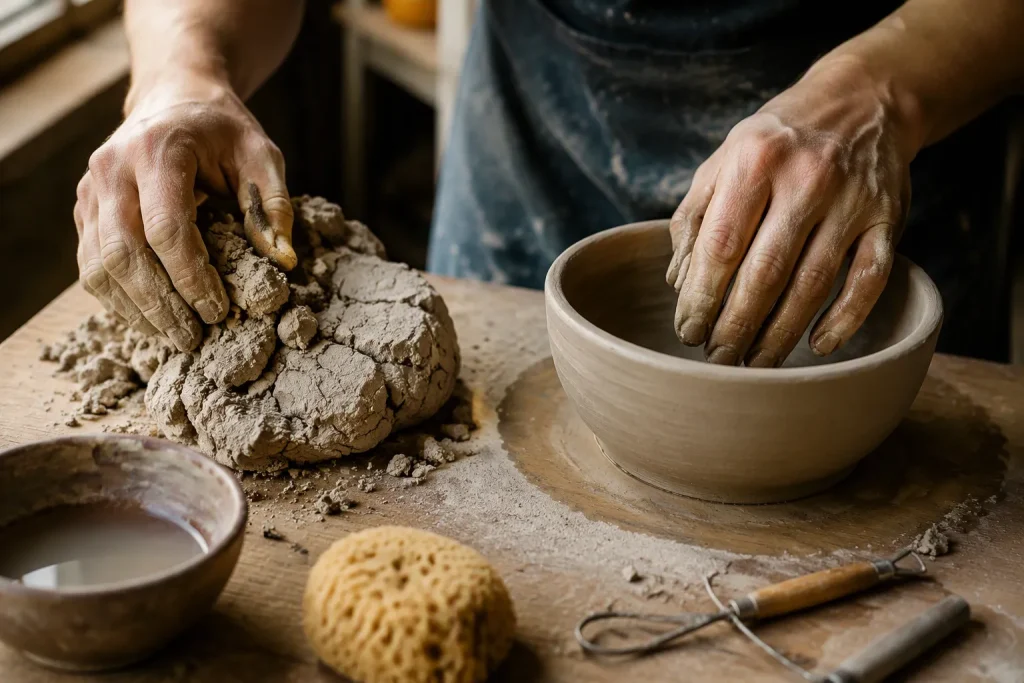
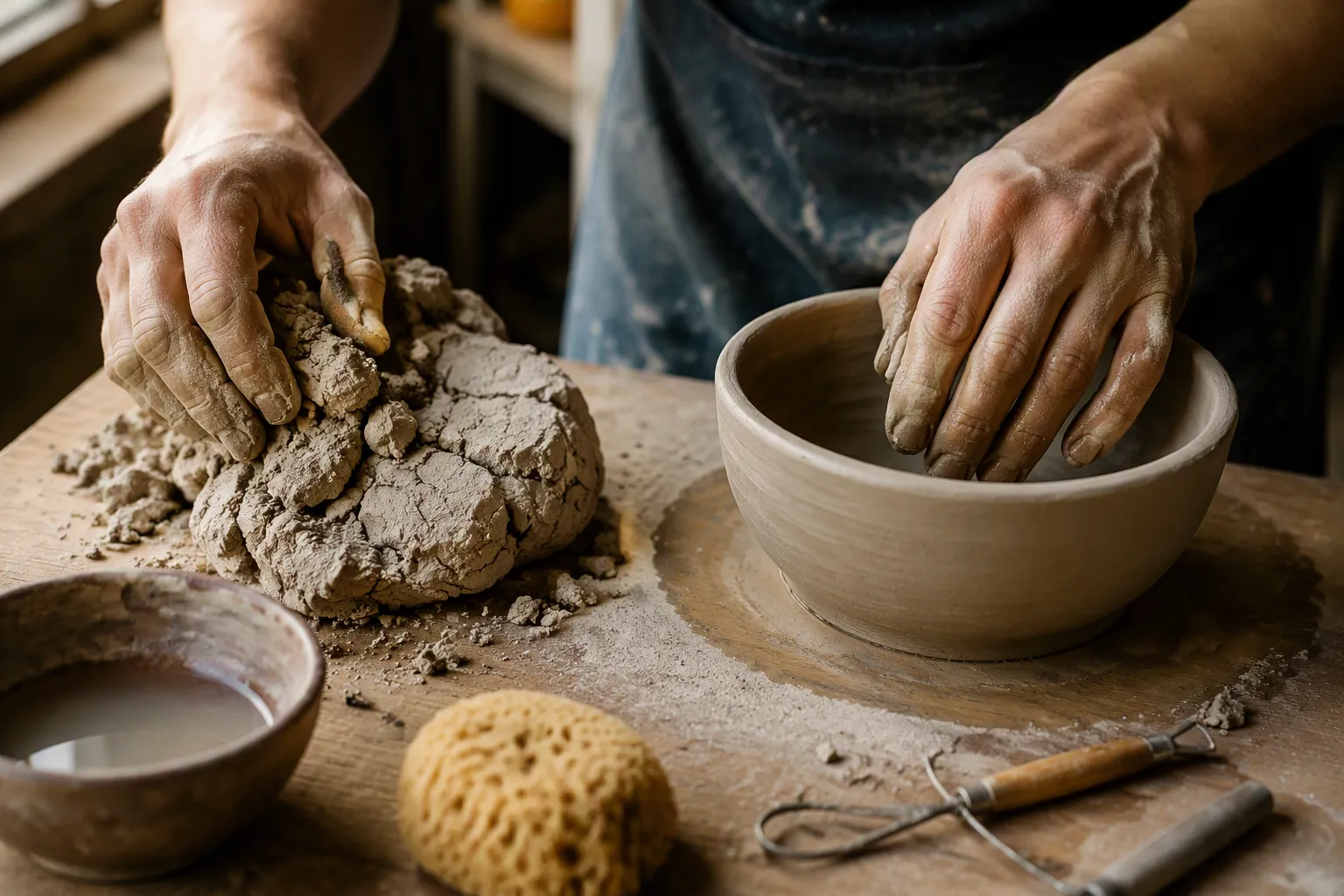
Water content decides how easy clay is to work with. Water sits between the clay particles and greases them, so they slide and reshape instead of cracking. Flexibility goes up and down with moisture. Clay works best within a certain moisture range, and most workable clay holds about 20% water by weight.
Too little water makes clay stiff and hard to shape. Too much water makes it soft and unstable. Each problem shows up differently on the wheel and on the table. You can learn to spot the right moisture with simple tests and small changes.
This guide explains how water content affects clay workability at each stage. You will learn to test moisture, adjust it little by little, and see what happens when you get it wrong.
Key Takeaways
Water works like a lubricant between clay particles. It lets them slide and change shape without cracking.
Clay works best when it has a certain amount of moisture. For most pottery clays, that is about 20% water by weight.
Check how wet the clay is by squeezing it, pressing it, or bending a coil. Then adjust it slowly by adding a few drops of water or letting it dry on a plaster bat.
If clay has too little water, it gets stiff and cracks easily. If it has too much water, it gets soft and won’t hold its shape.
Let clay pieces dry slowly and evenly over 2–3 days so they do not crack.
How Water Content Affects Clay Workability
Water as Lubricant
Think of water as tiny ball bearings between the clay grains. Each particle carries a thin film of water. That film lowers friction and lets neighboring particles slide past one another. You press or throw the clay, and the grains rearrange instead of locking up and tearing. Dry clay has no such film. The grains grip each other, and the wall cracks the moment you push it.
The film also controls how far the clay can move. A little water lets grains shift a small amount. More water lets them flow further before they stop. This is why a slightly damp lump feels forgiving and a bone-dry one feels brittle. Water content affects clay workability at the particle level before you ever touch the wheel.
Water and Plasticity
Plasticity is the clay’s ability to hold a shape after you work it. Water is the main lever here. Add moisture and the clay bends, stretches, and keeps the form you give it. Take moisture away and the same clay turns stiff and short.
Clay type matters too. Toughness depends on clay content, mineralogy, and water content together. The table below shows how different clays behave at their own optimum moisture.
Clay type | Optimum water content (%) | Plasticity index | Compressive stress (MPa) |
|---|---|---|---|
Afuze | 27 | Low (8–11) | 0.002 |
Kutigi | 27 | Low (8–11) | 0.002 |
Minna | 53 | High (49) | 0.03 |
Obowo | 57 | High (46) | 0.15 |
Kaolinite clays hold low plasticity indices of 8–11 and low compressive stress of 0.002 MPa. Zeolite-rich clays reach plasticity indices of 46 and 49. Push Kutigi or Afuze past roughly 27% moisture and they cross their plastic limit. The clay then cracks early and loses green strength. Low-plastic kaolin often needs blending with a more plastic clay to widen its working range.
The Stages of Water Content
Dry and Leather-Hard
Dry clay feels hard and resists your tools. You cannot bend it without breaking it. Dust rises when you sand or scrape it, and glaze clings unevenly to a bone-dry surface. Leather-hard clay sits in the middle. It still holds some water, so it feels cool to the touch. It does not feel sticky, and your finger leaves no print in the surface. It looks darker than bone-dry clay and has a matte finish instead of a wet sheen. This stage suits trimming and joining, because the clay holds its form and accepts added pieces with ease.
Water loss drives big changes as clay dries. Pore water leaves first, and the piece shrinks in a straight line while porosity drops. Air then enters at the inlet point, the bonding film between particles thins, and shrinkage slows. Near the shrinkage limit, particles touch, deformation stops, and density rises because the same solids now fill less space. Red clay stabilizes near 17.72% moisture and expansive soil near 29.53%, both close to their shrinkage limits.
Plastic and Slurry
Plastic clay is your main forming stage. It bends, stretches, and keeps the shape you give it. Most workable clay starts here with roughly 20–30% water held between the particles. Slurry goes further. You use it to join parts and to cast shapes in plaster molds. A typical casting slip has a specific gravity of about 1.8, and 1.6 signals too much water. The plaster pulls water out, and a solid layer builds in roughly 10–20 minutes.
Moisture level also shapes drying, shrinkage, density, flow behavior, strength, casting rate, pressing behavior, glaze application, and dust. Understanding how water content affects clay workability at each stage lets you match the moisture to the job.
Testing and Adjusting Water Content
Simple Moisture Tests
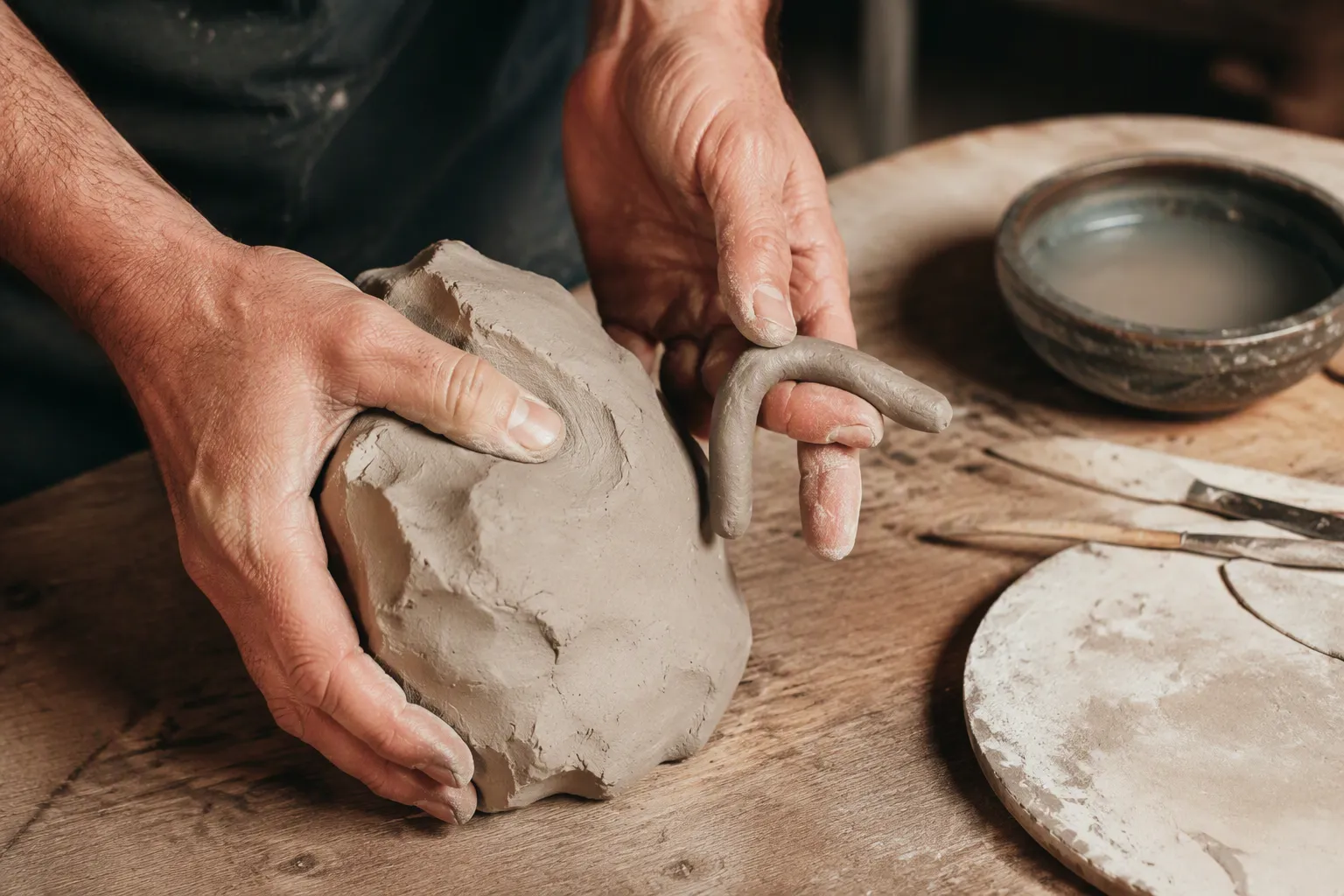
Your hands are the first tool. Squeeze a lump and feel how it gives. Plastic clay yields with slight resistance. Stiff clay pushes back hard. Sticky clay smears across your palm.
Next, press a finger into the surface. A clean dent that holds its shape signals good moisture. A dent that fills with water means the clay is too wet. A dent that crumbles at the edges means it is too dry.
The wedge-and-bend test confirms what your fingers tell you. Wedge a small coil, bend it over your finger, and watch the surface. Smooth bending means the clay is ready. Cracks along the outer curve mean you need more water.
A visual sheen check takes one second. Damp clay has a soft, even sheen. Dry clay looks matte and pale. Puddled clay shines with standing water.
You can also run a few standard physical tests on plastic clay bodies and porcelains:
LDW test (LOI, Density, Water Content): Weigh a sample wet, dry, and fired. The recorded numbers calculate water content, along with loss on ignition and density.
DFAC test (Drying Factor): Prepare a drying disk with a tin can blocking the inner portion from drying. The stresses cause cracking, and you record the pattern as a Drying Factor.
SHAB test (Shrinkage, Absorption): Measure shrinkage bars at each stage. This test tracks shrinkage and absorption rather than moisture directly.
Adding or Removing Water
Adjust in small steps. Add water a few drops at a time, then wedge thoroughly. Wedging spreads moisture evenly, so no pocket stays wet while another stays dry. Too much water at once creates soft spots that ruin the whole batch.
To remove water, dry the clay on a plaster bat.
Spread the mud onto a plaster bat. The plaster will pull the moisture out. Keep an eye on the edges, as they dry the fastest.
Flip the clay periodically. One side dries from the air, and the other dries from contact with the plaster.
Mixing clay as a slurry and then drying it produces a denser, more thoroughly wetted body. This route takes more work, yet it pays off when you need consistent moisture through the whole lump.
For certain clay soils, keep moisture close to the optimum. That narrow window protects both workability and strength. Careful moisture control shows up in fine craftsmanship, such as clayesouk‘s Jingdezhen handmade ceramic cups, where each piece depends on a body that behaves the same way every time.
Consequences of Improper Water Content
When Clay Is Too Dry
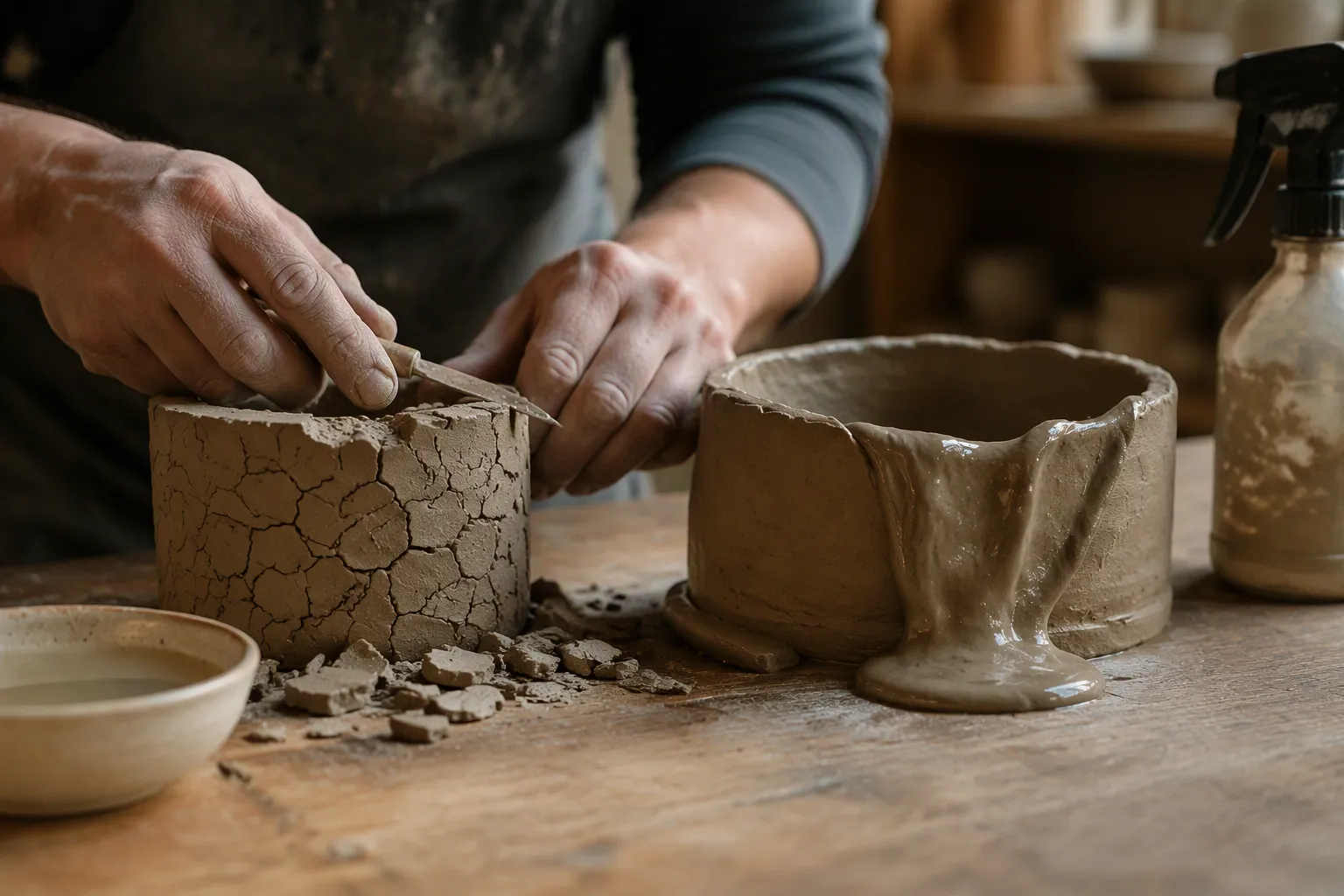
Dry clay fights you at every step. It feels hard and resistant under your fingers. Push a tool into it and the surface chips instead of yielding. Try to bend a coil and it snaps. The material has lost the water film that lets particles slide, so it cracks during forming and gives up its workability.
Air-dry clay is water-based, so the longer it sits in open air, the more moisture escapes. That steady loss is often the root of cracks. You can head it off by adding water gradually until the clay is workable but not sticky. Keep a small bowl of water or a spray bottle within reach, and remoisten the surface before it dries out and cracks.
Rapid drying is a leading cause of cracks. Let projects dry for 2–3 days in a cool, dry place away from direct sunlight. Never speed the process with a hairdryer. Clay needs to dry slowly and evenly. Fast drying hardens the outside before the inside, and the difference pulls the piece apart. A cool spot with good air circulation works best, away from sun and drafts.
Thickness matters as much as timing. Thin pieces can start to crack in open air, so keep every part more than 1/4-inch thick and consistent throughout. Thick pieces crack too, so hollow them out to cut down the clay that must dry. Keep moisture even while you work. Too much water causes cracks of its own, so let excess water sit for an hour or two before you continue.
When Clay Is Too Wet
Overly wet clay loses strength and shape. It collapses under its own weight, and it adds unnecessary weight to the finished piece. The table below shows why.
Mechanism | Effect on Clay |
|---|---|
Excess water weakens the clay structure | Walls become too thin or weak to support their own weight and collapse |
Too much water makes clay soft and weak | Walls slump, rims lose shape, and fine details disappear |
You can diagnose your own clay from these signs. A wall that sags at the base points to too much water. A rim that droops or a stamped detail that blurs tells the same story. Sticky clay that smears instead of holding a dent is another warning. Understanding how Water Content Affects Clay Workability means reading these signals early, before a piece fails. Dry clay cracks and resists; wet clay slumps and smears. Match the moisture to the task, and the clay will do what you ask.
Water content is the main lever for clay workability. Each stage has its own ideal moisture range. Typical pottery clays hold about 20% water, and highly plastic clays need more water to reach working consistency. Understanding how Water Content Affects Clay Workability helps you match moisture to the task.
Test moisture often. Roll a coil and bend it — the clay is ready if it bends without splitting. Adjust gradually with small water additions or a plaster bat. Match water content to the job at hand.
Practice with small batches. Watch how clay responds to each change. Your confidence will grow with every batch you test.
FAQ
How can you tell if your clay has the right amount of water?
Squeeze a lump and press a finger into it. A clean dent that holds its shape means the clay is ready. A soft sheen and a smooth bend on a coil confirm it. Sticky smears or crumbly edges tell you to adjust.
What should you do if your clay feels too wet?
Let the clay sit on a plaster bat and flip it now and then. The plaster pulls out the extra moisture. Work in small batches so you can watch the change. Stop once a finger dent holds cleanly.
Can you add water to clay that has dried out?
Yes. Add water a few drops at a time and wedge thoroughly. Wedging spreads the moisture evenly through the lump. Skip this step and you get soft pockets next to hard ones. Small, gradual additions keep the body consistent.
Do different clay types need different moisture levels?
Yes. Highly plastic clays need more water to reach working consistency. Low-plastic kaolin holds less and cracks sooner. Typical pottery clays hold about 20% water. Test each batch rather than trusting a single number.
Why does clay crack while it dries?
Fast drying hardens the outside before the inside. The difference pulls the piece apart. Keep walls more than 1/4-inch thick and even throughout. Let projects dry for 2–3 days in a cool spot away from sun and drafts.
