


Many ceramic artists sell beautiful work for too little money. They forget the hidden costs that eat into every sale. Kiln electricity, broken pots, and marketplace fees all add up. You deserve to cover these expenses.
Pricing is a formula, not a feeling. The core equation is simple: materials plus firing plus labor plus overhead plus breakage plus fees plus profit margin equals your retail price. When you learn How to Price Handmade Ceramics for Retail, you stop guessing.
A fair price is not greed. It keeps your studio alive and earns respect. This guide walks you through each step with clear examples. You will build prices that support your craft.
Key Takeaways
Use a pricing formula that includes materials, labor, overhead, breakage, fees, and profit.
Pay yourself for the hours you work, and add a separate profit margin to help your studio grow.
Add marketplace fees and breakage costs to your price so you don’t lose money.
Look at what other people charge, but don’t just copy their prices. Your work is one of a kind, so price it that way.
Check and raise your prices each quarter to keep your studio healthy.
How to Price Handmade Ceramics for Retail
You have made the leap to sell your work. Now you face the hardest question in your studio. How do you set a number that feels fair and keeps your lights on? This section gives you a clear path. You will learn how to price handmade ceramics for retail without fear.
Why Most Potters Undercharge
Many artists look at a supermarket mug and panic. They see a low price tag and assume their work must compete. This comparison destroys pottery pricing. A transfer-printed mug is not your product. Your mug carries hours of your life.
Other potters worry that honest numbers will scare buyers away. They say, “No one would pay what this is really worth.” That fear is understandable. It is also expensive. One potter noted that charging less than $30 for a handmade mug sends the wrong message to the whole craft.
You also might undercharge because you enjoy the making process. Joy is a wonderful reason to work. It is not a reason to ignore your costs. When you price pottery with real numbers, you protect your future.
The Cost Stack at a Glance
Every retail price is a stack of costs. You build it from the bottom up. The base includes clay, glaze, and packaging. A medium mug uses about $3 to $8.50 in materials. Firing adds kiln energy and maintenance. Labor covers throwing, trimming, glazing, and packing. Overhead pays for rent, water, and insurance. Breakage accounts for cracked or warped pieces. Fees cover marketplace commissions and card processing. Finally, you add your profit margin.
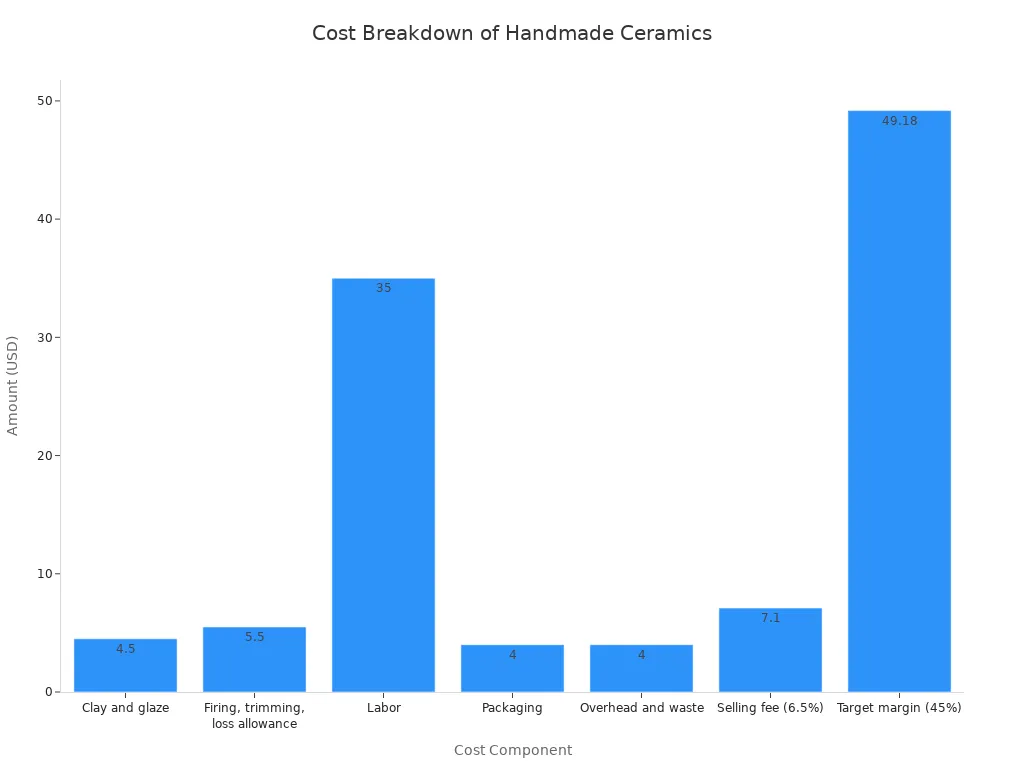
This stack is your foundation. When you know how to price handmade ceramics for retail, you stop guessing. You start building a sustainable studio.
The Pricing Formula That Works
You need a system you can use again and again, not just a guess. The main pricing formula is: (materials cost × markup) + labor + overhead + platform fees + shipping = retail price. This math gives you a clear way to set prices for every piece you make.
Materials, Glaze, and Packaging
Start your step‑by‑step cost breakdown with what goes into the piece. Clay, glaze, kiln supplies, and packaging all go here. A typical pottery piece uses $0.50–$2.00 in glaze materials alone. For a 450g mug, clay costs about $1.13 at $2.50 per kilogram. Packaging adds about $1.50 for a box, tissue, and tape. These numbers seem small. They add up across a whole kiln load.
Keep track of every material you use. Glaze chemicals, wax resist, sandpaper, and shipping boxes all have costs. A spreadsheet helps you record each item. One production potter used this method for years. The spreadsheet figured out a price, then the potter changed profit guesses. This way keeps your pottery pricing competitive and profitable.
Firing, Labor, and Overhead
Firing costs money even when you load the kiln yourself. Energy and kiln wear both count. A $15 firing split across 30 pieces gives you $0.50 per piece. That number covers electricity and wear on your kiln parts. Larger pieces take more kiln space. They should carry a bigger share of the firing cost.
Labor is the hardest cost to face. You must pay yourself for every task. Throwing, trimming, glazing, packing, and photographing all take time. The US Department of Labor says the average hourly wage for artists is $24.58. You can start lower and then move up. A piece made in 30 minutes at $15 per hour has a labor cost of $7.50. Keep good track of your working hours. Next, add material costs and overhead. Overhead covers rent, insurance, software, and accounting fees. A common way is to set overhead at 10% of combined costs. For a piece with $10 in materials and $7.50 in labor, overhead adds $1.75. Your total artwork cost reaches $19.25.
Proof from working potters shows something important. Labor, payroll, taxes, utilities, and insurance make up a big part of each mug or bowl. Clay, glaze, and firing costs stay small by comparison. This finding changes how you see your handmade products. Your time is the biggest investment. Price it with respect.
Small items like mugs need less overhead per piece than large platters. Give overhead fairly across your range. A spreadsheet tracks this well. Put in fixed costs, monthly firings, and working hours. Set a minimum salary and a target salary. The sheet then shows the price each item needs to cover costs and meet your income goal. Compare your current prices to that number. Change your product mix or pricing to avoid slowdowns between making and firing.
This framework works because it covers everything. You stop guessing and start building prices that keep your studio going.
Build In Breakage and Fees
The Breakage Factor
Every kiln load loses some pieces. Cracking, warping, or glaze defects happen in every firing. You cannot sell these products. Your pricing must account for this loss.
Apply a breakage percentage to your base cost. For example, if 10% of your handmade pieces break or warp, add 10% to your expense stack. A mug with a base price of $20 needs a breakage adjustment of $2. This brings your adjusted figure to $22 before fees and profit.
Many potters ignore this factor. They price only for perfect pieces. Then a bad firing wipes out their profit. Including breakage protects you from these losses. It also covers the labour you invest in pieces that do not make it to market.
Marketplace and Payment Fees
You face several fees when you sell online. Each fee reduces your take-home amount. You must include them in your price. Your marketplace choice affects your final retail figure.
Marketplace commissions take a large share. On a $100 sale, the transaction fee reaches $6.50. The listing fee adds $0.20. Payment processing takes another 3% plus $0.25. Combined, these fees total $9.75 on a $100 sale. You keep only $90.25 before shipping and packaging. Some marketplaces charge lower fees than others.
Different platforms charge different rates. This table shows common options.
Platform | Monthly Cost (US) | Per-Sale Fees (US) | Best For |
|---|---|---|---|
Etsy | $0 | $0.20 listing + 6.5% transaction + 3% + $0.25 payment processing (~10–13% all‑in) | Beginners, testing demand |
Shopify Basic | $39 | 2.9% + $0.30 (using Shopify Payments) | Established brands, 100+ pieces/month |
Squarespace Commerce Basic | $27 | 2.9% + $0.30 | Visual brands, modest catalogs |
Faire | $0 | 15% commission + payment processing (1.9–3.5% depending on payout speed) | Wholesale to boutiques |
Instagram + Linked Shop | $0 (plus shop cost) | 0% direct, 2.9–13% via linked shop | Makers with 1,000+ followers |
Big Cartel | $0–$29.99 | 0% Big Cartel fee + payment processor fee | Small‑batch artists |
Each marketplace takes its cut. You need to check current rates for your platform. Include these expenses in your retail price. If you do not, you lose money on every sale. Your labour costs must include all fees from the start.
Booth fees also matter for in-person sales. A weekend market can cost $50 to $200. Divide this by your expected sales to get a per-piece booth expense. Shipping supplies add another $1.50 to $3.00 per piece.
All these expenses stack up. Your handmade products deserve pricing that covers every fee. Build them into your formula from the beginning.
Your Complete Artisan Margin Guide
You now have your base cost. This number covers materials, labor, overhead, breakage, and fees. The next step turns that cost into a retail price. You need to understand margin well to protect your profit. This section is your complete artisan margin guide for building a studio that lasts.
Choosing a Sustainable Margin
Many potters mix up markup and margin. These two terms are not the same. Markup is the percentage you add to your cost. Margin is the profit percentage you keep from the final price. This difference matters for how you set your prices.
Here is how they compare.
Concept | Definition | Formula | Example (Cost $10, Price $15) |
|---|---|---|---|
Markup | Percentage added to the cost to set the selling price | (Selling Price − Cost) ÷ Cost | 5 ÷10 = 50% |
Gross Margin | Profit shown as a percentage of the selling price | (Selling Price − Cost) ÷ Selling Price | 5 ÷15 = 33.3% |
Key point. For the same profit, markup is always higher than margin. Markup uses cost. Margin uses selling price. To get a 50% gross margin on a $10 cost item, your price must be $20. The profit of $10 divided by $20 gives 50%. A price of $15 gives only 33.3% margin.
Why does this matter for you? When you use markup to set prices, you might earn less profit than you expect. A 50% markup sounds generous but gives only 33% margin. Understanding margins helps you pick a markup you can sustain. This pricing approach lets you sell handmade products for profit. A successful handmade business uses a 2 to 2.5 times multiplier on true costs. This approach builds in enough margin to cover surprises and support your studio.
From Base Cost to Retail Price
Apply your chosen multiplier to the base cost you figured out earlier. This step takes you from cost to retail price. Your pricing formula is now complete.
Think about a mug with a base cost of $19.25. This number includes materials, labor, overhead, breakage, and fees. Apply a 2.5 markup. Multiply $19.25 by 2.5 to get $48.13. Round to $48 or $50. This price covers costs and gives you healthy margins.
The multiplier you pick depends on your positioning. A luxury brand with strong recognition can charge a higher multiplier. A newer maker building a customer base might use a lower one. Your pottery pricing strategy should match your market tier.
Consider clayesouk. It comes from Jingdezhen, the porcelain capital with 1,700 years of heritage. Its artisans hold decades of experience. The brand carries ICH recognition. This positioning justifies a premium multiplier. Your studio can climb this path as you build reputation and quality.
The goal is profitability, not just survival. A sustainable handmade business uses margins that support growth. You should review your prices each quarter. Raise them slowly as your skills and reputation grow. This discipline protects your income and your future.
Start with one best-seller this week. Run the full formula. Apply your multiplier. See if the number feels honest. Adjust if needed. Price with confidence. You build a lasting studio.
How to Price Handmade Products for Your Market
Compare, Don’t Clone
The first step is to study the market. See what other ceramic artists charge. But treat their prices as clues, not rules. You cannot tell if other makers make money at their listed prices. Many sellers charge less than their real costs and slowly fail. Factory-made items work in a totally different way. Matching your prices to factory goods is a losing plan.
When you compare, think about these things that change the final number:
Comparison Factor | Why It Matters |
|---|---|
Material costs | Different clay and glaze costs change your cost base |
Labor time | Making one at a time or in batches changes time per piece |
Production methods | Hand-thrown or slip-cast pieces cost different amounts |
Business overhead | Studio rent and equipment affect your lowest price |
Packaging costs | Safe packaging adds to the cost of each item |
Platform and payment fees | Marketplace fees cut into the money you keep |
Brand positioning | Premium or discount pricing changes your price |
Customer expectations | Different buyers expect different value |
Profit requirements | Each maker needs a different profit |
Treat competitors as market clues, not rules. Ask yourself: What makes your product worth picking at its current price?
If the market price is lower than your cost-plus minimum, do not drop your price. Find buyers who value quality and being one of a kind. This is how to price handmade ceramics for retail without losing money.
Positioning at the Right Tier
Your market position sets your multiplier. The handmade market has several tiers:
Budget
Mid-Range
Premium
Luxury
Each tier allows a different markup. Premium and luxury tiers allow higher multipliers. Buyers at these levels pay for story and quality.
Think about clayesouk as an example. This brand comes from Jingdezhen, the porcelain capital with over 1,700 years of ceramic heritage. Its artisans have decades of experience. The brand carries ICH demonstration base recognition. This position allows a premium multiplier. You need to price handmade products at a level that shows your special value.
Your studio can move up this path. Start with honest pricing. Raise prices as your skills grow. When you know how to sell handmade products online, you pick the right marketplace for your tier. The best website to sell handmade items depends on your goals. Premium work belongs on a marketplace that draws buyers who value craft.
Each step lets you price handmade products for profit. Your work deserves a price that rewards your skill.
Wholesale, Retail, and Consignment Margins
You now know your base costs and retail multiplier. But where you sell changes everything. Selling straight to customers is not the same as selling to shops or galleries. Each channel has its own margin setup. You must understand wholesale vs retail pricing to protect your profit.
The Wholesale Multiplier
Wholesale means you sell your products to a store. The store then sells them to the final buyer. The industry norm follows a clear pattern. Wholesale price is about 50% of retail. This gives the store room to mark up your products for their own customers.
The common saying goes like this: Total Artwork Cost × 2 = Wholesale Price. Wholesale Price × 2 = Retail Price. This is called keystone pricing. The retail price is twice the wholesale price. That gives stores a 50% margin on their selling price.
Pricing Basis | Multiplier | Explanation |
|---|---|---|
Wholesale-to-retail | Retail price is twice the wholesale price, giving retailers a 50% margin. |
Wholesale to shops: Wholesale price. Retailer doubles it.
How does this work for you? Figure out your base cost first. Multiply by 2 to get your wholesale price. Then multiply that wholesale price by 2 to get the retail price the store will charge. This setup makes sure both you and the store make a fair profit. Your costs get covered. The store also earns enough to stay open.
Consignment and Gallery Splits
Consignment works in a different way. The gallery takes your pieces without paying upfront. They only pay you after a piece sells. The standard split for a new gallery is 50/50. You get 50% of the selling price. The gallery keeps 50%.
Consignment Model | Split | Payment Timing | Alternative |
|---|---|---|---|
Standard for new gallery | 50/50 (artist/gallery) | Artist paid 50% only after piece sells | Buying outright: 100–200% markup |
This sounds fair at first glance. But think about what it means for your costs. You already spent money on materials, firing, labor, and overhead. You also paid for packaging and shipping to the gallery. Now you only get half the retail price.
Gallery commission does not mean settling for half price. Artists should price their work so they can still profit from the 50% they receive while keeping retail prices competitive.
This is the key insight. Do not figure out your base cost and then cut it in half for consignment. Instead, set your retail price high enough that you earn a real profit from the 50% share you get. Your base cost must be covered first. The rest is your profit from the sale.
Some galleries buy pieces outright. This is called outright purchase. The gallery pays you a wholesale price upfront. They take all the risk. You get paid right away. This choice gives you more security than consignment.
Whichever channel you pick, know your numbers. Knowing these differences protects your income. Each marketplace has different rules. Another good way to sell handmade items is through your own website. This gives you full control over your marketplace pricing. You avoid the middleman entirely. Your handmade work deserves fair terms.
Common Pricing Mistakes to Avoid

Undercharging for Time and Overhead
You may think your labor cost is the same as your profit. That mistake hurts your studio’s growth. Without a separate profit margin, you cannot hire help or buy new equipment. Many artists also charge too little by ignoring raw materials, tools, studio overhead, insurance, and business tasks. Shipping costs need their own line too.
Charging too little for your time causes real problems. You may earn less than minimum wage per hour without knowing it. Your business turns into a hobby you support, not a real money-maker. One bad month can wipe out a year of hard work. As one expert put it, “If the math only works when you exclude your own time, that’s important information about what you actually have.” Write down every hour you spend on design, finding supplies, and checking quality. These tasks matter as much as throwing on the wheel.
Ignoring Fees, Breakage, and Taxes
Every kiln firing loses some pieces. You must add this loss into how you price your pottery. A skilled potter with a steady process sees about 5% breakage. A typical studio potter loses about 10%. New potters or those trying experimental work may lose 15% or more. Use a breakage factor to cover these losses. For a 10% loss rate, divide 1 by 0.90, which equals 1.11. Multiply your costs by 1.11 to pay for pieces that fail.
Platform fees also cut into your profit. Etsy and similar sites charge listing, transaction, and payment fees. Together these often add up to 8 to 10%. You also pay for kiln electricity, studio rent, and tool upkeep. Insurance may be required or optional, depending on your situation. Ongoing costs like software and accounting add up. A 2 to 3 times markup on base cost helps cover platform fees, shipping mishaps, breakage, and profit. Without this cushion, your handmade business cannot survive slow months or higher material costs.
Your Pricing Action Plan
You now have the formula. You understand your costs, fees, and margins. The next step is action. This section gives you two simple tasks. They turn your knowledge into real prices.
Recalculate One Best-Seller This Week
Pick your most popular piece. A mug, bowl, or vase works well. Run the full formula on this one item. Start with materials. A 450g mug uses about $1.13 of clay and $0.50 to $2.00 of glaze. Add $1.50 for packaging. Firing costs $0.50 per piece. Labor takes 30 minutes at $15 per hour, or $7.50. Overhead adds 10% of combined costs, about $1.06. Apply breakage at 10% for $1.07. Include marketplace fees at 10% for $1.18. Your base cost reaches $12.94. Now apply your profit margin. A 2.5 multiplier gives $32.35. Round to $32 or $33. Compare this number to your current price.
This exercise shows you where you stand. A price below this number means you lose money on every sale. Knowing how to calculate profitable prices changes how you run your studio. You can now price your handmade products for profit. This one action protects your income. Do it this week.
Review and Raise Prices on a Schedule
Set a quarterly calendar. January, April, July, and October work well. Use these months to review every product in your line. Check your costs. Did clay prices rise? Did your studio rent go up? Adjust your prices to match.
Raise prices gradually. A 5% to 10% increase each quarter feels fair to customers. They understand that quality costs more over time. Your regular buyers expect small changes. New buyers shop by value, not by the lowest number. A smart pricing strategy keeps your studio stable. It also shows your customers that you respect your craft. You can sell handmade items with confidence.
Consider clayesouk. This Jingdezhen brand adds value through custom ceramic design. Customers can personalize patterns, glazes, shapes, and sizes. This service justifies a higher retail price. You can use the same idea. Offer unique finishes, special glazes, or custom details. Every addition gives customers a reason to pay more for your quality. This pottery pricing strategy builds loyalty. Your handmade items earn the price you set.
Stick to your schedule. Review prices every three months. Raise them with confidence. Your work deserves fair payment. Your studio deserves to grow.
A well-calculated price shows professionalism, not arrogance. You honor your materials, your kiln, and your hours when you charge what your work truly costs. Apply the formula to one piece today. Pick a mug or bowl, run the numbers, and see the honest result.
FAQ
How do I know if my prices are too low?
Run your full cost formula on one piece. If the result sits above your current price, you lose money on every sale. A price below your base cost means your studio pays for the difference. Check your numbers before you guess.
Can I charge more than other potters in my area?
Yes, when your work earns it. Compare tiers, not exact numbers. Premium positioning comes from heritage, skill, and story. clayesouk charges more because Jingdezhen’s 1,700-year legacy and ICH recognition back every cup. Build your own reasons for a higher price.
What percentage should I add for breakage?
A steady studio potter loses about 10% of each kiln load. New potters or those testing new glazes may lose 15% or more. Divide 1 by your success rate to find your multiplier. A 10% loss rate gives you 1.11.
How often should I raise my retail prices?
Review your prices every quarter. January, April, July, and October work well. A 5% to 10% increase each quarter feels fair to loyal buyers. Small, regular raises protect your income without shocking your customers.
